

Solvolysis of Electron-Deficient Norbornyl Triflates 59
ing-group participation. Unfortunately, this is a common mistake and the readers
should be aware of it.
Once we have discarded that a single mechanistic pathway can explain the solvolysis of triflates 3 and 4, we should propose a reasonable mechanism to interpret
the results obtained in each case. We shouldn’t forget that a solvolysis is nothing
more than a nucleophilic substitution, and keeping in mind the different aspects of
this class of reactions could be of great help during the analysis of the experimental data.
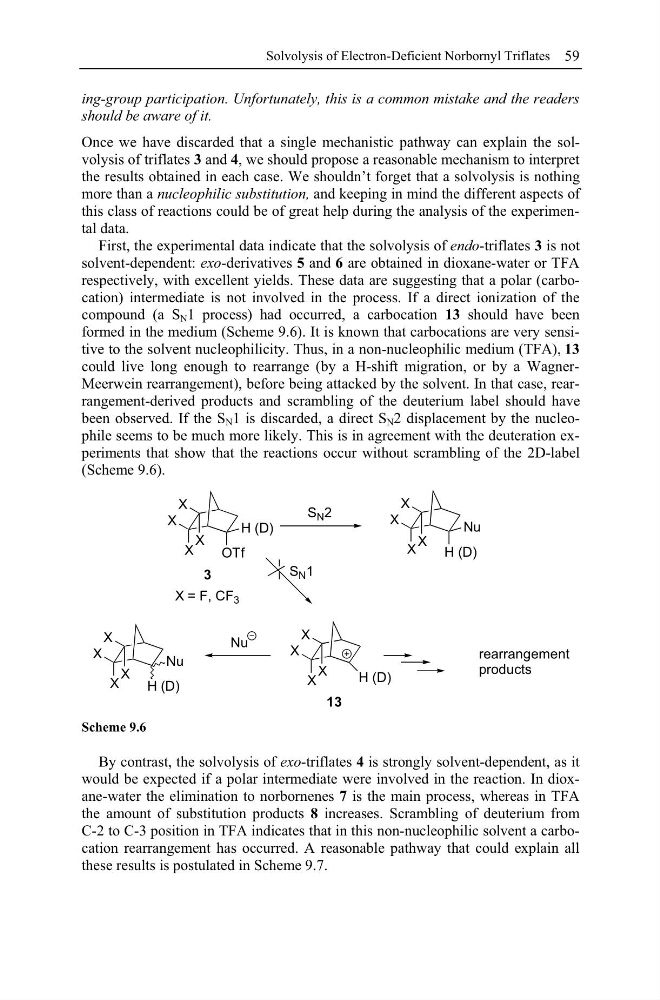
First, the experimental data indicate that the solvolysis of endo-triflates 3 is not
solvent-dependent: exo-derivatives 5 and 6 are obtained in dioxane-water or TFA
respectively, with excellent yields. These data are suggesting that a polar (carbocation) intermediate is not involved in the process. If a direct ionization of the
compound (a S N 1 process) had occurred, a carbocation 13 should have been
formed in the medium (Scheme 9.6). It is known that carbocations are very sensitive to the solvent nucleophilicity. Thus, in a non-nucleophilic medium (TFA), 13
could live long enough to rearrange (by a H-shift migration, or by a WagnerMeerwein rearrangement), before being attacked by the solvent. In that case, rearrangement-derived products and scrambling of the deuterium label should have
been observed. If the S N 1 is discarded, a direct S N 2 displacement by the nucleophile seems to be much more likely. This is in agreement with the deuteration experiments that show that the reactions occur without scrambling of the 2D-label
(Scheme 9.6).
X
X
H (D)
X
X
OTf
S N 2
X
X
X
X
H (D)
Nu
S N 1
X
X
X
X
H (D)
Nu
H (D)
X
X
X
X
3
X = F, CF 3
rearrangement
products
13
Nu
Scheme 9.6
By contrast, the solvolysis of exo-triflates 4 is strongly solvent-dependent, as it
would be expected if a polar intermediate were involved in the reaction. In dioxane-water the elimination to norbornenes 7 is the main process, whereas in TFA
the amount of substitution products 8 increases. Scrambling of deuterium from
C-2 to C-3 position in TFA indicates that in this non-nucleophilic solvent a carbocation rearrangement has occurred. A reasonable pathway that could explain all
these results is postulated in Scheme 9.7.
ing-group participation. Unfortunately, this is a common mistake and the readers
should be aware of it.
Once we have discarded that a single mechanistic pathway can explain the solvolysis of triflates 3 and 4, we should propose a reasonable mechanism to interpret
the results obtained in each case. We shouldn’t forget that a solvolysis is nothing
more than a nucleophilic substitution, and keeping in mind the different aspects of
this class of reactions could be of great help during the analysis of the experimental data.
First, the experimental data indicate that the solvolysis of endo-triflates 3 is not
solvent-dependent: exo-derivatives 5 and 6 are obtained in dioxane-water or TFA
respectively, with excellent yields. These data are suggesting that a polar (carbocation) intermediate is not involved in the process. If a direct ionization of the
compound (a S N 1 process) had occurred, a carbocation 13 should have been
formed in the medium (Scheme 9.6). It is known that carbocations are very sensitive to the solvent nucleophilicity. Thus, in a non-nucleophilic medium (TFA), 13
could live long enough to rearrange (by a H-shift migration, or by a WagnerMeerwein rearrangement), before being attacked by the solvent. In that case, rearrangement-derived products and scrambling of the deuterium label should have
been observed. If the S N 1 is discarded, a direct S N 2 displacement by the nucleophile seems to be much more likely. This is in agreement with the deuteration experiments that show that the reactions occur without scrambling of the 2D-label
(Scheme 9.6).
X
X
H (D)
X
X
OTf
S N 2
X
X
X
X
H (D)
Nu
S N 1
X
X
X
X
H (D)
Nu
H (D)
X
X
X
X
3
X = F, CF 3
rearrangement
products
13
Nu
Scheme 9.6
By contrast, the solvolysis of exo-triflates 4 is strongly solvent-dependent, as it
would be expected if a polar intermediate were involved in the reaction. In dioxane-water the elimination to norbornenes 7 is the main process, whereas in TFA
the amount of substitution products 8 increases. Scrambling of deuterium from
C-2 to C-3 position in TFA indicates that in this non-nucleophilic solvent a carbocation rearrangement has occurred. A reasonable pathway that could explain all
these results is postulated in Scheme 9.7.