

Level 1 – Case 9
60
X
X
X
X
H (D)
H
H
-H
X
X
X
X
H (D)
X
X
X
X
H (D)
Nu
X
OTf
H (D)
X
X
X
X
X
X
X
4
X = F, CF 3
1,2-H shift
13
7
8
Nu
14
1 2
3
1
2
3
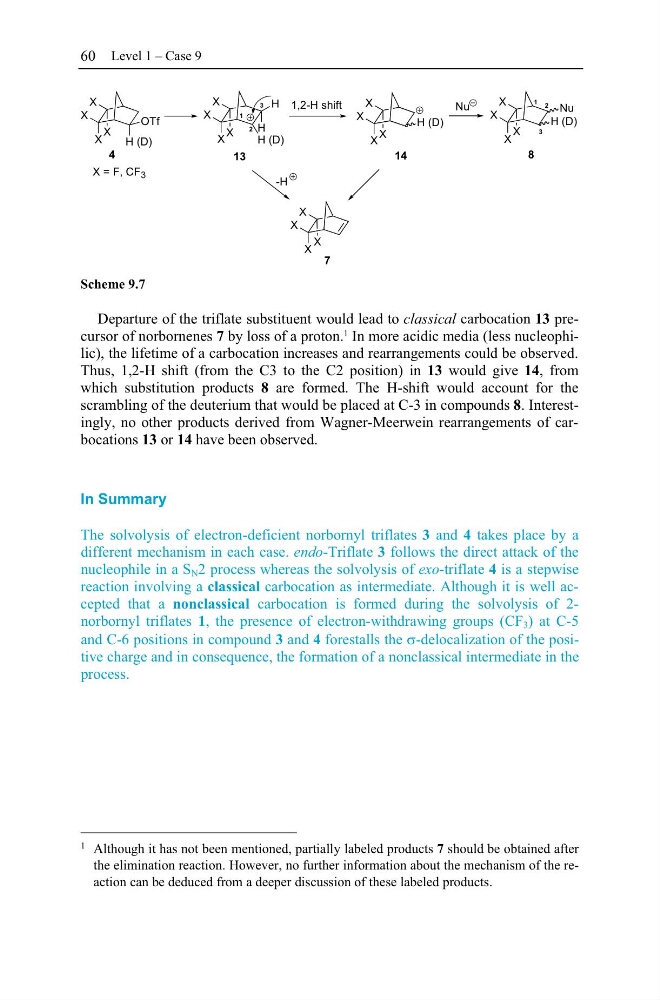
Scheme 9.7
Departure of the triflate substituent would lead to classical carbocation
l
13 precursor of norbornenes 7 by loss of a proton.
1 In more acidic media (less nucleophilic), the lifetime of a carbocation increases and rearrangements could be observed.
Thus, 1,2-H shift (from the C3 to the C2 position) in 13 would give 14, from
which substitution products 8 are formed. The H-shift would account for the
scrambling of the deuterium that would be placed at C-3 in compounds 8. Interestingly, no other products derived from Wagner-Meerwein rearrangements of carbocations 13 or 14 have been observed.
In Summary
The solvolysis of electron-deficient norbornyl triflates 3 and 4 takes place by a
different mechanism in each case. endo-Triflate 3 follows the direct attack of the
nucleophile in a S N 2 process whereas the solvolysis of exo-triflate 4 is a stepwise
reaction involving a classical carbocation as intermediate. Although it is well accepted that a nonclassical carbocation is formed during the solvolysis of 2norbornyl triflates 1, the presence of electron-withdrawing groups (CF 3 ) at C-5
and C-6 positions in compound 3 and 4 forestalls the V-delocalization of the positive charge and in consequence, the formation of a nonclassical intermediate in the
process.
1 Although it has not been mentioned, partially labeled products 7 should be obtained after
the elimination reaction. However, no further information about the mechanism of the reaction can be deduced from a deeper discussion of these labeled products.
60
X
X
X
X
H (D)
H
H
-H
X
X
X
X
H (D)
X
X
X
X
H (D)
Nu
X
OTf
H (D)
X
X
X
X
X
X
X
4
X = F, CF 3
1,2-H shift
13
7
8
Nu
14
1 2
3
1
2
3
Scheme 9.7
Departure of the triflate substituent would lead to classical carbocation
l
13 precursor of norbornenes 7 by loss of a proton.
1 In more acidic media (less nucleophilic), the lifetime of a carbocation increases and rearrangements could be observed.
Thus, 1,2-H shift (from the C3 to the C2 position) in 13 would give 14, from
which substitution products 8 are formed. The H-shift would account for the
scrambling of the deuterium that would be placed at C-3 in compounds 8. Interestingly, no other products derived from Wagner-Meerwein rearrangements of carbocations 13 or 14 have been observed.
In Summary
The solvolysis of electron-deficient norbornyl triflates 3 and 4 takes place by a
different mechanism in each case. endo-Triflate 3 follows the direct attack of the
nucleophile in a S N 2 process whereas the solvolysis of exo-triflate 4 is a stepwise
reaction involving a classical carbocation as intermediate. Although it is well accepted that a nonclassical carbocation is formed during the solvolysis of 2norbornyl triflates 1, the presence of electron-withdrawing groups (CF 3 ) at C-5
and C-6 positions in compound 3 and 4 forestalls the V-delocalization of the positive charge and in consequence, the formation of a nonclassical intermediate in the
process.
1 Although it has not been mentioned, partially labeled products 7 should be obtained after
the elimination reaction. However, no further information about the mechanism of the reaction can be deduced from a deeper discussion of these labeled products.