

Level 1 – Case 9
58
X
OTf
L
X
X
X
X
X
L
X
X
X
X
X
L
X
X
X
X
X L
Nu
X
X
X
X
L
X
L
OTf
X
X
X
Nu
X
X
X
X
L
X
X
X
X
Nu
L
L = H, D
1
5
12
Nu
Ñ
10
4
3
Nu
Ñ
11
X = F, CF 3
2
3
4
5
1 2 2
3
4
Scheme 9.5
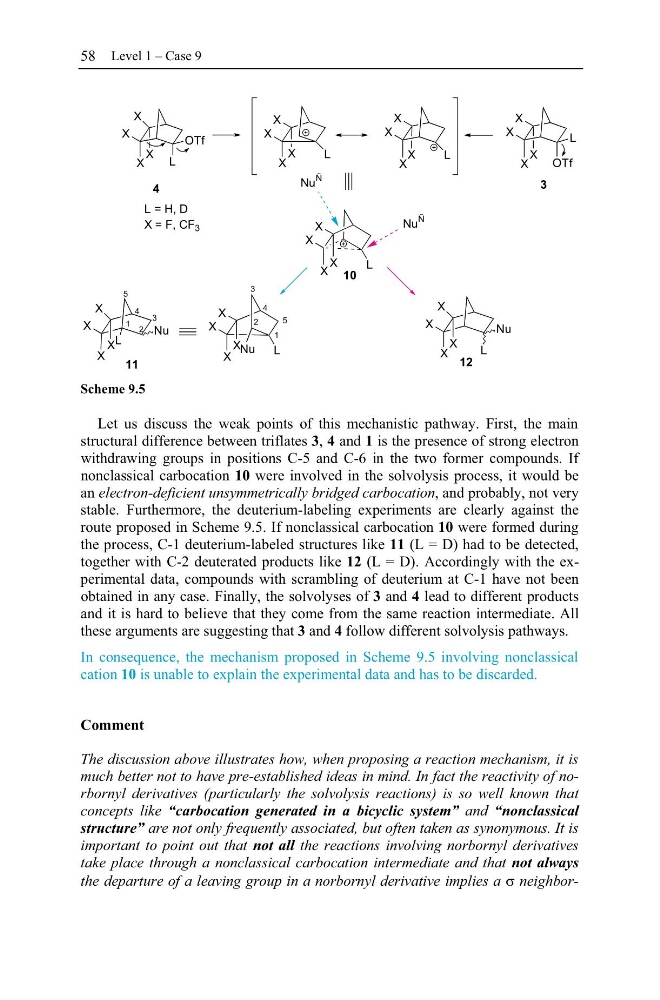
Let us discuss the weak points of this mechanistic pathway. First, the main
structural difference between triflates 3, 4 and 1 is the presence of strong electron
withdrawing groups in positions C-5 and C-6 in the two former compounds. If
nonclassical carbocation 10 were involved in the solvolysis process, it would be
an electron-deficient unsymmetrically bridged carbocation, and probably, not very
stable. Furthermore, the deuterium-labeling experiments are clearly against the
route proposed in Scheme 9.5. If nonclassical carbocation 10 were formed during
the process, C-1 deuterium-labeled structures like 11 (L = D) had to be detected,
together with C-2 deuterated products like 12 (L = D). Accordingly with the experimental data, compounds with scrambling of deuterium at C-1 have not been
obtained in any case. Finally, the solvolyses of 3 and 4 lead to different products
and it is hard to believe that they come from the same reaction intermediate. All
these arguments are suggesting that 3 and 4 follow different solvolysis pathways.
In consequence, the mechanism proposed in Scheme 9.5 involving nonclassical
cation 10 is unable to explain the experimental data and has to be discarded.
Comment
The discussion above illustrates how, when proposing a reaction mechanism, it is
much better not to have pre-established ideas in mind. In fact the reactivity of norbornyl derivatives (particularly the solvolysis reactions) is so well known that
concepts like “carbocation generated in a bicyclic system” and
”
“nonclassical
d
structure” are not only frequently associated, but often taken as synonymous. It is
”
important to point out that not all the reactions involving norbornyl derivatives
l
take place through a nonclassical carbocation intermediate and that not always
the departure of a leaving group in a norbornyl derivative implies a V neighbor-
58
X
OTf
L
X
X
X
X
X
L
X
X
X
X
X
L
X
X
X
X
X L
Nu
X
X
X
X
L
X
L
OTf
X
X
X
Nu
X
X
X
X
L
X
X
X
X
Nu
L
L = H, D
1
5
12
Nu
Ñ
10
4
3
Nu
Ñ
11
X = F, CF 3
2
3
4
5
1 2 2
3
4
Scheme 9.5
Let us discuss the weak points of this mechanistic pathway. First, the main
structural difference between triflates 3, 4 and 1 is the presence of strong electron
withdrawing groups in positions C-5 and C-6 in the two former compounds. If
nonclassical carbocation 10 were involved in the solvolysis process, it would be
an electron-deficient unsymmetrically bridged carbocation, and probably, not very
stable. Furthermore, the deuterium-labeling experiments are clearly against the
route proposed in Scheme 9.5. If nonclassical carbocation 10 were formed during
the process, C-1 deuterium-labeled structures like 11 (L = D) had to be detected,
together with C-2 deuterated products like 12 (L = D). Accordingly with the experimental data, compounds with scrambling of deuterium at C-1 have not been
obtained in any case. Finally, the solvolyses of 3 and 4 lead to different products
and it is hard to believe that they come from the same reaction intermediate. All
these arguments are suggesting that 3 and 4 follow different solvolysis pathways.
In consequence, the mechanism proposed in Scheme 9.5 involving nonclassical
cation 10 is unable to explain the experimental data and has to be discarded.
Comment
The discussion above illustrates how, when proposing a reaction mechanism, it is
much better not to have pre-established ideas in mind. In fact the reactivity of norbornyl derivatives (particularly the solvolysis reactions) is so well known that
concepts like “carbocation generated in a bicyclic system” and
”
“nonclassical
d
structure” are not only frequently associated, but often taken as synonymous. It is
”
important to point out that not all the reactions involving norbornyl derivatives
l
take place through a nonclassical carbocation intermediate and that not always
the departure of a leaving group in a norbornyl derivative implies a V neighbor-