

Solvolysis of Electron-Deficient Norbornyl Triflates 57
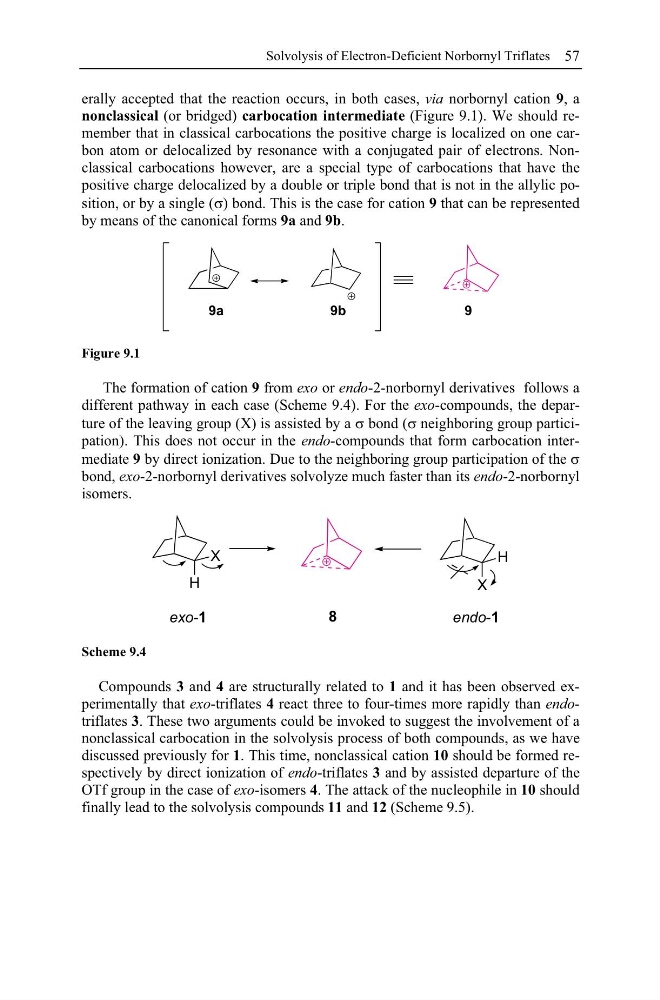
erally accepted that the reaction occurs, in both cases, via norbornyl cation 9, a
nonclassical (or bridged) carbocation intermediate (Figure 9.1). We should remember that in classical carbocations the positive charge is localized on one carbon atom or delocalized by resonance with a conjugated pair of electrons. Nonclassical carbocations however, are a special type of carbocations that have the
positive charge delocalized by a double or triple bond that is not in the allylic position, or by a single (V) bond. This is the case for cation 9 that can be represented
by means of the canonical forms 9a and 9b.
9a
9 b
9
Figure 9.1
The formation of cation 9 from exo or endo-2-norbornyl derivatives follows a
different pathway in each case (Scheme 9.4). For the exo-compounds, the departure of the leaving group (X) is assisted by a
u
V bond (V neighboring group participation). This does not occur in the endo-compounds that form carbocation intermediate 9 by direct ionization. Due to the neighboring group participation of the V
bond, exo-2-norbornyl derivatives solvolyze much faster than its endo-2-norbornyl
isomers.
X
H
H
X
exo-1
endo-1
8
Scheme 9.4
Compounds 3 and 4 are structurally related to 1 and it has been observed experimentally that exo-triflates 4 react three to four-times more rapidly than endotriflates 3. These two arguments could be invoked to suggest the involvement of a
nonclassical carbocation in the solvolysis process of both compounds, as we have
discussed previously for 1. This time, nonclassical cation 10 should be formed respectively by direct ionization of endo-triflates 3 and by assisted departure of the
OTf group in the case of exo-isomers 4. The attack of the nucleophile in 10 should
finally lead to the solvolysis compounds 11 and 12 (Scheme 9.5).
erally accepted that the reaction occurs, in both cases, via norbornyl cation 9, a
nonclassical (or bridged) carbocation intermediate (Figure 9.1). We should remember that in classical carbocations the positive charge is localized on one carbon atom or delocalized by resonance with a conjugated pair of electrons. Nonclassical carbocations however, are a special type of carbocations that have the
positive charge delocalized by a double or triple bond that is not in the allylic position, or by a single (V) bond. This is the case for cation 9 that can be represented
by means of the canonical forms 9a and 9b.
9a
9 b
9
Figure 9.1
The formation of cation 9 from exo or endo-2-norbornyl derivatives follows a
different pathway in each case (Scheme 9.4). For the exo-compounds, the departure of the leaving group (X) is assisted by a
u
V bond (V neighboring group participation). This does not occur in the endo-compounds that form carbocation intermediate 9 by direct ionization. Due to the neighboring group participation of the V
bond, exo-2-norbornyl derivatives solvolyze much faster than its endo-2-norbornyl
isomers.
X
H
H
X
exo-1
endo-1
8
Scheme 9.4
Compounds 3 and 4 are structurally related to 1 and it has been observed experimentally that exo-triflates 4 react three to four-times more rapidly than endotriflates 3. These two arguments could be invoked to suggest the involvement of a
nonclassical carbocation in the solvolysis process of both compounds, as we have
discussed previously for 1. This time, nonclassical cation 10 should be formed respectively by direct ionization of endo-triflates 3 and by assisted departure of the
OTf group in the case of exo-isomers 4. The attack of the nucleophile in 10 should
finally lead to the solvolysis compounds 11 and 12 (Scheme 9.5).