

Level 1 – Case 9
56
Experimental Data
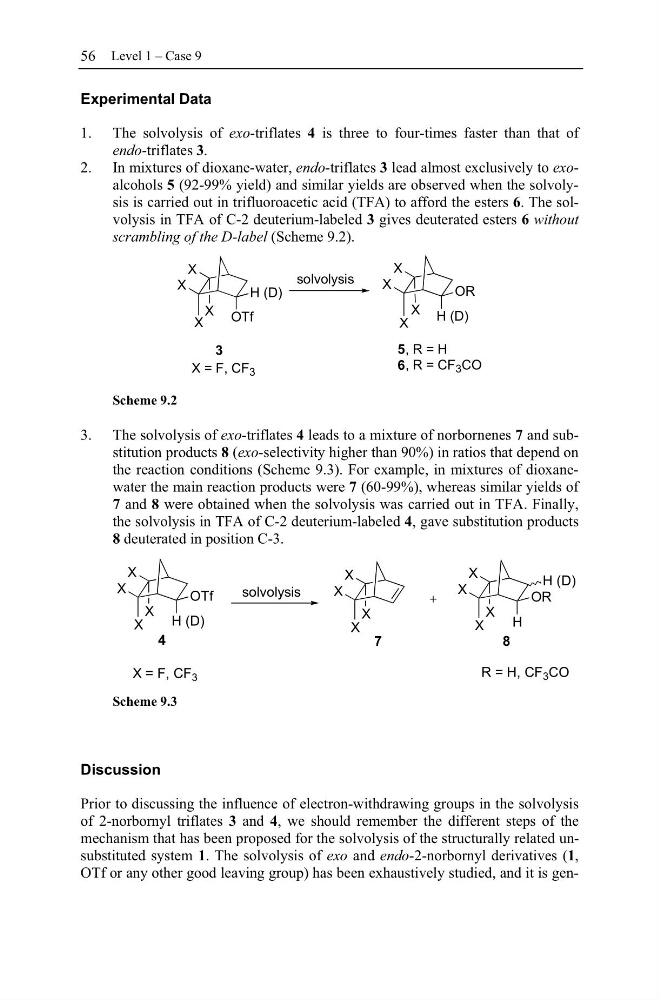
1. The solvolysis of exo-triflates 4 is three to four-times faster than that of
endo-triflates 3.
2. In mixtures of dioxane-water, endo-triflates 3 lead almost exclusively to exoalcohols 5 (92-99% yield) and similar yields are observed when the solvolysis is carried out in trifluoroacetic acid (TFA) to afford the esters 6. The solvolysis in TFA of C-2 deuterium-labeled 3 gives deuterated esters 6 without
scrambling of the D-label (Scheme 9.2).
l
3
X
X
X
H (D)
OTf
X = F, CF 3
5, R = H
6, R = CF 3 CO
X
X
X
OR
H (D)
solvolysis
X
X
Scheme 9.2
3. The solvolysis of exo-triflates 4 leads to a mixture of norbornenes 7 and substitution products 8 (exo-selectivity higher than 90%) in ratios that depend on
the reaction conditions (Scheme 9.3). For example, in mixtures of dioxanewater the main reaction products were 7 (60-99%), whereas similar yields of
7 and 8 were obtained when the solvolysis was carried out in TFA. Finally,
the solvolysis in TFA of C-2 deuterium-labeled
f
4, gave substitution products
8 deuterated in position C-3.
X
X
X
OTf
H (D)
X
X
X
X
X
X
X
X
OR
X
H
H (D)
R = H, CF 3 CO
4
7
8
solvolysis
X = F, CF 3
Scheme 9.3
Discussion
Prior to discussing the influence of electron-withdrawing groups in the solvolysis
of 2-norbornyl triflates 3 and 4, we should remember the different steps of the
mechanism that has been proposed for the solvolysis of the structurally related unsubstituted system 1. The solvolysis of exo and endo-2-norbornyl derivatives (1,
OTf or any other good leaving group) has been exhaustively studied, and it is gen-
56
Experimental Data
1. The solvolysis of exo-triflates 4 is three to four-times faster than that of
endo-triflates 3.
2. In mixtures of dioxane-water, endo-triflates 3 lead almost exclusively to exoalcohols 5 (92-99% yield) and similar yields are observed when the solvolysis is carried out in trifluoroacetic acid (TFA) to afford the esters 6. The solvolysis in TFA of C-2 deuterium-labeled 3 gives deuterated esters 6 without
scrambling of the D-label (Scheme 9.2).
l
3
X
X
X
H (D)
OTf
X = F, CF 3
5, R = H
6, R = CF 3 CO
X
X
X
OR
H (D)
solvolysis
X
X
Scheme 9.2
3. The solvolysis of exo-triflates 4 leads to a mixture of norbornenes 7 and substitution products 8 (exo-selectivity higher than 90%) in ratios that depend on
the reaction conditions (Scheme 9.3). For example, in mixtures of dioxanewater the main reaction products were 7 (60-99%), whereas similar yields of
7 and 8 were obtained when the solvolysis was carried out in TFA. Finally,
the solvolysis in TFA of C-2 deuterium-labeled
f
4, gave substitution products
8 deuterated in position C-3.
X
X
X
OTf
H (D)
X
X
X
X
X
X
X
X
OR
X
H
H (D)
R = H, CF 3 CO
4
7
8
solvolysis
X = F, CF 3
Scheme 9.3
Discussion
Prior to discussing the influence of electron-withdrawing groups in the solvolysis
of 2-norbornyl triflates 3 and 4, we should remember the different steps of the
mechanism that has been proposed for the solvolysis of the structurally related unsubstituted system 1. The solvolysis of exo and endo-2-norbornyl derivatives (1,
OTf or any other good leaving group) has been exhaustively studied, and it is gen-