

Level 1 – Case 8
50
N
OEt
OD
Me
OD
Ph
H
ZnCl 2
O
N
O
Ph
D H
H
Me
D
H
N
OD
COOEt
Ph
H
Me
O
MeNDOD
N
D
H
OEt
O
Me
OD
Ph
D
+
N
H
H
Me
OD
COOEt
D
Ph
3
1
experimental
result
nucleophilic
addition
mechanism
4
mixture of isomers
9
Scheme 8.5
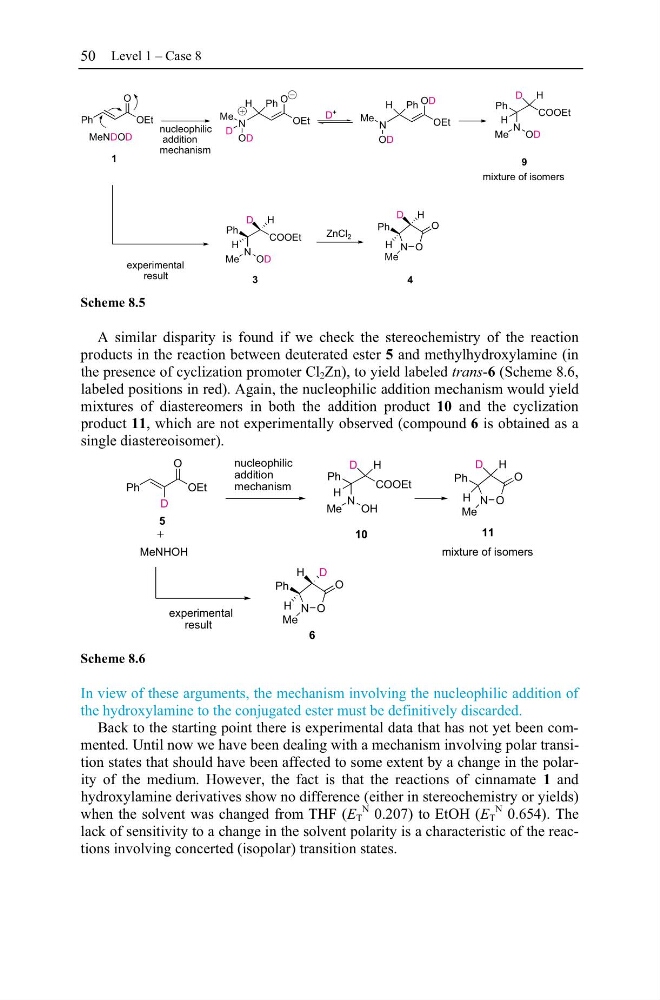
A similar disparity is found if we check the stereochemistry of the reaction
products in the reaction between deuterated ester 5 and methylhydroxylamine (in
the presence of cyclization promoter Cl 2 Zn), to yield labeled trans-6 (Scheme 8.6,
labeled positions in red). Again, the nucleophilic addition mechanism would yield
mixtures of diastereomers in both the addition product 10 and the cyclization
product 11, which are not experimentally observed (compound 6 is obtained as a
single diastereoisomer).
Ph
OEt
O
D
MeNHOH
O
N
O
Ph
H D
H
Me
N
OH
COOEt
D
Ph
H
H
Me
N
O
Ph
D H
H
Me
5
6
11
experimental
result
mixture of isomers
nucleophilic
addition
mechanism
10
Scheme 8.6
In view of these arguments, the mechanism involving the nucleophilic addition of
the hydroxylamine to the conjugated ester must be definitively discarded.
mented. Until now we have been dealing with a mechanism involving polar transition states that should have been affected to some extent by a change in the polarity of the medium. However, the fact is that the reactions of cinnamate 1 and
hydroxylamine derivatives show no difference (either in stereochemistry or yields)
when the solvent was changed from THF (E T
E E
N 0.207) to EtOH (E T
E E
N 0.654). The
lack of sensitivity to a change in the solvent polarity is a characteristic of the reactions involving concerted (isopolar) transition states.
50
N
OEt
OD
Me
OD
Ph
H
ZnCl 2
O
N
O
Ph
D H
H
Me
D
H
N
OD
COOEt
Ph
H
Me
O
MeNDOD
N
D
H
OEt
O
Me
OD
Ph
D
+
N
H
H
Me
OD
COOEt
D
Ph
3
1
experimental
result
nucleophilic
addition
mechanism
4
mixture of isomers
9
Scheme 8.5
A similar disparity is found if we check the stereochemistry of the reaction
products in the reaction between deuterated ester 5 and methylhydroxylamine (in
the presence of cyclization promoter Cl 2 Zn), to yield labeled trans-6 (Scheme 8.6,
labeled positions in red). Again, the nucleophilic addition mechanism would yield
mixtures of diastereomers in both the addition product 10 and the cyclization
product 11, which are not experimentally observed (compound 6 is obtained as a
single diastereoisomer).
Ph
OEt
O
D
MeNHOH
O
N
O
Ph
H D
H
Me
N
OH
COOEt
D
Ph
H
H
Me
N
O
Ph
D H
H
Me
5
6
11
experimental
result
mixture of isomers
nucleophilic
addition
mechanism
10
Scheme 8.6
In view of these arguments, the mechanism involving the nucleophilic addition of
the hydroxylamine to the conjugated ester must be definitively discarded.
mented. Until now we have been dealing with a mechanism involving polar transition states that should have been affected to some extent by a change in the polarity of the medium. However, the fact is that the reactions of cinnamate 1 and
hydroxylamine derivatives show no difference (either in stereochemistry or yields)
when the solvent was changed from THF (E T
E E
N 0.207) to EtOH (E T
E E
N 0.654). The
lack of sensitivity to a change in the solvent polarity is a characteristic of the reactions involving concerted (isopolar) transition states.