

Addition of Hydroxylamines to DE-Unsaturated Esters 51
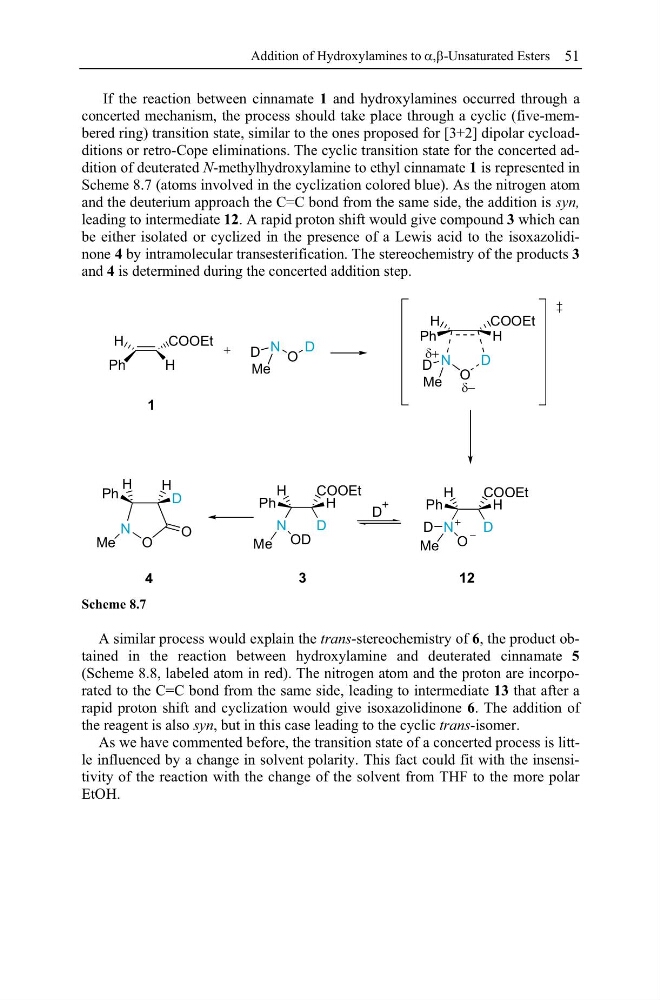
If the reaction between cinnamate 1 and hydroxylamines occurred through a
concerted mechanism, the process should take place through a cyclic (five-memd
bered ring) transition state, similar to the ones proposed for [3+2] dipolar cycloadditions or retro-Cope eliminations. The cyclic transition state for the concerted addition of deuterated N-methylhydroxylamine N N
to ethyl cinnamate 1 is represented in
Scheme 8.7 (atoms involved in the cyclization colored blue). As the nitrogen atom
and the deuterium approach the C=C bond from the same side, the addition is syn,
leading to intermediate 12. A rapid proton shift would give compound 3 which can
be either isolated or cyclized in the presence of a Lewis acid to the isoxazolidinone 4 by intramolecular transesterification. The stereochemistry of the products 3
and 4 is determined during the concerted addition step.
N
O
D
Ph
H
H
C O O E t
Me
D
COOEt
H
H
Ph h
N
O
D
Me
D
D
N
O
Ph
Me
H
H
D
O
D
N
Ph
H
COOEt
H
OD
Me
D
N
Ph
H
COOEt
H
O O
Me
D
G
G
1
12
3
4
Scheme 8.7
A similar process would explain the trans-stereochemistry of 6, the product obtained in the reaction between hydroxylamine and deuterated cinnamate 5
(Scheme 8.8, labeled atom in red). The nitrogen atom and the proton are incorporated to the C=C bond from the same side, leading to intermediate 13 that after a
rapid proton shift and cyclization would give isoxazolidinone 6. The addition of
the reagent is also syn, but in this case leading to the cyclic trans-isomer.
As we have commented before, the transition state of a concerted process is little influenced by a change in solvent polarity. This fact could fit with the insensitivity of the reaction with the change of the solvent from THF to the more polar
EtOH.
If the reaction between cinnamate 1 and hydroxylamines occurred through a
concerted mechanism, the process should take place through a cyclic (five-memd
bered ring) transition state, similar to the ones proposed for [3+2] dipolar cycloadditions or retro-Cope eliminations. The cyclic transition state for the concerted addition of deuterated N-methylhydroxylamine N N
to ethyl cinnamate 1 is represented in
Scheme 8.7 (atoms involved in the cyclization colored blue). As the nitrogen atom
and the deuterium approach the C=C bond from the same side, the addition is syn,
leading to intermediate 12. A rapid proton shift would give compound 3 which can
be either isolated or cyclized in the presence of a Lewis acid to the isoxazolidinone 4 by intramolecular transesterification. The stereochemistry of the products 3
and 4 is determined during the concerted addition step.
N
O
D
Ph
H
H
C O O E t
Me
D
COOEt
H
H
Ph h
N
O
D
Me
D
D
N
O
Ph
Me
H
H
D
O
D
N
Ph
H
COOEt
H
OD
Me
D
N
Ph
H
COOEt
H
O O
Me
D
G
G
1
12
3
4
Scheme 8.7
A similar process would explain the trans-stereochemistry of 6, the product obtained in the reaction between hydroxylamine and deuterated cinnamate 5
(Scheme 8.8, labeled atom in red). The nitrogen atom and the proton are incorporated to the C=C bond from the same side, leading to intermediate 13 that after a
rapid proton shift and cyclization would give isoxazolidinone 6. The addition of
the reagent is also syn, but in this case leading to the cyclic trans-isomer.
As we have commented before, the transition state of a concerted process is little influenced by a change in solvent polarity. This fact could fit with the insensitivity of the reaction with the change of the solvent from THF to the more polar
EtOH.