

Addition of Hydroxylamines to DE-Unsaturated Esters 49
Ph
OEt
O
N
OEt
O
Ph
R
2
OR
1
H
NHR
2 OR
1
N
OEt
O
Ph
R
2
OR
1
O
Ph
R
2
OMe
N
O
Ph
R
2
1 = H
7
2, R
2 = Me
8, R
2 = H
R
1 = Me
not observed
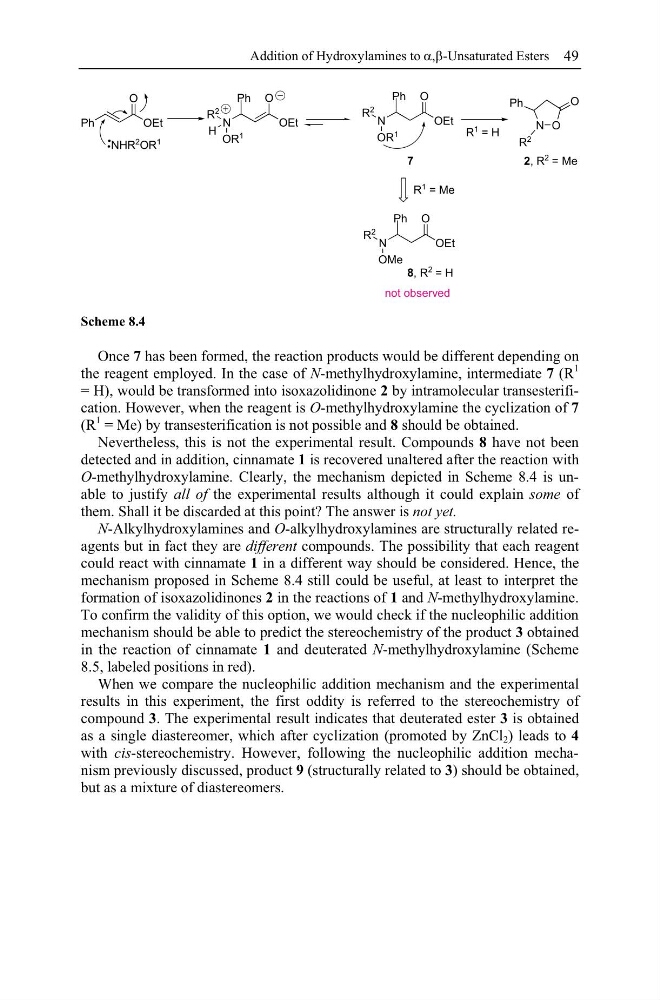
Scheme 8.4
Once 7 has been formed, the reaction products would be different depending on
the reagent employed. In the case of N-methylhydroxylamine, intermediate
N N
7 (R
1
= H), would be transformed into isoxazolidinone 2 by intramolecular transesterification. However, when the reagent is O-methylhydroxylamine the cyclization of 7
(R
1 = Me) by transesterification is not possible and 8 should be obtained.
Nevertheless, this is not the experimental result. Compounds 8 have not been
detected and in addition, cinnamate 1 is recovered unaltered after the reaction with
O-methylhydroxylamine. Clearly, the mechanism depicted in Scheme 8.4 is unable to justify all of the experimental results although it could explain some of
them. Shall it be discarded at this point? The answer is not yet.
N-Alkylhydroxylamines and
N N
O-alkylhydroxylamines are structurally related reagents but in fact they are different compounds. The possib
t
ility that each reagent
could react with cinnamate 1 in a different way should be considered. Hence, the
mechanism proposed in Scheme 8.4 still could be useful, at least to interpret the
formation of isoxazolidinones 2 in the reactions of 1 and N-methylhydroxylamine. N N
To confirm the validity of this option, we would check if the nucleophilic addition
mechanism should be able to predict the stereochemistry of the product 3 obtained
in the reaction of cinnamate 1 and deuterated N-methylhydroxylamine (Scheme
N N
8.5, labeled positions in red).
When we compare the nucleophilic addition mechanism and the experimental
results in this experiment, the first oddity is referred to the stereochemistry of
compound 3. The experimental result indicates that deuterated ester 3 is obtained
as a single diastereomer, which after cyclization (promoted by ZnCl 2 ) leads to 4
with cis-stereochemistry. However, following the nucleophilic addition mechanism previously discussed, product 9 (structurally related to 3) should be obtained,
but as a mixture of diastereomers.
Ph
OEt
O
N
OEt
O
Ph
R
2
OR
1
H
NHR
2 OR
1
N
OEt
O
Ph
R
2
OR
1
O
Ph
R
2
OMe
N
O
Ph
R
2
1 = H
7
2, R
2 = Me
8, R
2 = H
R
1 = Me
not observed
Scheme 8.4
Once 7 has been formed, the reaction products would be different depending on
the reagent employed. In the case of N-methylhydroxylamine, intermediate
N N
7 (R
1
= H), would be transformed into isoxazolidinone 2 by intramolecular transesterification. However, when the reagent is O-methylhydroxylamine the cyclization of 7
(R
1 = Me) by transesterification is not possible and 8 should be obtained.
Nevertheless, this is not the experimental result. Compounds 8 have not been
detected and in addition, cinnamate 1 is recovered unaltered after the reaction with
O-methylhydroxylamine. Clearly, the mechanism depicted in Scheme 8.4 is unable to justify all of the experimental results although it could explain some of
them. Shall it be discarded at this point? The answer is not yet.
N-Alkylhydroxylamines and
N N
O-alkylhydroxylamines are structurally related reagents but in fact they are different compounds. The possib
t
ility that each reagent
could react with cinnamate 1 in a different way should be considered. Hence, the
mechanism proposed in Scheme 8.4 still could be useful, at least to interpret the
formation of isoxazolidinones 2 in the reactions of 1 and N-methylhydroxylamine. N N
To confirm the validity of this option, we would check if the nucleophilic addition
mechanism should be able to predict the stereochemistry of the product 3 obtained
in the reaction of cinnamate 1 and deuterated N-methylhydroxylamine (Scheme
N N
8.5, labeled positions in red).
When we compare the nucleophilic addition mechanism and the experimental
results in this experiment, the first oddity is referred to the stereochemistry of
compound 3. The experimental result indicates that deuterated ester 3 is obtained
as a single diastereomer, which after cyclization (promoted by ZnCl 2 ) leads to 4
with cis-stereochemistry. However, following the nucleophilic addition mechanism previously discussed, product 9 (structurally related to 3) should be obtained,
but as a mixture of diastereomers.