

Level 1 – Case 8
48
Experimental Data
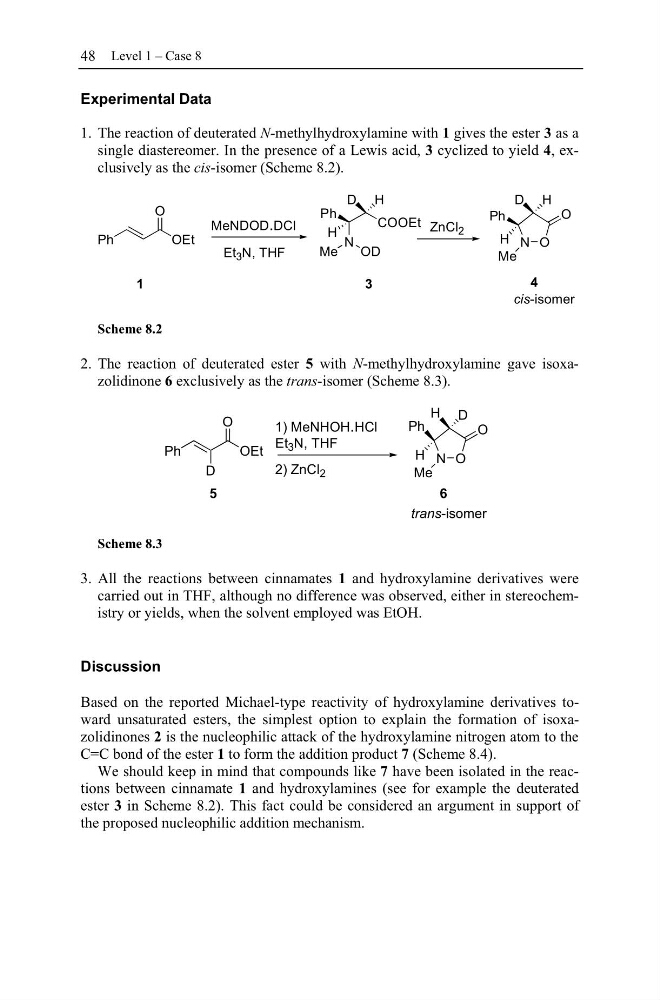
1. The reaction of deuterated N-methylhydroxylamine with
N N
1 gives the ester 3 as a
single diastereomer. In the presence of a Lewis acid, 3 cyclized to yield 4, exclusively as the cis-isomer (Scheme 8.2).
Ph
OEt
O
MeNDOD.DCl
Et 3 N, THF
H
H
Me
N
OD
COOEt
D
Ph
ZnCl 2
O
Ph
D H
H
Me
O
N
1
3
4
cis-isomer
Scheme 8.2
2. The reaction of deuterated ester 5 with N-methylhydroxylamine gave isoxaN N
zolidinone 6 exclusively as the trans-isomer (Scheme 8.3).
Ph
O E t
O
D
1) MeNHOH.HCl
Et 3 N, THF
O
N
O
Ph
H D
H
Me
2) ZnCl 2
5
6
trans-isomer
Scheme 8.3
3. All the reactions between cinnamates 1 and hydroxylamine derivatives were
carried out in THF, although no difference was observed, either in stereochemistry or yields, when the solvent employed was EtOH.
Discussion
Based on the reported Michael-type reactivity of hydroxylamine derivatives toward unsaturated esters, the simplest option to explain the formation of isoxazolidinones 2 is the nucleophilic attack of the hydroxylamine nitrogen atom to the
C=C bond of the ester 1 to form the addition product 7 (Scheme 8.4).
We should keep in mind that compounds like 7 have been isolated in the reactions between cinnamate 1 and hydroxylamines (see for example the deuterated
ester 3 in Scheme 8.2). This fact could be considered an argument in support of
the proposed nucleophilic addition mechanism.
48
Experimental Data
1. The reaction of deuterated N-methylhydroxylamine with
N N
1 gives the ester 3 as a
single diastereomer. In the presence of a Lewis acid, 3 cyclized to yield 4, exclusively as the cis-isomer (Scheme 8.2).
Ph
OEt
O
MeNDOD.DCl
Et 3 N, THF
H
H
Me
N
OD
COOEt
D
Ph
ZnCl 2
O
Ph
D H
H
Me
O
N
1
3
4
cis-isomer
Scheme 8.2
2. The reaction of deuterated ester 5 with N-methylhydroxylamine gave isoxaN N
zolidinone 6 exclusively as the trans-isomer (Scheme 8.3).
Ph
O E t
O
D
1) MeNHOH.HCl
Et 3 N, THF
O
N
O
Ph
H D
H
Me
2) ZnCl 2
5
6
trans-isomer
Scheme 8.3
3. All the reactions between cinnamates 1 and hydroxylamine derivatives were
carried out in THF, although no difference was observed, either in stereochemistry or yields, when the solvent employed was EtOH.
Discussion
Based on the reported Michael-type reactivity of hydroxylamine derivatives toward unsaturated esters, the simplest option to explain the formation of isoxazolidinones 2 is the nucleophilic attack of the hydroxylamine nitrogen atom to the
C=C bond of the ester 1 to form the addition product 7 (Scheme 8.4).
We should keep in mind that compounds like 7 have been isolated in the reactions between cinnamate 1 and hydroxylamines (see for example the deuterated
ester 3 in Scheme 8.2). This fact could be considered an argument in support of
the proposed nucleophilic addition mechanism.