

Level 1 – Case 4
22
R 1
OR 3
O
R 2
O
1
OR 3
OH
R 2
O
R 1
OR 3
OH
R 2
O
syn-2
anti-3
a) TiCl 4 , CH 2 Cl 2
-78 o C
b) BH 3 .py
a) CeCl 3 , THF
-78 o C
b) LiEt 3 BH
1
R 1 = Me, Ph
R 2 = Me, Bn, allyl, propargyl
R 3 = Et, t-Bu t t
Scheme 4.1
Experimental Data
Donor numbers DN (kcal mol
N
–1 ): 1,2-dichloroethane (DN
( (
0.0); Diethyl ether
N
(Et 2 O) (DN ( (
19.2); Tetrahydrofurane (THF) (
N
DN
( (
20.0).
N
Discussion
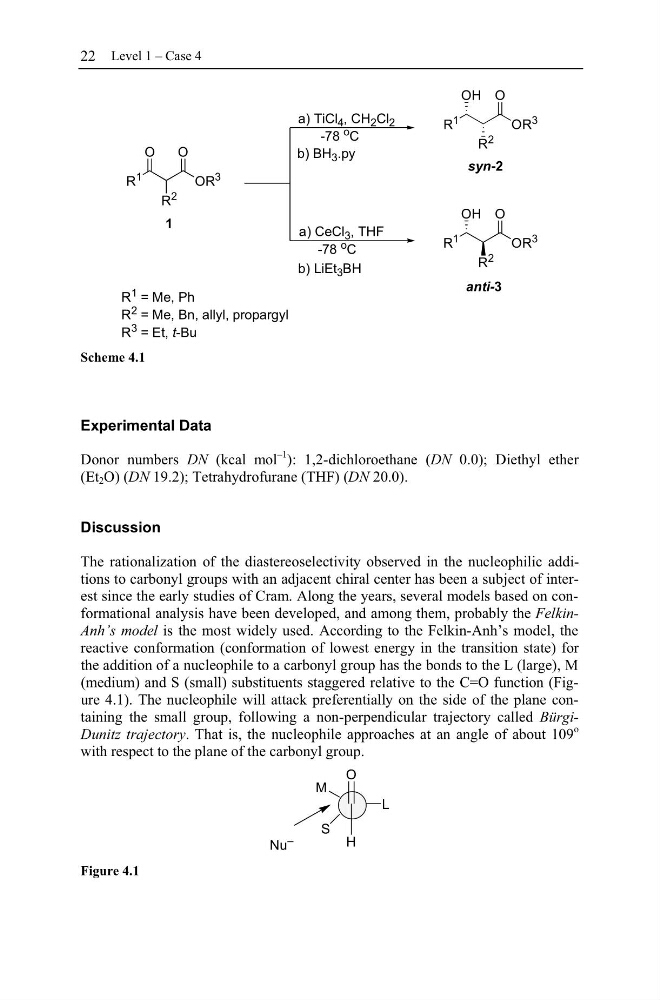
The rationalization of the diastereoselectivity observed in the nucleophilic additions to carbonyl groups with an adjacent chiral center has been a subject of interest since the early studies of Cram. Along the years, several models based on conformational analysis have been developed, and among them, probably the FelkinAnh’s model is the most widely used. According to the Felkin-Anh’s model, the
l
reactive conformation (conformation of lowest energy in the transition state) for
the addition of a nucleophile to a carbonyl group has the bonds to the L (large), M
(medium) and S (small) substituents staggered relative to the C=O function (Figure 4.1). The nucleophile will attack preferentially on the side of the plane containing the small group, following a non-perpendicular trajectory called BürgiDunitz trajectory. That is, the nucleophile approaches at an angle of about 109
o
with respect to the plane of the carbonyl group.
L
O
H
S
M
Nu –
Figure 4.1
22
R 1
OR 3
O
R 2
O
1
OR 3
OH
R 2
O
R 1
OR 3
OH
R 2
O
syn-2
anti-3
a) TiCl 4 , CH 2 Cl 2
-78 o C
b) BH 3 .py
a) CeCl 3 , THF
-78 o C
b) LiEt 3 BH
1
R 1 = Me, Ph
R 2 = Me, Bn, allyl, propargyl
R 3 = Et, t-Bu t t
Scheme 4.1
Experimental Data
Donor numbers DN (kcal mol
N
–1 ): 1,2-dichloroethane (DN
( (
0.0); Diethyl ether
N
(Et 2 O) (DN ( (
19.2); Tetrahydrofurane (THF) (
N
DN
( (
20.0).
N
Discussion
The rationalization of the diastereoselectivity observed in the nucleophilic additions to carbonyl groups with an adjacent chiral center has been a subject of interest since the early studies of Cram. Along the years, several models based on conformational analysis have been developed, and among them, probably the FelkinAnh’s model is the most widely used. According to the Felkin-Anh’s model, the
l
reactive conformation (conformation of lowest energy in the transition state) for
the addition of a nucleophile to a carbonyl group has the bonds to the L (large), M
(medium) and S (small) substituents staggered relative to the C=O function (Figure 4.1). The nucleophile will attack preferentially on the side of the plane containing the small group, following a non-perpendicular trajectory called BürgiDunitz trajectory. That is, the nucleophile approaches at an angle of about 109
o
with respect to the plane of the carbonyl group.
L
O
H
S
M
Nu –
Figure 4.1