

Diastereoselective Reductions of E-Ketoesters
23
The additions of nucleophiles to aldehydes and ketones are promoted by coordination of a Lewis acid to the oxygen atom of the carbonyl group. The coordination with the metal enhances the electrophilicity of the C=O group facilitating the
attack of the nucleophile. From a stereochemical point of view, the presence of a
Lewis acid is particularly important when a substituent with a heteroatom able to
coordinate with the metal is placed next to the carbonyl group. In such cases, the
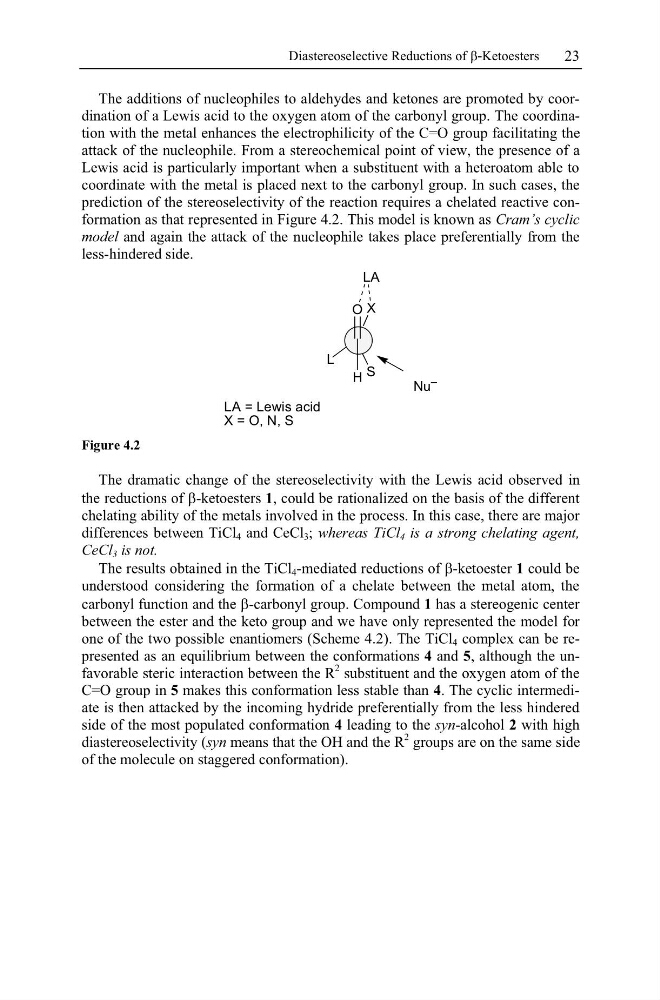
prediction of the stereoselectivity of the reaction requires a chelated reactive conformation as that represented in Figure 4.2. This model is known as Cram’s cyclic
model and again the attack of the nucleoph
l
ile takes place preferentially from the
less-hindered side.
X
O
H S
L
LA
Nu –
LA = Lewis acid
X = O, N, S
Figure 4.2
The dramatic change of the stereoselectivity with the Lewis acid observed in
the reductions of E-ketoesters 1, could be rationalized on the basis of the different
chelating ability of the metals involved in the process. In this case, there are major
differences between TiCl 4 and CeCl 3 ; whereas TiCl 4
l is a strong chelating agent,
CeCl 3
l is not.
The results obtained in the TiCl 4 -mediated reductions of E-ketoester 1 could be
understood considering the formation of a chelate between the metal atom, the
carbonyl function and the E-carbonyl group. Compound 1 has a stereogenic center
between the ester and the keto group and we have only represented the model for
one of the two possible enantiomers (Scheme 4.2). The TiCl 4 complex can be represented as an equilibrium between the conformations 4 and 5, although the unfavorable steric interaction between the R
2 substituent and the oxygen atom of the
C=O group in 5 makes this conformation less stable than 4. The cyclic intermediate is then attacked by the incoming hydride preferentially from the less hindered
side of the most populated conformation 4 leading to the syn-alcohol 2 with high
diastereoselectivity (syn means that the OH and the R
2
R groups are on the same side
of the molecule on staggered conformation).
23
The additions of nucleophiles to aldehydes and ketones are promoted by coordination of a Lewis acid to the oxygen atom of the carbonyl group. The coordination with the metal enhances the electrophilicity of the C=O group facilitating the
attack of the nucleophile. From a stereochemical point of view, the presence of a
Lewis acid is particularly important when a substituent with a heteroatom able to
coordinate with the metal is placed next to the carbonyl group. In such cases, the
prediction of the stereoselectivity of the reaction requires a chelated reactive conformation as that represented in Figure 4.2. This model is known as Cram’s cyclic
model and again the attack of the nucleoph
l
ile takes place preferentially from the
less-hindered side.
X
O
H S
L
LA
Nu –
LA = Lewis acid
X = O, N, S
Figure 4.2
The dramatic change of the stereoselectivity with the Lewis acid observed in
the reductions of E-ketoesters 1, could be rationalized on the basis of the different
chelating ability of the metals involved in the process. In this case, there are major
differences between TiCl 4 and CeCl 3 ; whereas TiCl 4
l is a strong chelating agent,
CeCl 3
l is not.
The results obtained in the TiCl 4 -mediated reductions of E-ketoester 1 could be
understood considering the formation of a chelate between the metal atom, the
carbonyl function and the E-carbonyl group. Compound 1 has a stereogenic center
between the ester and the keto group and we have only represented the model for
one of the two possible enantiomers (Scheme 4.2). The TiCl 4 complex can be represented as an equilibrium between the conformations 4 and 5, although the unfavorable steric interaction between the R
2 substituent and the oxygen atom of the
C=O group in 5 makes this conformation less stable than 4. The cyclic intermediate is then attacked by the incoming hydride preferentially from the less hindered
side of the most populated conformation 4 leading to the syn-alcohol 2 with high
diastereoselectivity (syn means that the OH and the R
2
R groups are on the same side
of the molecule on staggered conformation).