

Level 1 – Case 4
Diastereoselective Reductions of E E-Ketoesters
Key point: Chelation versus non-chelation control
R 1
OR 3
O
R 2
O
1
OR 3
OH
R 2
O
R 1
OR 3
OH
R 2
O
syn
anti
a) TiCl 4 , CH 2 Cl 2
-78 o C
b) BH 3 .py
a) CeCl 3 , THF
-78 o C
b) LiEt 3 BH
Diastereoselective Reductions of E E-Ketoesters
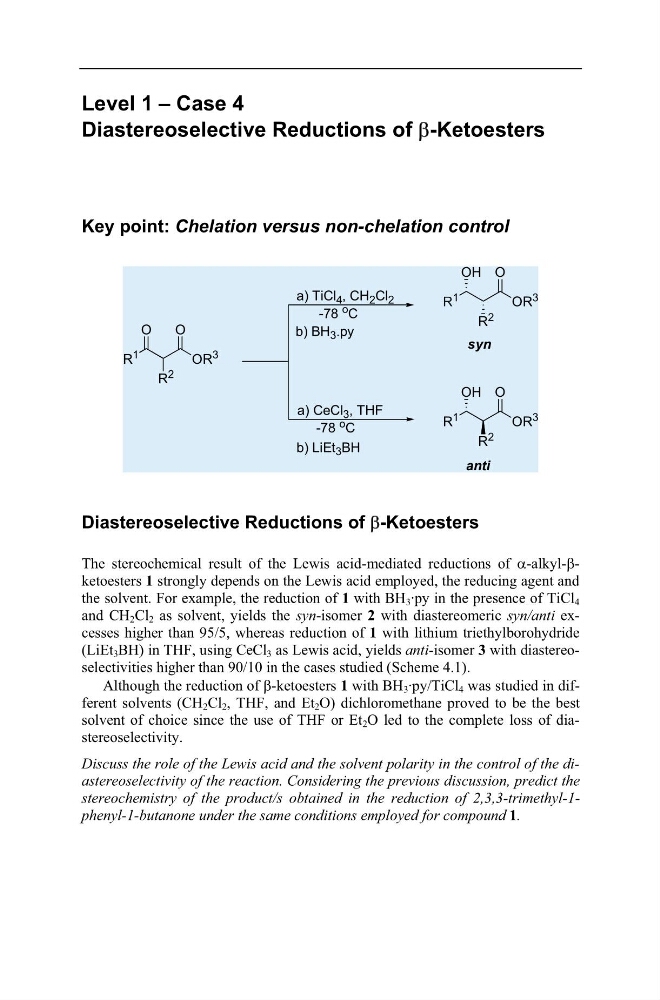
The stereochemical result of the Lewis acid-mediated reductions of D-alkyl-Eketoesters 1 strongly depends on the Lewis acid employed, the reducing agent and
the solvent. For example, the reduction of 1 with BH 3 ·py in the presence of TiCl 4
and CH 2 Cl 2 as solvent, yields the syn-isomer 2 with diastereomeric syn/anti excesses higher than 95/5, whereas reduction of 1 with lithium triethylborohydride
(LiEt 3 BH) in THF, using CeCl 3 as Lewis acid, yields anti-isomer 3 with diastereoselectivities higher than 90/10 in the cases studied (Scheme 4.1).
Although the reduction of E-ketoesters 1 with BH 3 ·py/TiCl 4 was studied in different solvents (CH 2 Cl 2 , THF, and Et 2 O) dichloromethane proved to be the best
solvent of choice since the use of THF or Et 2 O led to the complete loss of diastereoselectivity.
Discuss the role of the Lewis acid and the solvent polarity in the control of the diastereoselectivity of the reaction. Considering the previous discussion, predict the
stereochemistry of the product/s obtained in the reduction of 2,3,3-trimethyl-1phenyl-1-butanone under the same conditions employed for compound 1.
Diastereoselective Reductions of E E-Ketoesters
Key point: Chelation versus non-chelation control
R 1
OR 3
O
R 2
O
1
OR 3
OH
R 2
O
R 1
OR 3
OH
R 2
O
syn
anti
a) TiCl 4 , CH 2 Cl 2
-78 o C
b) BH 3 .py
a) CeCl 3 , THF
-78 o C
b) LiEt 3 BH
Diastereoselective Reductions of E E-Ketoesters
The stereochemical result of the Lewis acid-mediated reductions of D-alkyl-Eketoesters 1 strongly depends on the Lewis acid employed, the reducing agent and
the solvent. For example, the reduction of 1 with BH 3 ·py in the presence of TiCl 4
and CH 2 Cl 2 as solvent, yields the syn-isomer 2 with diastereomeric syn/anti excesses higher than 95/5, whereas reduction of 1 with lithium triethylborohydride
(LiEt 3 BH) in THF, using CeCl 3 as Lewis acid, yields anti-isomer 3 with diastereoselectivities higher than 90/10 in the cases studied (Scheme 4.1).
Although the reduction of E-ketoesters 1 with BH 3 ·py/TiCl 4 was studied in different solvents (CH 2 Cl 2 , THF, and Et 2 O) dichloromethane proved to be the best
solvent of choice since the use of THF or Et 2 O led to the complete loss of diastereoselectivity.
Discuss the role of the Lewis acid and the solvent polarity in the control of the diastereoselectivity of the reaction. Considering the previous discussion, predict the
stereochemistry of the product/s obtained in the reduction of 2,3,3-trimethyl-1phenyl-1-butanone under the same conditions employed for compound 1.