

Level 3 – Case 40
274
OBs
OBs
AcO
AcOH
AcOH
OAc
endo-2
17
16
9
G G
13
G G
3
18
isomerization
?
enantiomer of 3
f
4
3
8
a
b
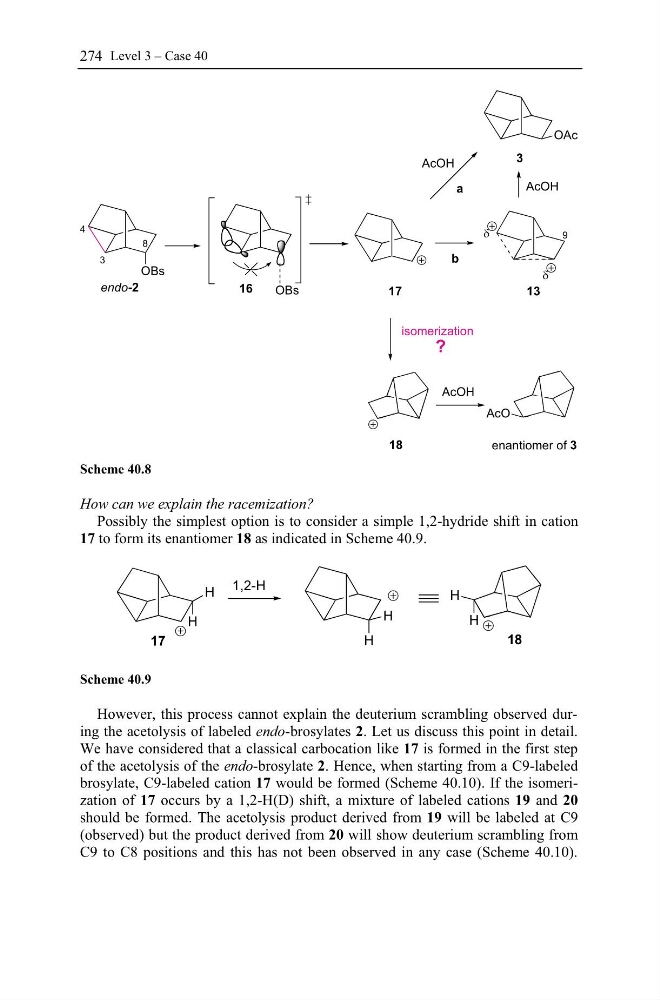
Scheme 40.8
How can we explain the racemization?
Possibly the simplest option is to consider a simple 1,2-hydride shift in cation
17 to form its enantiomer 18 as indicated in Scheme 40.9.
17
18
1,2-H
H
H
H
H
H
H
Scheme 40.9
However, this process cannot explain the deuterium scrambling observed during the acetolysis of labeled endo-brosylates 2. Let us discuss this point in detail.
We have considered that a classical carbocation like 17 is formed in the first step
of the acetolysis of the endo-brosylate 2. Hence, when starting from a C9-labeled
brosylate, C9-labeled cation 17 would be formed (Scheme 40.10). If the isomerization of 17 occurs by a 1,2-H(D) shift, a mixture of labeled cations 19 and 20
should be formed. The acetolysis product derived from 19 will be labeled at C9
(observed) but the product derived from 20 will show deuterium scrambling from
C9 to C8 positions and this has not been observed in any case (Scheme 40.10).
274
OBs
OBs
AcO
AcOH
AcOH
OAc
endo-2
17
16
9
G G
13
G G
3
18
isomerization
?
enantiomer of 3
f
4
3
8
a
b
Scheme 40.8
How can we explain the racemization?
Possibly the simplest option is to consider a simple 1,2-hydride shift in cation
17 to form its enantiomer 18 as indicated in Scheme 40.9.
17
18
1,2-H
H
H
H
H
H
H
Scheme 40.9
However, this process cannot explain the deuterium scrambling observed during the acetolysis of labeled endo-brosylates 2. Let us discuss this point in detail.
We have considered that a classical carbocation like 17 is formed in the first step
of the acetolysis of the endo-brosylate 2. Hence, when starting from a C9-labeled
brosylate, C9-labeled cation 17 would be formed (Scheme 40.10). If the isomerization of 17 occurs by a 1,2-H(D) shift, a mixture of labeled cations 19 and 20
should be formed. The acetolysis product derived from 19 will be labeled at C9
(observed) but the product derived from 20 will show deuterium scrambling from
C9 to C8 positions and this has not been observed in any case (Scheme 40.10).