

Solvolysis of 8-Deltacyclyl Brosylates 275
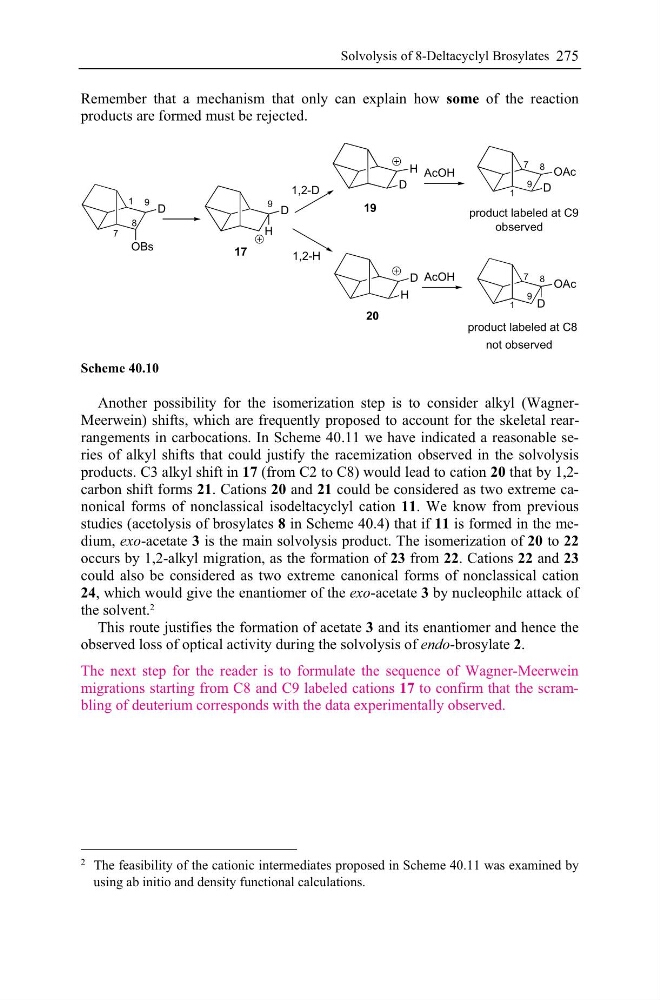
Remember that a mechanism that only can explain how some of the reaction
products are formed must be rejected.
D
H
D
OAc
D
H
H
D
product labeled at C9
product labeled at C8
not observed
19
20
9
17
D
9
OBs
AcOH
observed
9
7
8
1
7
1
8
1,2-H
1,2-D
AcOH
OAc
9
7
1
8
D
Scheme 40.10
Another possibility for the isomerization step is to consider alkyl (WagnerMeerwein) shifts, which are frequently proposed to account for the skeletal rearrangements in carbocations. In Scheme 40.11 we have indicated a reasonable series of alkyl shifts that could justify the racemization observed in the solvolysis
products. C3 alkyl shift in 17 (from C2 to C8) would lead to cation 20 that by 1,2carbon shift forms 21. Cations 20 and 21 could be considered as two extreme canonical forms of nonclassical isodeltacyclyl cation 11. We know from previous
studies (acetolysis of brosylates 8 in Scheme 40.4) that if 11 is formed in the medium, exo-acetate 3 is the main solvolysis product. The isomerization of 20 to 22
occurs by 1,2-alkyl migration, as the formation of 23 from 22. Cations 22 and 23
could also be considered as two extreme canonical forms of nonclassical cation
24, which would give the enantiomer of the exo-acetate 3 by nucleophilc attack of
the solvent.
2
This route justifies the formation of acetate 3 and its enantiomer and hence the
observed loss of optical activity during the solvolysis of endo-brosylate 2.
The next step for the reader is to formulate the sequence of Wagner-Meerwein
migrations starting from C8 and C9 labeled cations 17 to confirm that the scrambling of deuterium corresponds with the data experimentally observed.
2 The feasibility of the cationic intermediates proposed in Scheme 40.11 was examined by
using ab initio and density functional calculations.
Remember that a mechanism that only can explain how some of the reaction
products are formed must be rejected.
D
H
D
OAc
D
H
H
D
product labeled at C9
product labeled at C8
not observed
19
20
9
17
D
9
OBs
AcOH
observed
9
7
8
1
7
1
8
1,2-H
1,2-D
AcOH
OAc
9
7
1
8
D
Scheme 40.10
Another possibility for the isomerization step is to consider alkyl (WagnerMeerwein) shifts, which are frequently proposed to account for the skeletal rearrangements in carbocations. In Scheme 40.11 we have indicated a reasonable series of alkyl shifts that could justify the racemization observed in the solvolysis
products. C3 alkyl shift in 17 (from C2 to C8) would lead to cation 20 that by 1,2carbon shift forms 21. Cations 20 and 21 could be considered as two extreme canonical forms of nonclassical isodeltacyclyl cation 11. We know from previous
studies (acetolysis of brosylates 8 in Scheme 40.4) that if 11 is formed in the medium, exo-acetate 3 is the main solvolysis product. The isomerization of 20 to 22
occurs by 1,2-alkyl migration, as the formation of 23 from 22. Cations 22 and 23
could also be considered as two extreme canonical forms of nonclassical cation
24, which would give the enantiomer of the exo-acetate 3 by nucleophilc attack of
the solvent.
2
This route justifies the formation of acetate 3 and its enantiomer and hence the
observed loss of optical activity during the solvolysis of endo-brosylate 2.
The next step for the reader is to formulate the sequence of Wagner-Meerwein
migrations starting from C8 and C9 labeled cations 17 to confirm that the scrambling of deuterium corresponds with the data experimentally observed.
2 The feasibility of the cationic intermediates proposed in Scheme 40.11 was examined by
using ab initio and density functional calculations.