

Solvolysis of 8-Deltacyclyl Brosylates 273
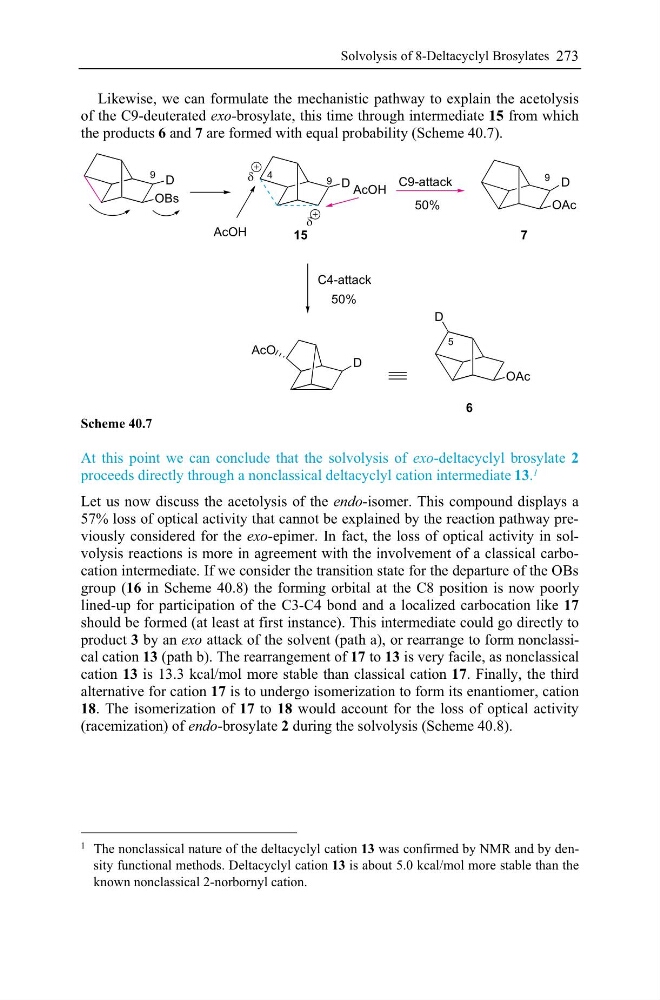
Likewise, we can formulate the mechanistic pathway to explain the acetolysis
of the C9-deuterated exo-brosylate, this time through intermediate 15 from which
the products 6 and 7 are formed with equal probability (Scheme 40.7).
OBs
D
D
D
OAc
AcOH
AcO O
D
D
OAc
AcOH
9
G G
G
15
6
7
50%
5
9
4
C4-attack
50%
C9-attack
9
Scheme 40.7
At this point we can conclude that the solvolysis of exo-deltacyclyl brosylate 2
proceeds directly through a nonclassical deltacyclyl cation intermediate 13.
1
Let us now discuss the acetolysis of the endo-isomer. This compound displays a
57% loss of optical activity that cannot be explained by the reaction pathway previously considered for the exo-epimer. In fact, the loss of optical activity in solvolysis reactions is more in agreement with the involvement of a classical carbof
cation intermediate. If we consider the transition state for the departure of the OBs
group (16 in Scheme 40.8) the forming orbital at the C8 position is now poorly
lined-up for participation of the C3-C4 bond and a localized carbocation like 17
should be formed (at least at first instance). This intermediate could go directly to
product 3 by an exo attack of the solvent (path a), or rearrange to form nonclassical cation 13 (path b). The rearrangement of 17 to 13 is very facile, as nonclassical
cation 13 is 13.3 kcal/mol more stable than classical cation 17. Finally, the third
alternative for cation 17 is to undergo isomerization to form its enantiomer, cation
18. The isomerization of 17 to 18 would account for the loss of optical activity
(racemization) of endo-brosylate 2 during the solvolysis (Scheme 40.8).
1 The nonclassical nature of the deltacyclyl cation 13 was confirmed by NMR and by density functional methods. Deltacyclyl cation 13 is about 5.0 kcal/mol more stable than the
known nonclassical 2-norbornyl cation.
Likewise, we can formulate the mechanistic pathway to explain the acetolysis
of the C9-deuterated exo-brosylate, this time through intermediate 15 from which
the products 6 and 7 are formed with equal probability (Scheme 40.7).
OBs
D
D
D
OAc
AcOH
AcO O
D
D
OAc
AcOH
9
G G
G
15
6
7
50%
5
9
4
C4-attack
50%
C9-attack
9
Scheme 40.7
At this point we can conclude that the solvolysis of exo-deltacyclyl brosylate 2
proceeds directly through a nonclassical deltacyclyl cation intermediate 13.
1
Let us now discuss the acetolysis of the endo-isomer. This compound displays a
57% loss of optical activity that cannot be explained by the reaction pathway previously considered for the exo-epimer. In fact, the loss of optical activity in solvolysis reactions is more in agreement with the involvement of a classical carbof
cation intermediate. If we consider the transition state for the departure of the OBs
group (16 in Scheme 40.8) the forming orbital at the C8 position is now poorly
lined-up for participation of the C3-C4 bond and a localized carbocation like 17
should be formed (at least at first instance). This intermediate could go directly to
product 3 by an exo attack of the solvent (path a), or rearrange to form nonclassical cation 13 (path b). The rearrangement of 17 to 13 is very facile, as nonclassical
cation 13 is 13.3 kcal/mol more stable than classical cation 17. Finally, the third
alternative for cation 17 is to undergo isomerization to form its enantiomer, cation
18. The isomerization of 17 to 18 would account for the loss of optical activity
(racemization) of endo-brosylate 2 during the solvolysis (Scheme 40.8).
1 The nonclassical nature of the deltacyclyl cation 13 was confirmed by NMR and by density functional methods. Deltacyclyl cation 13 is about 5.0 kcal/mol more stable than the
known nonclassical 2-norbornyl cation.