

Level 3 – Case 40
272
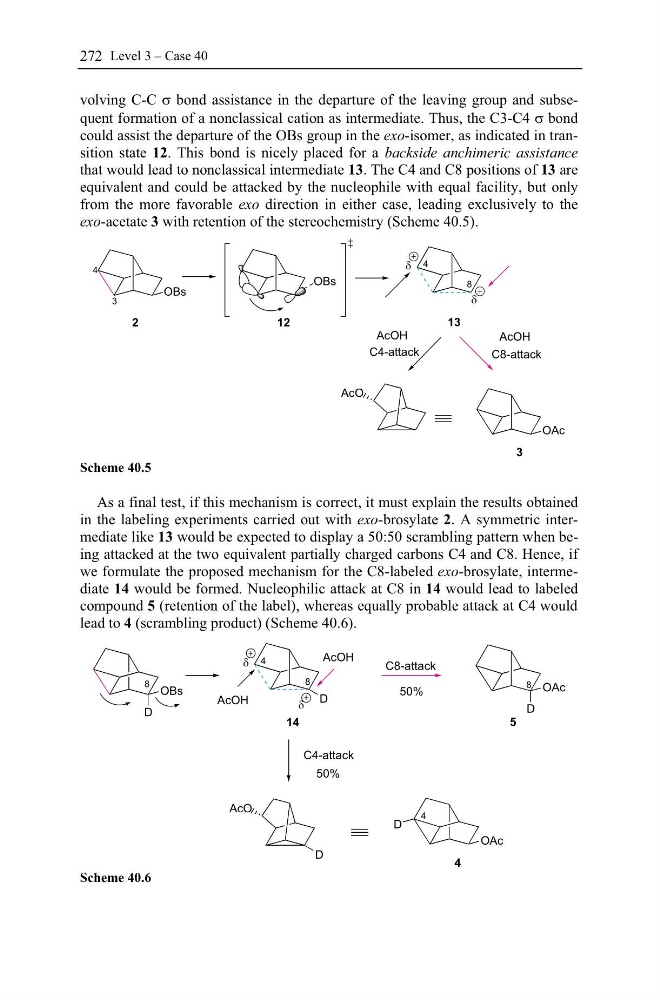
volving C-C V bond assistance in the departure of the leaving group and subsequent formation of a nonclassical cation as intermediate. Thus, the C3-C4 V bond
could assist the departure of the OBs group in the exo-isomer, as indicated in transition state 12. This bond is nicely placed for a backside anchimeric assistance
that would lead to nonclassical intermediate 13. The C4 and C8 positions of 13 are
equivalent and could be attacked by the nucleophile with equal facility, but only
from the more favorable exo direction in either case, leading exclusively to the
exo-acetate 3 with retention of the stereochemistry (Scheme 40.5).
OBs
OBs
AcOH
AcOH
AcO O
OAc
3
4
2
G
G
12
13
8
4
C8-attack
3
C4-attack
Scheme 40.5
As a final test, if this mechanism is correct, it must explain the results obtained
in the labeling experiments carried out with exo-brosylate 2. A symmetric intermediate like 13 would be expected to display a 50:50 scrambling pattern when being attacked at the two equivalent partially charged carbons C4 and C8. Hence, if
we formulate the proposed mechanism for the C8-labeled exo-brosylate, intermediate 14 would be formed. Nucleophilic attack at C8 in 14 would lead to labeled
compound 5 (retention of the label), whereas equally probable attack at C4 would
lead to 4 (scrambling product) (Scheme 40.6).
OBs
D
D
AcOH
AcO O
D
AcOH
OAc
D
OAc
D
G G
4
C4-attack
4
8
G
14
8
4
8
C8-attack
5
50%
50%
Scheme 40.6
272
volving C-C V bond assistance in the departure of the leaving group and subsequent formation of a nonclassical cation as intermediate. Thus, the C3-C4 V bond
could assist the departure of the OBs group in the exo-isomer, as indicated in transition state 12. This bond is nicely placed for a backside anchimeric assistance
that would lead to nonclassical intermediate 13. The C4 and C8 positions of 13 are
equivalent and could be attacked by the nucleophile with equal facility, but only
from the more favorable exo direction in either case, leading exclusively to the
exo-acetate 3 with retention of the stereochemistry (Scheme 40.5).
OBs
OBs
AcOH
AcOH
AcO O
OAc
3
4
2
G
G
12
13
8
4
C8-attack
3
C4-attack
Scheme 40.5
As a final test, if this mechanism is correct, it must explain the results obtained
in the labeling experiments carried out with exo-brosylate 2. A symmetric intermediate like 13 would be expected to display a 50:50 scrambling pattern when being attacked at the two equivalent partially charged carbons C4 and C8. Hence, if
we formulate the proposed mechanism for the C8-labeled exo-brosylate, intermediate 14 would be formed. Nucleophilic attack at C8 in 14 would lead to labeled
compound 5 (retention of the label), whereas equally probable attack at C4 would
lead to 4 (scrambling product) (Scheme 40.6).
OBs
D
D
AcOH
AcO O
D
AcOH
OAc
D
OAc
D
G G
4
C4-attack
4
8
G
14
8
4
8
C8-attack
5
50%
50%
Scheme 40.6