

Solvolysis of 8-Deltacyclyl Brosylates 271
AcOH
OAc
D
AcOH
OAc
D
OAc
D
OAc
D
4
5
7
6
4
8
9
5
D
OBs
OBs
D
8
9
Scheme 40.3
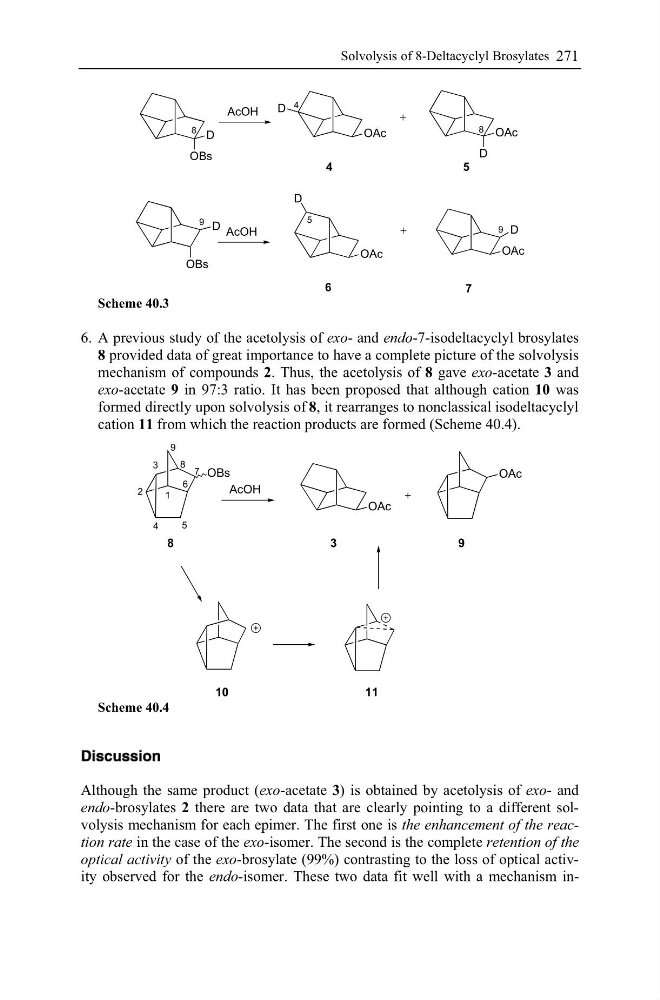
6. A previous study of the acetolysis of exo- and endo-7-isodeltacyclyl brosylates
8 provided data of great importance to have a complete picture of the solvolysis
a a
mechanism of compounds 2. Thus, the acetolysis of 8 gave exo-acetate 3 and
exo-acetate 9 in 97:3 ratio. It has been proposed that although cation 10 was
formed directly upon solvolysis of 8, it rearranges to nonclassical isodeltacyclyl
cation 11 from which the reaction products are formed (Scheme 40.4).
AcOH
OAc
OAc
8
6
2
9
3
10
11
7 7
8
9
4
3
5
1
Scheme 40.4
D Di is sc cu us ss si io on n
Although the same product (exo-acetate 3) is obtained by acetolysis of exo- and
endo-brosylates 2 there are two data that are clearly pointing to a different solvolysis mechanism for each epimer. The first one is the enhancement of the reaction rate in the case of the exo-isomer. The second is the complete retention of the
optical activity of the exo-brosylate (99%) contrasting to the loss of optical activity observed for the endo-isomer. These two data fit well with a mechanism in-
AcOH
OAc
D
AcOH
OAc
D
OAc
D
OAc
D
4
5
7
6
4
8
9
5
D
OBs
OBs
D
8
9
Scheme 40.3
6. A previous study of the acetolysis of exo- and endo-7-isodeltacyclyl brosylates
8 provided data of great importance to have a complete picture of the solvolysis
a a
mechanism of compounds 2. Thus, the acetolysis of 8 gave exo-acetate 3 and
exo-acetate 9 in 97:3 ratio. It has been proposed that although cation 10 was
formed directly upon solvolysis of 8, it rearranges to nonclassical isodeltacyclyl
cation 11 from which the reaction products are formed (Scheme 40.4).
AcOH
OAc
OAc
8
6
2
9
3
10
11
7 7
8
9
4
3
5
1
Scheme 40.4
D Di is sc cu us ss si io on n
Although the same product (exo-acetate 3) is obtained by acetolysis of exo- and
endo-brosylates 2 there are two data that are clearly pointing to a different solvolysis mechanism for each epimer. The first one is the enhancement of the reaction rate in the case of the exo-isomer. The second is the complete retention of the
optical activity of the exo-brosylate (99%) contrasting to the loss of optical activity observed for the endo-isomer. These two data fit well with a mechanism in-