

Substitution of E-Halostyrenes by MeS
– 255
Nu u u
Nu
Nu
maximum
hyperconjugation
zero
hyperconjugation
A
B
Scheme 38.6
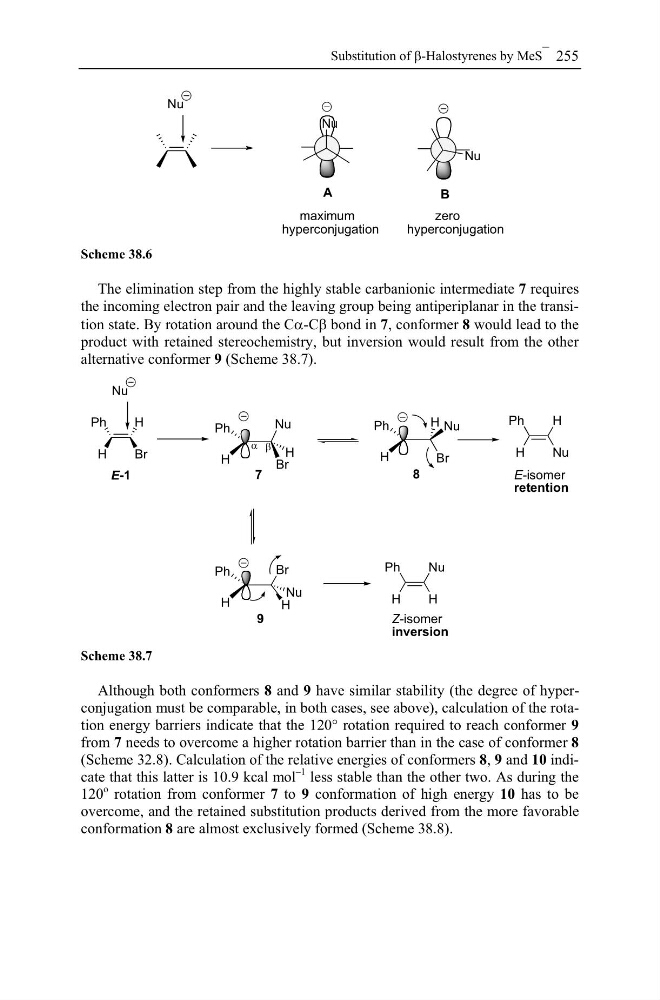
The elimination step from the highly stable carbanionic intermediate 7 requires
the incoming electron pair and the leaving group being antiperiplanar in the transition state. By rotation around the CD-CE bond in 7, conformer 8 would lead to the
product with retained stereochemistry, but inversion would result from the other
alternative conformer 9 (Scheme 38.7).
Nu
H
Br
Ph
H
H
Br
Ph
H
Nu
H
Ph
Br
H
Nu
H
H
Ph
Nu
H
Ph
Br
Nu
H
H
Nu
Ph
H
E-1 E E
E-isomer E E
retention
Z-isomer
inversion
D E
7
9
8
Scheme 38.7
Although both conformers 8 and 9 have similar stability (the degree of hyperconjugation must be comparable, in both cases, see above), calculation of the rotation energy barriers indicate that the 120° rotation required to reach conformer 9
from 7 needs to overcome a higher rotation barrier than in the case of conformer 8
(Scheme 32.8). Calculation of the relative energies of conformers 8, 9 and 10 indicate that this latter is 10.9 kcal mol
–1 less stable than the other two. As during the
120
o rotation from conformer 7 to 9 conformation of high energy 10 has to be
overcome, and the retained substitution products derived from the more favorable
conformation 8 are almost exclusively formed (Scheme 38.8).
– 255
Nu u u
Nu
Nu
maximum
hyperconjugation
zero
hyperconjugation
A
B
Scheme 38.6
The elimination step from the highly stable carbanionic intermediate 7 requires
the incoming electron pair and the leaving group being antiperiplanar in the transition state. By rotation around the CD-CE bond in 7, conformer 8 would lead to the
product with retained stereochemistry, but inversion would result from the other
alternative conformer 9 (Scheme 38.7).
Nu
H
Br
Ph
H
H
Br
Ph
H
Nu
H
Ph
Br
H
Nu
H
H
Ph
Nu
H
Ph
Br
Nu
H
H
Nu
Ph
H
E-1 E E
E-isomer E E
retention
Z-isomer
inversion
D E
7
9
8
Scheme 38.7
Although both conformers 8 and 9 have similar stability (the degree of hyperconjugation must be comparable, in both cases, see above), calculation of the rotation energy barriers indicate that the 120° rotation required to reach conformer 9
from 7 needs to overcome a higher rotation barrier than in the case of conformer 8
(Scheme 32.8). Calculation of the relative energies of conformers 8, 9 and 10 indicate that this latter is 10.9 kcal mol
–1 less stable than the other two. As during the
120
o rotation from conformer 7 to 9 conformation of high energy 10 has to be
overcome, and the retained substitution products derived from the more favorable
conformation 8 are almost exclusively formed (Scheme 38.8).