

Level 3 – Case 38
254
H
Br
Ph
H
PhC CH
MeS
PhC CHSMe
H
H
SMe
Ph
H
- HBr
elimination-addition
E-1
5
Z+E-2
elimination step
addition step
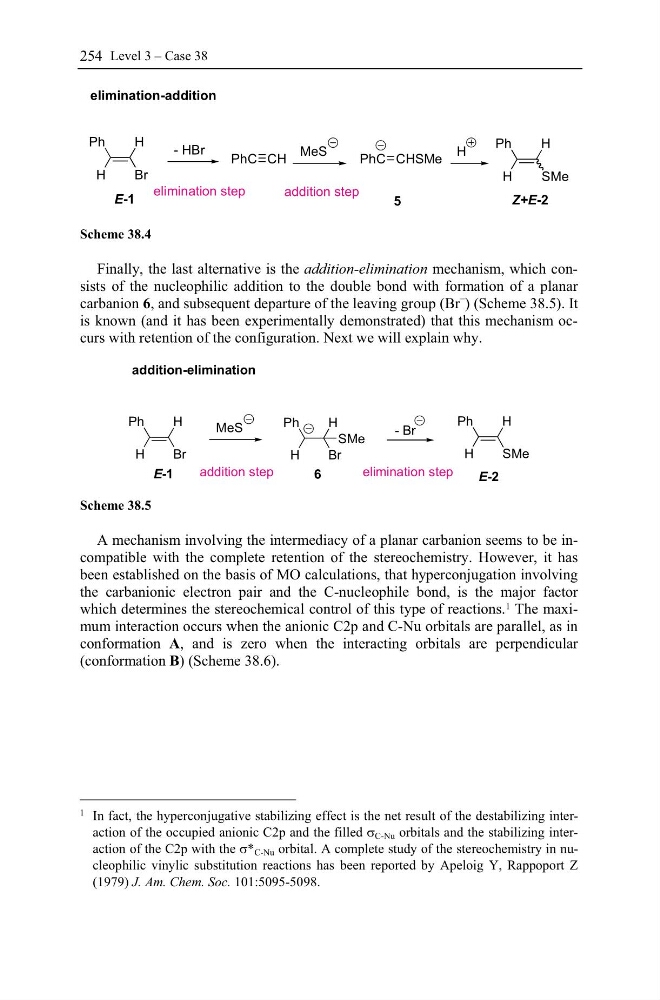
Scheme 38.4
Finally, the last alternative is the addition-elimination mechanism, which consists of the nucleophilic addition to the double bond with formation of a planar
carbanion 6, and subsequent departure of the leaving group (Br
–
) (Scheme 38.5). It
is known (and it has been experimentally demonstrated) that this mechanism occurs with retention of the configuration. Next we will explain why.
MeS
H
Br
Ph
H
H
Br
Ph
H
SMe
H
SMe
Ph
H
- Br
addition-elimination
E-1 E E
6
E-2
addition step
elimination step
Scheme 38.5
A mechanism involving the intermediacy of a planar carbanion seems to be inf
compatible with the complete retention of the stereochemistry. However, it has
been established on the basis of MO calculations, that hyperconjugation involving
the carbanionic electron pair and the C-nucleophile bond, is the major factor
which determines the stereochemical control of this type of reactions.
1 The maximum interaction occurs when the anionic C2p and C-Nu orbitals are parallel, as in
conformation A, and is zero when the interacting orbitals are perpendicular
(conformation B) (Scheme 38.6).
1 In fact, the hyperconjugative stabilizing effect is the net result of the destabilizing interaction of the occupied anionic C2p and the filled V C-Nu orbitals and the stabilizing interaction of the C2p with the V* C-Nu orbital. A complete study of the stereochemistry in nucleophilic vinylic substitution reactions has been reported by Apeloig Y, Rappoport Z
(1979) J. Am. Chem. Soc. 101:5095-5098.
254
H
Br
Ph
H
PhC CH
MeS
PhC CHSMe
H
H
SMe
Ph
H
- HBr
elimination-addition
E-1
5
Z+E-2
elimination step
addition step
Scheme 38.4
Finally, the last alternative is the addition-elimination mechanism, which consists of the nucleophilic addition to the double bond with formation of a planar
carbanion 6, and subsequent departure of the leaving group (Br
–
) (Scheme 38.5). It
is known (and it has been experimentally demonstrated) that this mechanism occurs with retention of the configuration. Next we will explain why.
MeS
H
Br
Ph
H
H
Br
Ph
H
SMe
H
SMe
Ph
H
- Br
addition-elimination
E-1 E E
6
E-2
addition step
elimination step
Scheme 38.5
A mechanism involving the intermediacy of a planar carbanion seems to be inf
compatible with the complete retention of the stereochemistry. However, it has
been established on the basis of MO calculations, that hyperconjugation involving
the carbanionic electron pair and the C-nucleophile bond, is the major factor
which determines the stereochemical control of this type of reactions.
1 The maximum interaction occurs when the anionic C2p and C-Nu orbitals are parallel, as in
conformation A, and is zero when the interacting orbitals are perpendicular
(conformation B) (Scheme 38.6).
1 In fact, the hyperconjugative stabilizing effect is the net result of the destabilizing interaction of the occupied anionic C2p and the filled V C-Nu orbitals and the stabilizing interaction of the C2p with the V* C-Nu orbital. A complete study of the stereochemistry in nucleophilic vinylic substitution reactions has been reported by Apeloig Y, Rappoport Z
(1979) J. Am. Chem. Soc. 101:5095-5098.