

Substitution of E-Halostyrenes by MeS
– 253
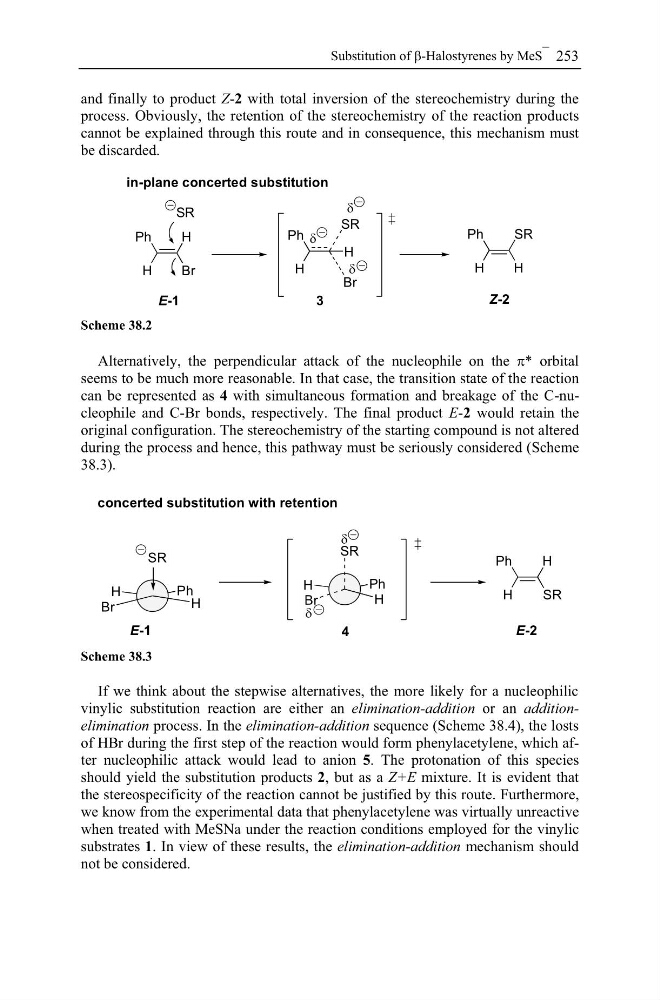
and finally to product Z- Z Z 2 with total inversion of the stereochemistry during the
process. Obviously, the retention of the stereochemistry of the reaction products
cannot be explained through this route and in consequence, this mechanism must
be discarded.
H
Br
Ph
H
SR
H
Br
Ph
SR
H
H
H
Ph
SR
G
G
in-plane concerted substitution
E-1
3
Z-2
G
Scheme 38.2
Alternatively, the perpendicular attack of the nucleophile on the S* orbital
seems to be much more reasonable. In that case, the transition state of the reaction
t
can be represented as 4 with simultaneous formation and breakage of the C-nucleophile and C-Br bonds, respectively. The final product E-2 would retain the
original configuration. The stereochemistry of the starting compound is not altered
during the process and hence, this pathway must be seriously considered (Scheme
38.3).
H
SR
Ph
H
G
G
concerted substitution with retention
E-1
4
E-2
H
Ph
SR
H
Br r
H
Ph
SR
H
Br
Scheme 38.3
If we think about the stepwise alternatives, the more likely for a nucleophilic
vinylic substitution reaction are either an elimination-addition or an additionelimination process. In the elimination-addition sequence (Scheme 38.4), the losts
of HBr during the first step of the reaction would form phenylacetylene, which after nucleophilic attack would lead to anion 5. The protonation of this species
should yield the substitution products 2, but as a Z+E mixture. It is evident that
E
the stereospecificity of the reaction cannot be justified by this route. Furthermore,
we know from the experimental data that phenylacetylene was virtually unreactive
when treated with MeSNa under the reaction conditions employed for the vinylic
substrates 1. In view of these results, the elimination-addition mechanism should
not be considered.
– 253
and finally to product Z- Z Z 2 with total inversion of the stereochemistry during the
process. Obviously, the retention of the stereochemistry of the reaction products
cannot be explained through this route and in consequence, this mechanism must
be discarded.
H
Br
Ph
H
SR
H
Br
Ph
SR
H
H
H
Ph
SR
G
G
in-plane concerted substitution
E-1
3
Z-2
G
Scheme 38.2
Alternatively, the perpendicular attack of the nucleophile on the S* orbital
seems to be much more reasonable. In that case, the transition state of the reaction
t
can be represented as 4 with simultaneous formation and breakage of the C-nucleophile and C-Br bonds, respectively. The final product E-2 would retain the
original configuration. The stereochemistry of the starting compound is not altered
during the process and hence, this pathway must be seriously considered (Scheme
38.3).
H
SR
Ph
H
G
G
concerted substitution with retention
E-1
4
E-2
H
Ph
SR
H
Br r
H
Ph
SR
H
Br
Scheme 38.3
If we think about the stepwise alternatives, the more likely for a nucleophilic
vinylic substitution reaction are either an elimination-addition or an additionelimination process. In the elimination-addition sequence (Scheme 38.4), the losts
of HBr during the first step of the reaction would form phenylacetylene, which after nucleophilic attack would lead to anion 5. The protonation of this species
should yield the substitution products 2, but as a Z+E mixture. It is evident that
E
the stereospecificity of the reaction cannot be justified by this route. Furthermore,
we know from the experimental data that phenylacetylene was virtually unreactive
when treated with MeSNa under the reaction conditions employed for the vinylic
substrates 1. In view of these results, the elimination-addition mechanism should
not be considered.