

Level 3 – Case 38
252
E Ex xp pe er ri im me en nt ta al l D Da at ta a
1. The reactions in HMPA (hexamethylphosphoramide) were very fast (only took
a few minutes). Similar stereoselectivities and yields were obtained when the
reactions were carried out in DMSO or DMF. However, the reaction rates der
creased when mixtures of DMSO:CHCl 3 were used.
2. Reactions carried out with mixtures Z-1/E- / / 1 demonstrated that the Z-isomer reZ Z
acted faster than the E-isomer: k (
k Z- Z Z 1)/k (
k E-1) = 2.6 ± 0.1. Similar results were
observed when mixtures of the corresponding Z- and
Z Z
E-chlorides were employed.
3. The effect of the halogen on the rate-determining step of the reaction (element
effect) was established by comparison of the
t t
Z-Br and
Z Z
Z-Cl reaction rates in
Z Z
DMSO-d 6
d d :CD 3 OD mixtures. The reaction times increase considerably with the
addition of CD 3 OD to the reaction mixtures (Table 38.1).
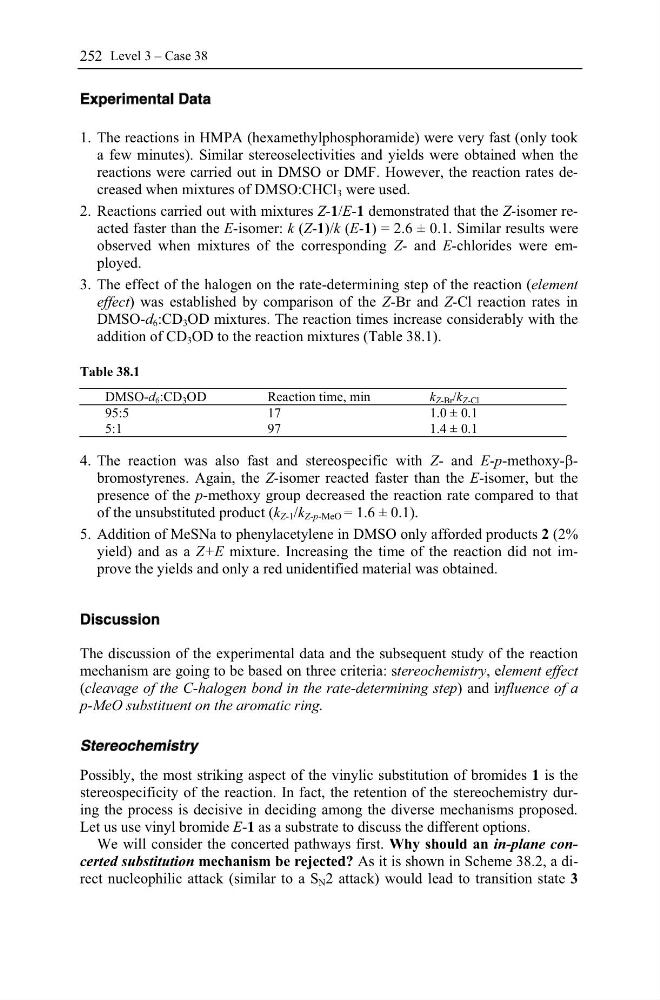
Table 38.1
DMSO-d 6
d d :CD 3 OD
Reaction time, min
k Z
k -Br
Z Z /
r r k Z
k -Cl
Z Z
95:5
17
1.0 ± 0.1
5:1
97
1.4 ± 0.1
4. The reaction was also fast and stereospecific with Z- and
Z Z
E-p - -methoxy-Ebromostyrenes. Again, the Z-isomer reacted faster than the
Z Z
E-isomer, but the
presence of the p-methoxy group decreased the reaction rate compared to that
of the unsubstituted product (k Z
k -1
Z Z /k Z
k -
Z Z p
- -MeO = 1.6 ± 0.1).
5. Addition of MeSNa to phenylacetylene in DMSO only afforded products
f f
2 (2%
yield) and as a Z+E mixture. Increasing the time of the reaction did not imE
prove the yields and only a red unidentified material was obtained.
D Di is sc cu us ss si io on n
The discussion of the experimental data and the subsequent study of the reaction
mechanism are going to be based on three criteria: stereochemistry, element effect
(cleavage of the C-halogen bond in the rate-determining step
d
) and influence of a
p-MeO substituent on the aromatic ring.
S St te te t te te te te t ter re re r re re re re r reo oc ch he em mi is is i is i is is i i t tr t tr tr tr tr t t y
ry ry y
Possibly, the most striking aspect of the vinylic substitution of bromides 1 is the
stereospecificity of the reaction. In fact, the retention of the stereochemistry during the process is decisive in deciding among the diverse mechanisms proposed.
Let us use vinyl bromide E-1 as a substrate to discuss the different options.
We will consider the concerted pathways first. Why should an in-plane concerted substitution mechanism be rejected? As it is shown in Scheme 38.2, a direct nucleophilic attack (similar to a S N 2 attack) would lead to transition state 3
252
E Ex xp pe er ri im me en nt ta al l D Da at ta a
1. The reactions in HMPA (hexamethylphosphoramide) were very fast (only took
a few minutes). Similar stereoselectivities and yields were obtained when the
reactions were carried out in DMSO or DMF. However, the reaction rates der
creased when mixtures of DMSO:CHCl 3 were used.
2. Reactions carried out with mixtures Z-1/E- / / 1 demonstrated that the Z-isomer reZ Z
acted faster than the E-isomer: k (
k Z- Z Z 1)/k (
k E-1) = 2.6 ± 0.1. Similar results were
observed when mixtures of the corresponding Z- and
Z Z
E-chlorides were employed.
3. The effect of the halogen on the rate-determining step of the reaction (element
effect) was established by comparison of the
t t
Z-Br and
Z Z
Z-Cl reaction rates in
Z Z
DMSO-d 6
d d :CD 3 OD mixtures. The reaction times increase considerably with the
addition of CD 3 OD to the reaction mixtures (Table 38.1).
Table 38.1
DMSO-d 6
d d :CD 3 OD
Reaction time, min
k Z
k -Br
Z Z /
r r k Z
k -Cl
Z Z
95:5
17
1.0 ± 0.1
5:1
97
1.4 ± 0.1
4. The reaction was also fast and stereospecific with Z- and
Z Z
E-p - -methoxy-Ebromostyrenes. Again, the Z-isomer reacted faster than the
Z Z
E-isomer, but the
presence of the p-methoxy group decreased the reaction rate compared to that
of the unsubstituted product (k Z
k -1
Z Z /k Z
k -
Z Z p
- -MeO = 1.6 ± 0.1).
5. Addition of MeSNa to phenylacetylene in DMSO only afforded products
f f
2 (2%
yield) and as a Z+E mixture. Increasing the time of the reaction did not imE
prove the yields and only a red unidentified material was obtained.
D Di is sc cu us ss si io on n
The discussion of the experimental data and the subsequent study of the reaction
mechanism are going to be based on three criteria: stereochemistry, element effect
(cleavage of the C-halogen bond in the rate-determining step
d
) and influence of a
p-MeO substituent on the aromatic ring.
S St te te t te te te te t ter re re r re re re re r reo oc ch he em mi is is i is i is is i i t tr t tr tr tr tr t t y
ry ry y
Possibly, the most striking aspect of the vinylic substitution of bromides 1 is the
stereospecificity of the reaction. In fact, the retention of the stereochemistry during the process is decisive in deciding among the diverse mechanisms proposed.
Let us use vinyl bromide E-1 as a substrate to discuss the different options.
We will consider the concerted pathways first. Why should an in-plane concerted substitution mechanism be rejected? As it is shown in Scheme 38.2, a direct nucleophilic attack (similar to a S N 2 attack) would lead to transition state 3