

L Le ev ve el l 3 3 C Ca as se e 3 38 8
S Su ub bs st ti it tu ut ti io on n o of f E E- -H Ha al lo os st ty yr re en ne es s b by y M Me eS S
K Ke ey y p po oi in nt t: : C Co on nc ce er rt t t
r rte te t te te te te t ted d v ve ve v ve ve ve ve v ver rs rs r rs rs rs rs r r u us s s st te te t te te te te t tep ep ep pw wi wi wi w wi wi w wis is i is is is i i e e m me ec ch ha an ni is is i is is is i i m m
H
Br
Ph
H
RS
-
HMPA
H
SR
Ph
H
stereospecific
S Su ub bs st ti it tu ut ti io on n o of f E E- -H Ha al lo os st ty yr re en ne es s b by y M Me eS S
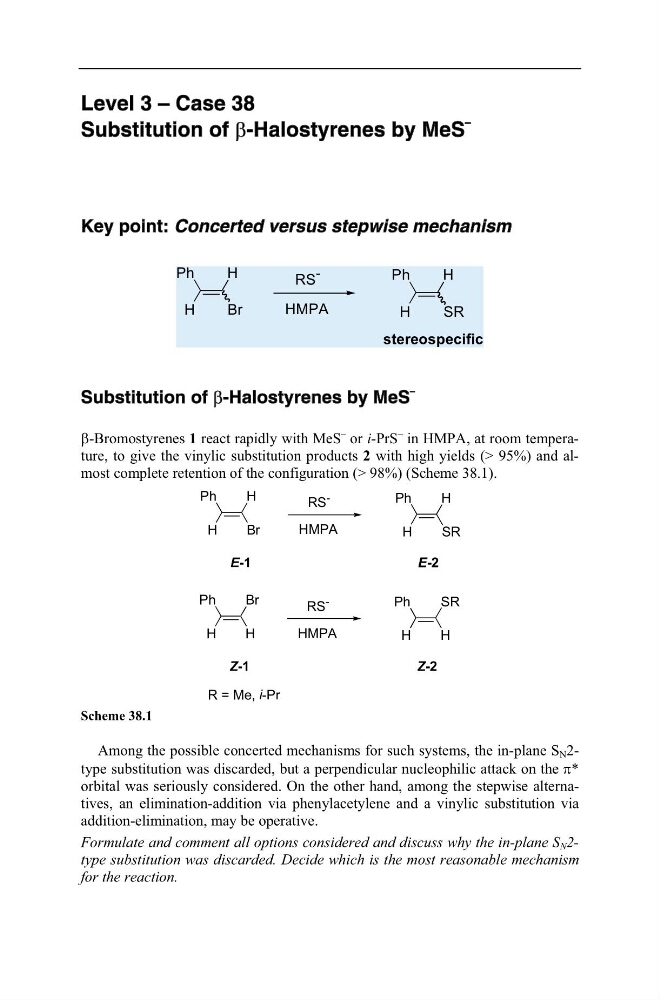
E-Bromostyrenes 1 react rapidly with MeS
– or i-PrS
– in HMPA, at room tempera–
ture, to give the vinylic substitution products 2 with high yields (> 95%) and almost complete retention of the configuration (> 98%) (Scheme 38.1).
H
Br
Ph
H
RS -
HMPA
H
H
Ph
Br
RS
-
HMPA
H
H
Ph
SR
H
SR
Ph
H
E-1 E E
E-2
Z-1 Z Z
Z-2 Z Z
R = Me, i-Pr i i
Scheme 38.1
Among the possible concerted mechanisms for such systems, the in-plane S N 2type substitution was discarded, but a perpendicular nucleophilic attack on the S*
orbital was seriously considered. On the other hand, among the stepwise alternatives, an elimination-addition via phenylacetylene and a vinylic substitution via
addition-elimination, may be operative.
Formulate and comment all options considered and discuss why the in-plane S N
S 2N N
type substitution was discarded. Decide which is the most reasonable mechanism
for the reaction.
S Su ub bs st ti it tu ut ti io on n o of f E E- -H Ha al lo os st ty yr re en ne es s b by y M Me eS S
K Ke ey y p po oi in nt t: : C Co on nc ce er rt t t
r rte te t te te te te t ted d v ve ve v ve ve ve ve v ver rs rs r rs rs rs rs r r u us s s st te te t te te te te t tep ep ep pw wi wi wi w wi wi w wis is i is is is i i e e m me ec ch ha an ni is is i is is is i i m m
H
Br
Ph
H
RS
-
HMPA
H
SR
Ph
H
stereospecific
S Su ub bs st ti it tu ut ti io on n o of f E E- -H Ha al lo os st ty yr re en ne es s b by y M Me eS S
E-Bromostyrenes 1 react rapidly with MeS
– or i-PrS
– in HMPA, at room tempera–
ture, to give the vinylic substitution products 2 with high yields (> 95%) and almost complete retention of the configuration (> 98%) (Scheme 38.1).
H
Br
Ph
H
RS -
HMPA
H
H
Ph
Br
RS
-
HMPA
H
H
Ph
SR
H
SR
Ph
H
E-1 E E
E-2
Z-1 Z Z
Z-2 Z Z
R = Me, i-Pr i i
Scheme 38.1
Among the possible concerted mechanisms for such systems, the in-plane S N 2type substitution was discarded, but a perpendicular nucleophilic attack on the S*
orbital was seriously considered. On the other hand, among the stepwise alternatives, an elimination-addition via phenylacetylene and a vinylic substitution via
addition-elimination, may be operative.
Formulate and comment all options considered and discuss why the in-plane S N
S 2N N
type substitution was discarded. Decide which is the most reasonable mechanism
for the reaction.