

Level 3 – Case 38
256
Ph
H
Br
Nu N N N
H
7
60 o
Ph
H
Br
Nu
H
8
H
Br
Nu u u u
H
7
60 o
Ph
Nu
H
Br
H
10
Nu
H
Br r
H
9
60 o
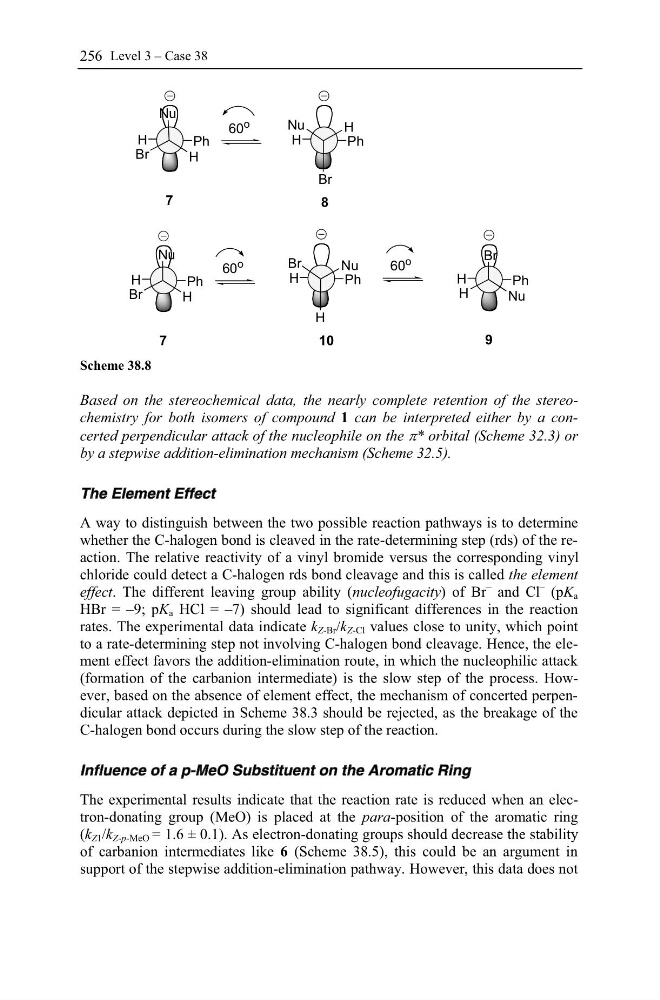
Scheme 38.8
Based on the stereochemical data, the nearly complete retention of the stereochemistry for both isomers of compound 1 can be interpreted either by a concerted perpendicular attack of the nucleophile on the S* orbital (Scheme 32.3) or
by a stepwise addition-elimination mechanism (Scheme 32.5).
T Th T Th Th Th Th T T e e E El E El El E El E E e
le l le le le l lem me en nt t E Ef Ef Ef E Ef E E f
f ff ff ff ff f ff f f f e
fe f fe f fe fe f fec ct t
A way to distinguish between the two possible reaction pathways is to determine
whether the C-halogen bond is cleaved in the rate-determining step (rds) of the reaction. The relative reactivity of a vinyl bromide versus the corresponding vinyl
chloride could detect a C-halogen rds bond cleavage and this is called the element
effect. The different leaving group ability (nucleofugacity) of Br
– and Cl
–
– (p
–
K a
K K
HBr = –9; pK a
K K HCl = –7) should lead to significant differences in the reaction
rates. The experimental data indicate k Z
k -Br
Z Z /
r r k Z
k -Cl
Z Z
values close to unity, which point
to a rate-determining step not involving C-halogen bond cleavage. Hence, the element effect favors the addition-elimination route, in which the nucleophilic attack
(formation of the carbanion intermediate) is the slow step of the process. However, based on the absence of element effect, the mechanism of
f f
concerted perpenf
dicular attack depicted in Scheme 38.3 should be rejected, as the breakage of the
C-halogen bond occurs during the slow step of the reaction.
I In I In I In In I I f fl f fl fl f fl f f u ue en nc ce e o of f a a p p- -M Me Me M Me Me Me M MeO O S Su ub b b
ubs st ti ti ti t ti ti t tit itu u
tue en nt t o on n t th t th th th th t t e e A Ar ro ro r ro ro ro ro r rom ma at ti ti ti t ti ti t tic ic ic ic i i R Ri i i
Rin i in in in i i g g
The experimental results indicate that the reaction rate is reduced when an electron-donating group (MeO) is placed at the para-position of the aromatic ring
(k Z
k 1 /k Z
k -
Z Z p
- -MeO = 1.6 ± 0.1). As electron-donating groups should decrease the stability
of carbanion intermediates like 6 (Scheme 38.5), this could be an argument in
support of the stepwise addition-elimination pathway. However, this data does not
256
Ph
H
Br
Nu N N N
H
7
60 o
Ph
H
Br
Nu
H
8
H
Br
Nu u u u
H
7
60 o
Ph
Nu
H
Br
H
10
Nu
H
Br r
H
9
60 o
Scheme 38.8
Based on the stereochemical data, the nearly complete retention of the stereochemistry for both isomers of compound 1 can be interpreted either by a concerted perpendicular attack of the nucleophile on the S* orbital (Scheme 32.3) or
by a stepwise addition-elimination mechanism (Scheme 32.5).
T Th T Th Th Th Th T T e e E El E El El E El E E e
le l le le le l lem me en nt t E Ef Ef Ef E Ef E E f
f ff ff ff ff f ff f f f e
fe f fe f fe fe f fec ct t
A way to distinguish between the two possible reaction pathways is to determine
whether the C-halogen bond is cleaved in the rate-determining step (rds) of the reaction. The relative reactivity of a vinyl bromide versus the corresponding vinyl
chloride could detect a C-halogen rds bond cleavage and this is called the element
effect. The different leaving group ability (nucleofugacity) of Br
– and Cl
–
– (p
–
K a
K K
HBr = –9; pK a
K K HCl = –7) should lead to significant differences in the reaction
rates. The experimental data indicate k Z
k -Br
Z Z /
r r k Z
k -Cl
Z Z
values close to unity, which point
to a rate-determining step not involving C-halogen bond cleavage. Hence, the element effect favors the addition-elimination route, in which the nucleophilic attack
(formation of the carbanion intermediate) is the slow step of the process. However, based on the absence of element effect, the mechanism of
f f
concerted perpenf
dicular attack depicted in Scheme 38.3 should be rejected, as the breakage of the
C-halogen bond occurs during the slow step of the reaction.
I In I In I In In I I f fl f fl fl f fl f f u ue en nc ce e o of f a a p p- -M Me Me M Me Me Me M MeO O S Su ub b b
ubs st ti ti ti t ti ti t tit itu u
tue en nt t o on n t th t th th th th t t e e A Ar ro ro r ro ro ro ro r rom ma at ti ti ti t ti ti t tic ic ic ic i i R Ri i i
Rin i in in in i i g g
The experimental results indicate that the reaction rate is reduced when an electron-donating group (MeO) is placed at the para-position of the aromatic ring
(k Z
k 1 /k Z
k -
Z Z p
- -MeO = 1.6 ± 0.1). As electron-donating groups should decrease the stability
of carbanion intermediates like 6 (Scheme 38.5), this could be an argument in
support of the stepwise addition-elimination pathway. However, this data does not