

Level 3 – Case 35
234
Ph
H
D
IPh BF 4
AcOH
Ph
H
D
O
IPh
Ac
H
Ph
H
OAc
D
PhI
5
D
6Z
D
9
minor isomer
G
G
Scheme 35.6
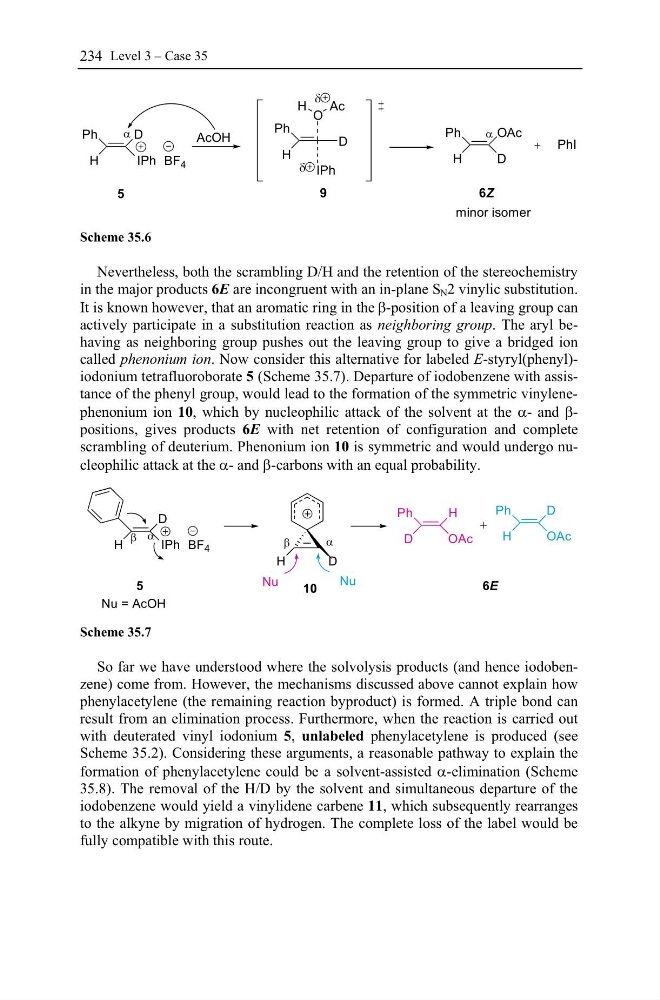
Nevertheless, both the scrambling D/H and the retention of the stereochemistry
in the major products 6E are incongruent with an in-plane S
E
N 2 vinylic substitution.
It is known however, that an aromatic ring in the E-position of a leaving group can
actively participate in a substitution reaction as neighboring group. The aryl behaving as neighboring group pushes out the leaving group to give a bridged ion
called phenonium ion. Now consider this alternative for labeled E-styryl(phenyl)iodonium tetrafluoroborate 5 (Scheme 35.7). Departure of iodobenzene with assistance of the phenyl group, would lead to the formation of the symmetric vinylenephenonium ion 10, which by nucleophilic attack of the solvent at the D- and Epositions, gives products 6E with net retention of configuration and complete
E
scrambling of deuterium. Phenonium ion 10 is symmetric and would undergo nucleophilic attack at the D- and E-carbons with an equal probability.
H
D
IPh BF 4
D
H
Ph
D
H
OAc
Ph
H
D
OAc
5
Nu
Nu
Nu = AcOH
6E
10
D
D D
E
E
Scheme 35.7
So far we have understood where the solvolysis products (and hence iodobenzene) come from. However, the mechanisms discussed above cannot explain how
phenylacetylene (the remaining reaction byproduct) is formed. A triple bond can
result from an elimination process. Furthermore, when the reaction is carried out
with deuterated vinyl iodonium 5, unlabeled phenylacetylene is produced (see
Scheme 35.2). Considering these arguments, a reasonable pathway to explain the
formation of phenylacetylene could be a solvent-assisted D-elimination (Scheme
35.8). The removal of the H/D by the solvent and simultaneous departure of the
iodobenzene would yield a vinylidene carbene 11, which subsequently rearranges
to the alkyne by migration of hydrogen. The complete loss of the label would be
fully compatible with this route.
234
Ph
H
D
IPh BF 4
AcOH
Ph
H
D
O
IPh
Ac
H
Ph
H
OAc
D
PhI
5
D
6Z
D
9
minor isomer
G
G
Scheme 35.6
Nevertheless, both the scrambling D/H and the retention of the stereochemistry
in the major products 6E are incongruent with an in-plane S
E
N 2 vinylic substitution.
It is known however, that an aromatic ring in the E-position of a leaving group can
actively participate in a substitution reaction as neighboring group. The aryl behaving as neighboring group pushes out the leaving group to give a bridged ion
called phenonium ion. Now consider this alternative for labeled E-styryl(phenyl)iodonium tetrafluoroborate 5 (Scheme 35.7). Departure of iodobenzene with assistance of the phenyl group, would lead to the formation of the symmetric vinylenephenonium ion 10, which by nucleophilic attack of the solvent at the D- and Epositions, gives products 6E with net retention of configuration and complete
E
scrambling of deuterium. Phenonium ion 10 is symmetric and would undergo nucleophilic attack at the D- and E-carbons with an equal probability.
H
D
IPh BF 4
D
H
Ph
D
H
OAc
Ph
H
D
OAc
5
Nu
Nu
Nu = AcOH
6E
10
D
D D
E
E
Scheme 35.7
So far we have understood where the solvolysis products (and hence iodobenzene) come from. However, the mechanisms discussed above cannot explain how
phenylacetylene (the remaining reaction byproduct) is formed. A triple bond can
result from an elimination process. Furthermore, when the reaction is carried out
with deuterated vinyl iodonium 5, unlabeled phenylacetylene is produced (see
Scheme 35.2). Considering these arguments, a reasonable pathway to explain the
formation of phenylacetylene could be a solvent-assisted D-elimination (Scheme
35.8). The removal of the H/D by the solvent and simultaneous departure of the
iodobenzene would yield a vinylidene carbene 11, which subsequently rearranges
to the alkyne by migration of hydrogen. The complete loss of the label would be
fully compatible with this route.