

Solvolysis of Vinyl Iodonium Salts 235
Ph
H
D
IPh BF 4
Ph
H
C
PhC CH
5
Nu
11
Scheme 35.8
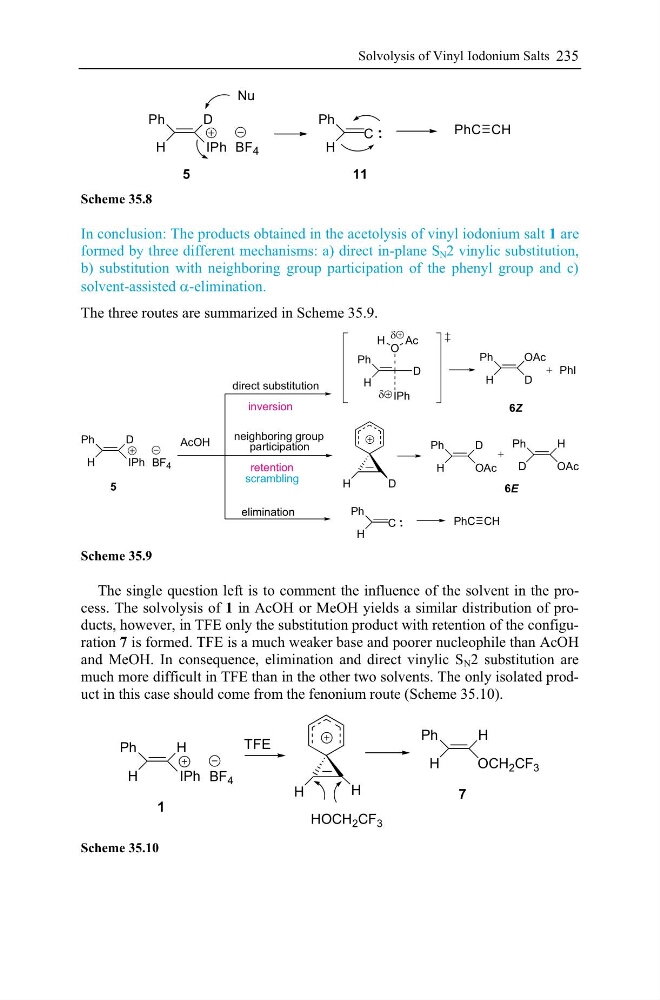
In conclusion: The products obtained in the acetolysis of vinyl iodonium salt 1 are
formed by three different mechanisms: a) direct in-plane S N 2 vinylic substitution,
b) substitution with neighboring group participation of the phenyl group and c)
solvent-assisted D-elimination.
The three routes are summarized in Scheme 35.9.
Ph
H
OAc
D
Ph
H
D
IPh BF 4
AcOH
Ph
H
D
H
Ph
H
D
O
IPh
Ac
H
C
Ph
H
D
OAc
PhC CH
Ph
D
H
OAc
PhI
5
G
6Z
6E
elimination
direct substitution
inversion
retention
scrambling
neighboring group
participation
G
Scheme 35.9
The single question left is to comment the influence of the solvent in the process. The solvolysis of 1 in AcOH or MeOH yields a similar distribution of products, however, in TFE only the substitution product with retention of the configuration 7 is formed. TFE is a much weaker base and poorer nucleophile than AcOH
and MeOH. In consequence, elimination and direct vinylic S N 2 substitution are
much more difficult in TFE than in the other two solvents. The only isolated product in this case should come from the fenonium route (Scheme 35.10).
Ph
H
H
IPh
H
H
BF 4
HOCH 2 CF 3
Ph
H
H
OCH 2 CF 3
1
TFE
7
Scheme 35.10
Ph
H
D
IPh BF 4
Ph
H
C
PhC CH
5
Nu
11
Scheme 35.8
In conclusion: The products obtained in the acetolysis of vinyl iodonium salt 1 are
formed by three different mechanisms: a) direct in-plane S N 2 vinylic substitution,
b) substitution with neighboring group participation of the phenyl group and c)
solvent-assisted D-elimination.
The three routes are summarized in Scheme 35.9.
Ph
H
OAc
D
Ph
H
D
IPh BF 4
AcOH
Ph
H
D
H
Ph
H
D
O
IPh
Ac
H
C
Ph
H
D
OAc
PhC CH
Ph
D
H
OAc
PhI
5
G
6Z
6E
elimination
direct substitution
inversion
retention
scrambling
neighboring group
participation
G
Scheme 35.9
The single question left is to comment the influence of the solvent in the process. The solvolysis of 1 in AcOH or MeOH yields a similar distribution of products, however, in TFE only the substitution product with retention of the configuration 7 is formed. TFE is a much weaker base and poorer nucleophile than AcOH
and MeOH. In consequence, elimination and direct vinylic S N 2 substitution are
much more difficult in TFE than in the other two solvents. The only isolated product in this case should come from the fenonium route (Scheme 35.10).
Ph
H
H
IPh
H
H
BF 4
HOCH 2 CF 3
Ph
H
H
OCH 2 CF 3
1
TFE
7
Scheme 35.10