

Solvolysis of Vinyl Iodonium Salts 233
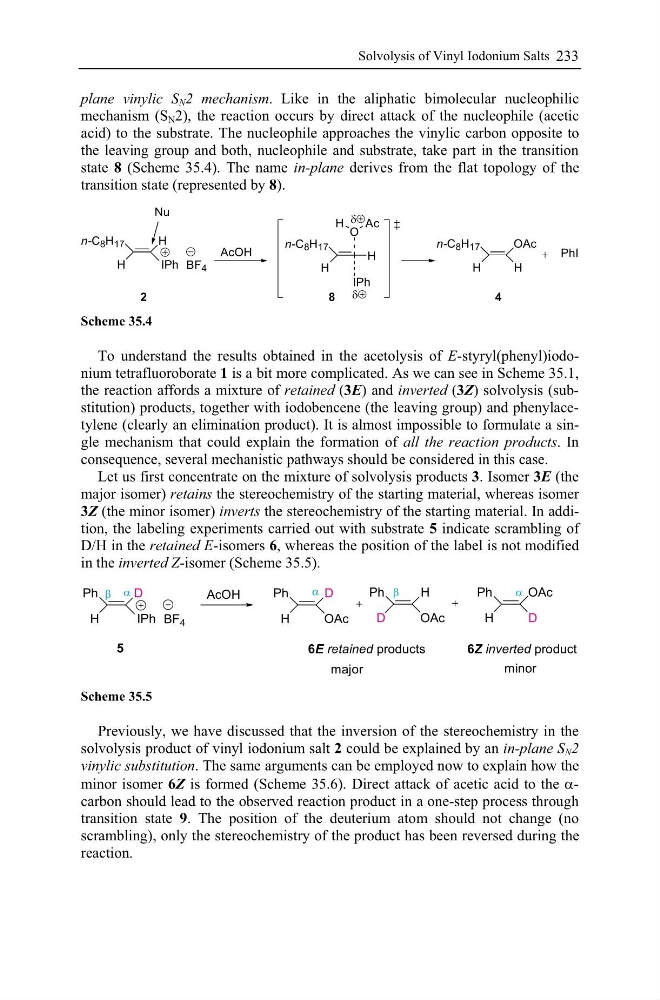
plane vinylic S N
S 2
N N
mechanism. Like in the aliphatic bimolecular nucleophilic
mechanism (S N 2), the reaction occurs by direct attack of the nucleophile (acetic
acid) to the substrate. The nucleophile approaches the vinylic carbon opposite to
the leaving group and both, nucleophile and substrate, take part in the transition
state 8 (Scheme 35.4). The name in-plane derives from the flat topology of the
transition state (represented by 8).
n-C 8 H 17
H
H
IPh BF 4
AcOH
n-C 8 H 17
H
H
O
IPh
Ac
H
n-C 8 H 17
H
OAc
H
PhI
G
8
Nu
2
4
G
Scheme 35.4
To understand the results obtained in the acetolysis of E-styryl(phenyl)iodonium tetrafluoroborate 1 is a bit more complicated. As we can see in Scheme 35.1,
the reaction affords a mixture of retained (
d 3E) and inverted (
d 3Z) solvolysis (subZ Z
stitution) products, together with iodobencene (the leaving group) and phenylacetylene (clearly an elimination product). It is almost impossible to formulate a single mechanism that could explain the formation of all the reaction products. In
consequence, several mechanistic pathways should be considered in this case.
Let us first concentrate on the mixture of solvolysis products 3. Isomer 3E (the
E
major isomer) retains the stereochemistry of the starting material, whereas isomer
3Z (the minor isomer)
Z
inverts the stereochemistry of the starting material. In addition, the labeling experiments carried out with substrate 5 indicate scrambling of
D/H in the retained E-isomers 6, whereas the position of the label is not modified
in the inverted Z-isomer (Scheme 35.5).
Z Z
Ph
H
D
IPh BF 4
AcOH
Ph
H
D
OAc
Ph
D
H
OAc
Ph
H
OAc
D
5
D
E
6Z inverted
Z
product
d
6E re r r tained i i
products
major
minor
D
D
E
Scheme 35.5
Previously, we have discussed that the inversion of the stereochemistry in the
solvolysis product of vinyl iodonium salt 2 could be explained by an in-plane S N
S 2
N N
vinylic substitution. The same arguments can be employed now to explain how the
minor isomer 6Z is formed (Scheme 35.6). Direct
Z
attack of acetic acid to the
t
Dcarbon should lead to the observed reaction product in a one-step process through
transition state 9. The position of the deuterium atom should not change (no
scrambling), only the stereochemistry of the product has been reversed during the
reaction.
plane vinylic S N
S 2
N N
mechanism. Like in the aliphatic bimolecular nucleophilic
mechanism (S N 2), the reaction occurs by direct attack of the nucleophile (acetic
acid) to the substrate. The nucleophile approaches the vinylic carbon opposite to
the leaving group and both, nucleophile and substrate, take part in the transition
state 8 (Scheme 35.4). The name in-plane derives from the flat topology of the
transition state (represented by 8).
n-C 8 H 17
H
H
IPh BF 4
AcOH
n-C 8 H 17
H
H
O
IPh
Ac
H
n-C 8 H 17
H
OAc
H
PhI
G
8
Nu
2
4
G
Scheme 35.4
To understand the results obtained in the acetolysis of E-styryl(phenyl)iodonium tetrafluoroborate 1 is a bit more complicated. As we can see in Scheme 35.1,
the reaction affords a mixture of retained (
d 3E) and inverted (
d 3Z) solvolysis (subZ Z
stitution) products, together with iodobencene (the leaving group) and phenylacetylene (clearly an elimination product). It is almost impossible to formulate a single mechanism that could explain the formation of all the reaction products. In
consequence, several mechanistic pathways should be considered in this case.
Let us first concentrate on the mixture of solvolysis products 3. Isomer 3E (the
E
major isomer) retains the stereochemistry of the starting material, whereas isomer
3Z (the minor isomer)
Z
inverts the stereochemistry of the starting material. In addition, the labeling experiments carried out with substrate 5 indicate scrambling of
D/H in the retained E-isomers 6, whereas the position of the label is not modified
in the inverted Z-isomer (Scheme 35.5).
Z Z
Ph
H
D
IPh BF 4
AcOH
Ph
H
D
OAc
Ph
D
H
OAc
Ph
H
OAc
D
5
D
E
6Z inverted
Z
product
d
6E re r r tained i i
products
major
minor
D
D
E
Scheme 35.5
Previously, we have discussed that the inversion of the stereochemistry in the
solvolysis product of vinyl iodonium salt 2 could be explained by an in-plane S N
S 2
N N
vinylic substitution. The same arguments can be employed now to explain how the
minor isomer 6Z is formed (Scheme 35.6). Direct
Z
attack of acetic acid to the
t
Dcarbon should lead to the observed reaction product in a one-step process through
transition state 9. The position of the deuterium atom should not change (no
scrambling), only the stereochemistry of the product has been reversed during the
reaction.