

Level 3 – Case 35
232
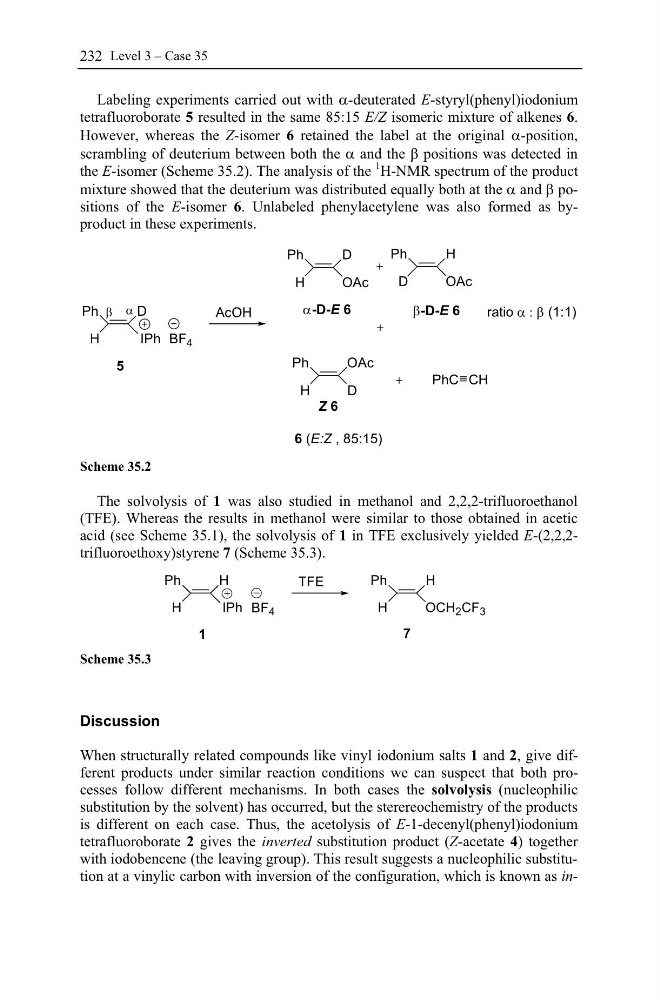
Labeling experiments carried out with D-deuterated E-styryl(phenyl)iodonium
tetrafluoroborate 5 resulted in the same 85:15 E/Z isomeric mixture of alkenes
Z
6.
However, whereas the Z-isomer Z Z
6 retained the label at the original D-position,
scrambling of deuterium between both the D and the E positions was detected in
the E-isomer (Scheme 35.2). The analysis of the
1
H-NMR spectrum of the product
mixture showed that the deuterium was distributed equally both at the D and E positions of the E-isomer 6. Unlabeled phenylacetylene was also formed as byproduct in these experiments.
D
IPh
Ph
BF 4
AcOH
Ph
H
D
OAc
Ph
H
OAc
D
Ph
D
H
OAc
CH
PhC
5
D-D-E 6
Z 6
D
E
E-D-E 6
6 (E:Z , 85:15)
Z
ratio DDE (1:1)
Scheme 35.2
The solvolysis of 1 was also studied in methanol and 2,2,2-trifluoroethanol
(TFE). Whereas the results in methanol were similar to those obtained in acetic
acid (see Scheme 35.1), the solvolysis of 1 in TFE exclusively yielded E-(2,2,2trifluoroethoxy)styrene 7 (Scheme 35.3).
Ph
H
H
IPh BF 4
TFE
Ph
H
H
OCH 2 CF 3
1
7
Scheme 35.3
Discussion
When structurally related compounds like vinyl iodonium salts 1 and 2, give different products under similar reaction conditions we can suspect that both processes follow different mechanisms. In both cases the solvolysis (nucleophilic
substitution by the solvent) has occurred, but the sterereochemistry of the products
is different on each case. Thus, the acetolysis of E-1-decenyl(phenyl)iodonium
tetrafluoroborate 2 gives the inverted substitution
d
product (Z-acetate Z Z
4) together
with iodobencene (the leaving group). This result suggests a nucleophilic substitution at a vinylic carbon with inversion of the configuration, which is known as in-
232
Labeling experiments carried out with D-deuterated E-styryl(phenyl)iodonium
tetrafluoroborate 5 resulted in the same 85:15 E/Z isomeric mixture of alkenes
Z
6.
However, whereas the Z-isomer Z Z
6 retained the label at the original D-position,
scrambling of deuterium between both the D and the E positions was detected in
the E-isomer (Scheme 35.2). The analysis of the
1
H-NMR spectrum of the product
mixture showed that the deuterium was distributed equally both at the D and E positions of the E-isomer 6. Unlabeled phenylacetylene was also formed as byproduct in these experiments.
D
IPh
Ph
BF 4
AcOH
Ph
H
D
OAc
Ph
H
OAc
D
Ph
D
H
OAc
CH
PhC
5
D-D-E 6
Z 6
D
E
E-D-E 6
6 (E:Z , 85:15)
Z
ratio DDE (1:1)
Scheme 35.2
The solvolysis of 1 was also studied in methanol and 2,2,2-trifluoroethanol
(TFE). Whereas the results in methanol were similar to those obtained in acetic
acid (see Scheme 35.1), the solvolysis of 1 in TFE exclusively yielded E-(2,2,2trifluoroethoxy)styrene 7 (Scheme 35.3).
Ph
H
H
IPh BF 4
TFE
Ph
H
H
OCH 2 CF 3
1
7
Scheme 35.3
Discussion
When structurally related compounds like vinyl iodonium salts 1 and 2, give different products under similar reaction conditions we can suspect that both processes follow different mechanisms. In both cases the solvolysis (nucleophilic
substitution by the solvent) has occurred, but the sterereochemistry of the products
is different on each case. Thus, the acetolysis of E-1-decenyl(phenyl)iodonium
tetrafluoroborate 2 gives the inverted substitution
d
product (Z-acetate Z Z
4) together
with iodobencene (the leaving group). This result suggests a nucleophilic substitution at a vinylic carbon with inversion of the configuration, which is known as in-