

228 Lcvcl 3 -Case 34
Let us check how the presence of a bridge in the helicene system influences the
rate of racemization. From data in Table 34.1 it is clear that the shorter is the
bridge the faster is the racemization ( 4 racemizes faster than 3). The inlluence of
the bridge length is also manifested in the acti vation parameters. The entropy of
activation (L'I..S;) gives information about the in crease ( decrease) of order when
passing from the reagents to the activated complex, whereas the enthalpy of activation L'I..H:ţ measures all energy changes that occur between reagents and the activated complex. Finally, the L'I..G:ţ values have no physical significance and give the
same information as the rate constant to which they are directly related (transition
state theory).
The L' I..Ht values in Table 34.2 indicate that the energy balance of the racemization is more favorable for bridged compounds 3 and 4 than for the parent 1, and
even better for the helicene with the shorter bridge 4. For this compmmd we observe the highest L' I..St value, which indicates the most ordered transition state in
the racemization process. These results are somehow surprising. One should have
expected that the racemization would be easier in the compound with the longer
bridge.
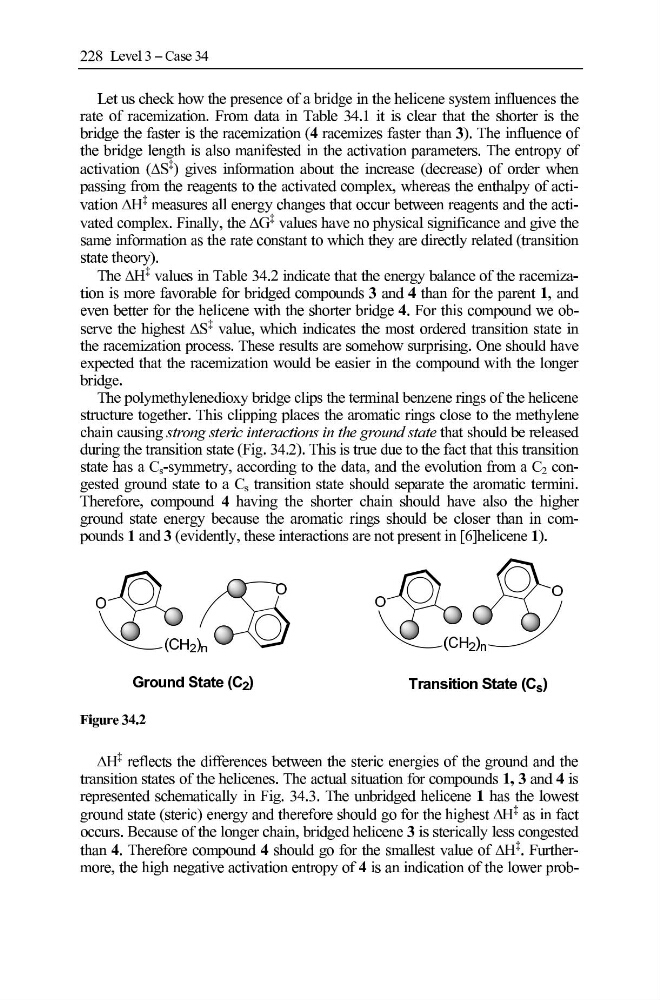
The polymethylenedioxy bridge clips the terminal benzene rings ofthe helicene
stmcture together. This clipping places the aromatic rings close to the methylene
chain causing strong sferic interactions in the ground state that should be released
during the transition state (Fig. 34.2). This is true due to the fact that this transition
state has a Cs-symmetry, according to the data, and the evolution from a C 2 congested ground state to a C, transition state should separate the aromatic termini.
Therefore, compound 4 having the shorter chain should have also the higher
ground state energy because the aromatic rings should be closer than in compounds 1 and 3 ( evidently, these interactions are not present in [6)helicene 1).
Ground State (C2)
Transition State (C 5 )
f?igure 34.2
L'I..Ht reflects the differences between the steric energies of the ground and the
transition states ofthe helicenes. The actual situation for compounds 1, 3 and 4 is
represented schematically in Fig. 34.3. The unbridged helicene 1 has the lowest
ground state (steric) energy and therefore should go for the highest L'.Ht as in fact
occurs. Because ofthe longer chain, bridged helicene 3 is sterically less congested
than 4. Therefore compound 4 should go for the smallest value of L'.H~. Furthermore, the high negative activation entropy of 4 is an indication ofthe lower prob-
Let us check how the presence of a bridge in the helicene system influences the
rate of racemization. From data in Table 34.1 it is clear that the shorter is the
bridge the faster is the racemization ( 4 racemizes faster than 3). The inlluence of
the bridge length is also manifested in the acti vation parameters. The entropy of
activation (L'I..S;) gives information about the in crease ( decrease) of order when
passing from the reagents to the activated complex, whereas the enthalpy of activation L'I..H:ţ measures all energy changes that occur between reagents and the activated complex. Finally, the L'I..G:ţ values have no physical significance and give the
same information as the rate constant to which they are directly related (transition
state theory).
The L' I..Ht values in Table 34.2 indicate that the energy balance of the racemization is more favorable for bridged compounds 3 and 4 than for the parent 1, and
even better for the helicene with the shorter bridge 4. For this compmmd we observe the highest L' I..St value, which indicates the most ordered transition state in
the racemization process. These results are somehow surprising. One should have
expected that the racemization would be easier in the compound with the longer
bridge.
The polymethylenedioxy bridge clips the terminal benzene rings ofthe helicene
stmcture together. This clipping places the aromatic rings close to the methylene
chain causing strong sferic interactions in the ground state that should be released
during the transition state (Fig. 34.2). This is true due to the fact that this transition
state has a Cs-symmetry, according to the data, and the evolution from a C 2 congested ground state to a C, transition state should separate the aromatic termini.
Therefore, compound 4 having the shorter chain should have also the higher
ground state energy because the aromatic rings should be closer than in compounds 1 and 3 ( evidently, these interactions are not present in [6)helicene 1).
Ground State (C2)
Transition State (C 5 )
f?igure 34.2
L'I..Ht reflects the differences between the steric energies of the ground and the
transition states ofthe helicenes. The actual situation for compounds 1, 3 and 4 is
represented schematically in Fig. 34.3. The unbridged helicene 1 has the lowest
ground state (steric) energy and therefore should go for the highest L'.Ht as in fact
occurs. Because ofthe longer chain, bridged helicene 3 is sterically less congested
than 4. Therefore compound 4 should go for the smallest value of L'.H~. Furthermore, the high negative activation entropy of 4 is an indication ofthe lower prob-