

Hcliccnophancs and thcir Raccmization 227
Discussion
According to the transition state theory (Eyring equation) enthalpy (L'l.H~), entropy
(L'l.St) and free energy (L'l.Gt) of activation can be calculated from the Arrhenius parameters Ea and A obtained experimenlally. The aclivation energy Ea is related to
the enthalpy ofactivation through Eq. 34.1. On the other hand, the pre-exponential
factor A can be related to the entropy of activation through Eq. 34.2. Once both
L'l.Ht and L'l.S~ are known, il is easy to calculate L'l.Gt by means of Eq. 34.3 (kR and h
are the Boltzmann and Planck constants respectively, T the absolute temperature
and the gas constantR is given in J K
1
mol
1
).
Ea=Mft +RT
ksTe M :/
A=--e /R
h
(34.1)
(34.2)
(34.3)
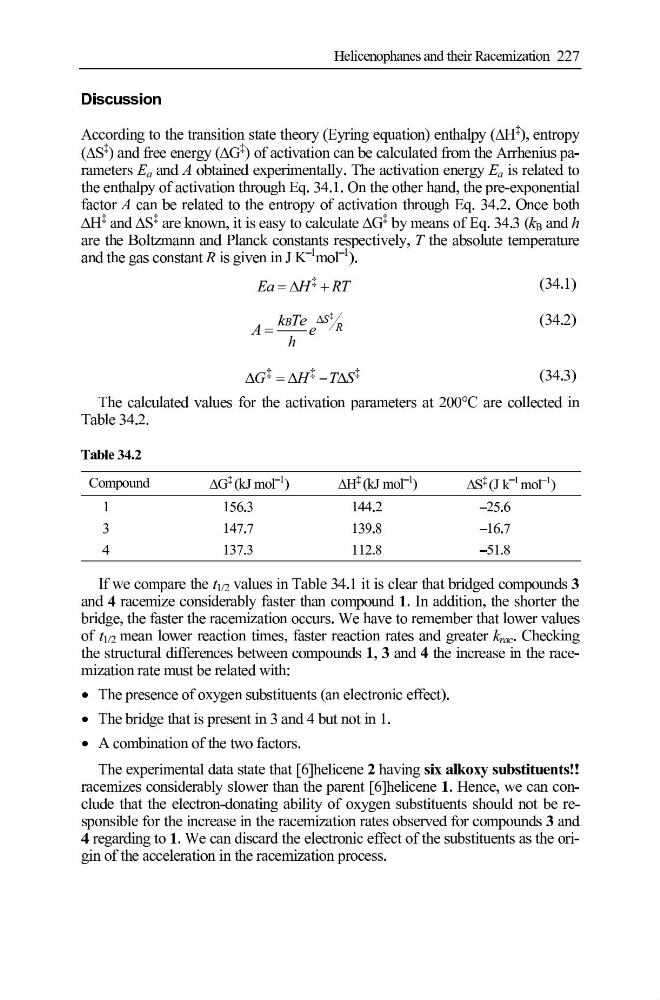
The calculated values for the activalion parameters at 200°C are collected in
Table 34.2.
Table 34.2
Compound
3
4
156.3
147.7
137.3
144.2
139.8
112.8
-25.6
-16.7
-51.8
lf we compare the t 112 values in Table 34.1 it is clear that bridged compounds 3
and 4 racemize considerably faster than compound 1. In addition, the shorter the
bridge, the faster the racemization occurs. We have to remember that lower values
of t 112 mean lower reaction times, faster reaction rates and greater krac· Checking
the structural differences between compounds 1, 3 and 4 the increase in the racemization rate must be related with:
• The presence of oxygen substituents (an electronic effect).
• The bridge that is present in 3 and 4 but not in 1.
• A combination of the two factors.
The experimental data state that [6]helicene 2 having six alkoxy substituents!!
racemizes considerably slower than the parent [6]helicene 1. Hence, we can conclude that the electron-donaling ability of oxygen substituents should nol be responsible for the increase in the racemizalion rates observed for compounds 3 and
4 regarding to 1. We can discard the electronic effect ofthe substituents as the origin of the acceleration in the racemization process.
Discussion
According to the transition state theory (Eyring equation) enthalpy (L'l.H~), entropy
(L'l.St) and free energy (L'l.Gt) of activation can be calculated from the Arrhenius parameters Ea and A obtained experimenlally. The aclivation energy Ea is related to
the enthalpy ofactivation through Eq. 34.1. On the other hand, the pre-exponential
factor A can be related to the entropy of activation through Eq. 34.2. Once both
L'l.Ht and L'l.S~ are known, il is easy to calculate L'l.Gt by means of Eq. 34.3 (kR and h
are the Boltzmann and Planck constants respectively, T the absolute temperature
and the gas constantR is given in J K
1
mol
1
).
Ea=Mft +RT
ksTe M :/
A=--e /R
h
(34.1)
(34.2)
(34.3)
The calculated values for the activalion parameters at 200°C are collected in
Table 34.2.
Table 34.2
Compound
3
4
156.3
147.7
137.3
144.2
139.8
112.8
-25.6
-16.7
-51.8
lf we compare the t 112 values in Table 34.1 it is clear that bridged compounds 3
and 4 racemize considerably faster than compound 1. In addition, the shorter the
bridge, the faster the racemization occurs. We have to remember that lower values
of t 112 mean lower reaction times, faster reaction rates and greater krac· Checking
the structural differences between compounds 1, 3 and 4 the increase in the racemization rate must be related with:
• The presence of oxygen substituents (an electronic effect).
• The bridge that is present in 3 and 4 but not in 1.
• A combination of the two factors.
The experimental data state that [6]helicene 2 having six alkoxy substituents!!
racemizes considerably slower than the parent [6]helicene 1. Hence, we can conclude that the electron-donaling ability of oxygen substituents should nol be responsible for the increase in the racemizalion rates observed for compounds 3 and
4 regarding to 1. We can discard the electronic effect ofthe substituents as the origin of the acceleration in the racemization process.