

Hcliccnophancs and thcir Raccmization 229
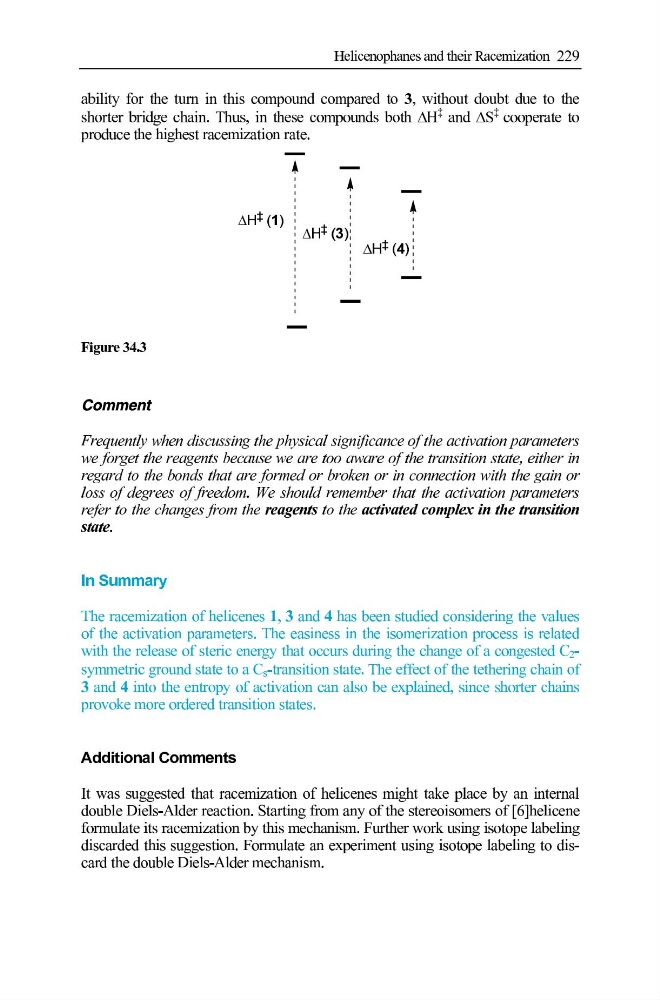
ability for the turn in this compound compared to 3, without doubt due to the
shorter bridge chain. Thus, in these compounds both L'.Ht and L'.S~ cooperate to
produce the highest racemization rate.
Figure 34.3
Comment
'
'
L'lH:ţ (3):
L'.H:ţ (4):
Frequently when discussing the physical signijicance ofthe activation parameters
we forget the reagents because we are too aware of the transition state, either in
regard to the bond~ that are formed or broken or in connection with the gain or
loss of degrees offreedom. We should remember that the activation parameters
refer to the changes from the reagents to the activated complex in the transition
state.
In Summary
The racemization of helicenes 1, 3 and 4 has been studied considering the values
of the activation parameters. The easiness in the isomerization process is related
with the release of steric energy that occurs during the change of a congested C 2 -
symmetric ground state to a C,-transition state. The eiTect of the tethering chain of
3 and 4 into the entropy of activation can also be explained, since shorter chains
provoke more ordered transition states.
Additional Comments
It was suggested that racemization of helicenes might take place by an interna!
double Diels-Aider reaction. Starting from any of the stereoisomers of[6]helicene
formulate its racemization by this mechanism. Further work using isotope labei ing
discarded this suggestion. Formulate an experiment using isotope labeling to discard the double Diels-Aider mechanism.
ability for the turn in this compound compared to 3, without doubt due to the
shorter bridge chain. Thus, in these compounds both L'.Ht and L'.S~ cooperate to
produce the highest racemization rate.
Figure 34.3
Comment
'
'
L'lH:ţ (3):
L'.H:ţ (4):
Frequently when discussing the physical signijicance ofthe activation parameters
we forget the reagents because we are too aware of the transition state, either in
regard to the bond~ that are formed or broken or in connection with the gain or
loss of degrees offreedom. We should remember that the activation parameters
refer to the changes from the reagents to the activated complex in the transition
state.
In Summary
The racemization of helicenes 1, 3 and 4 has been studied considering the values
of the activation parameters. The easiness in the isomerization process is related
with the release of steric energy that occurs during the change of a congested C 2 -
symmetric ground state to a C,-transition state. The eiTect of the tethering chain of
3 and 4 into the entropy of activation can also be explained, since shorter chains
provoke more ordered transition states.
Additional Comments
It was suggested that racemization of helicenes might take place by an interna!
double Diels-Aider reaction. Starting from any of the stereoisomers of[6]helicene
formulate its racemization by this mechanism. Further work using isotope labei ing
discarded this suggestion. Formulate an experiment using isotope labeling to discard the double Diels-Aider mechanism.