

Level 3 – Case 33
220
As the C-F bond is being broken in the slow step either in path a or in path b,
we are unable to distinguish between both alternatives by means of a F KIE (it
will be significant in both cases). However from a kinetic point of view, there is a
main difference between them. Path a, is a catalyzed process and if the reaction
follows this pathway, a linear dependence of the rate constant and the base concentration must be observed. Path b, is not base-catalyzed and in consequence, if
the reaction follows this pathway, the rate constant should be independent of the
concentration of base. The experimental data indicate that the reaction of DNFB
with o-toluidine shows a dependence of k obs
k k with the concentration of base. This
should point to the base-catalyzed mechanism. The odd fact is that the dependence
of k obs
k k with the concentration of base is not linear, as should be generally expected
for the catalysis process. To understand this apparent incongruity we should make
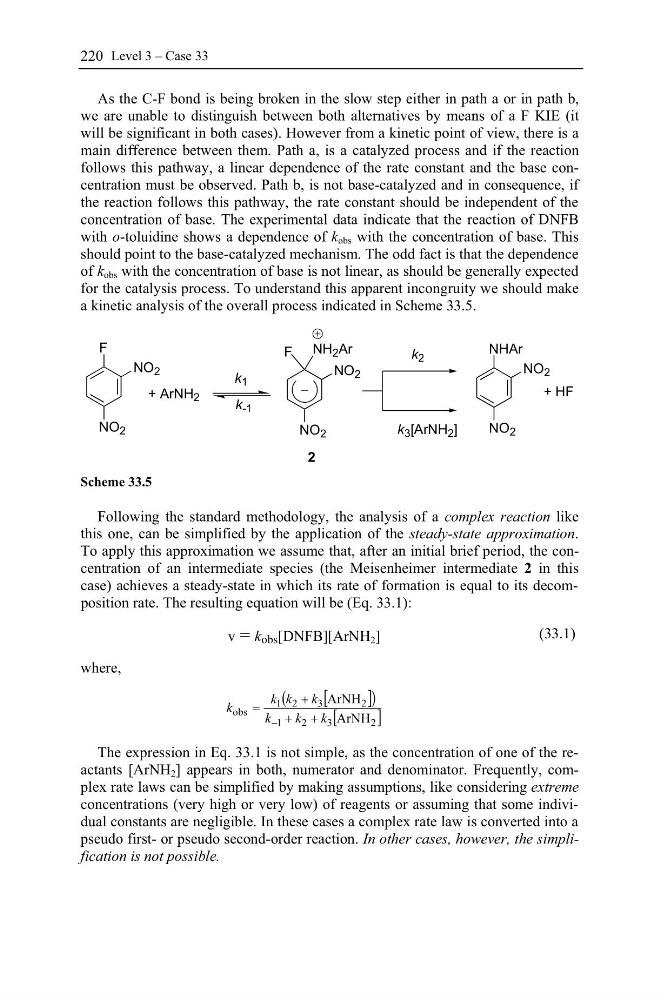
a kinetic analysis of the overall process indicated in Scheme 33.5.
NO 2
F
NO 2
NO 2
NO 2
F NH 2 Ar
NO 2
NHAr
NO 2
k 1
k -1
k k
+ ArNH 2
+ HF
k 2
k k
k 3
k k [ArNH 2 ]
2
Scheme 33.5
Following the standard methodology, the analysis of a complex reaction like
this one, can be simplified by the application of the steady-state approximation.
To apply this approximation we assume that, after an initial brief period, the concentration of an intermediate species (the Meisenheimer intermediate 2 in this
case) achieves a steady-state in which its rate of formation is equal to its decomposition rate. The resulting equation will be (Eq. 33.1):
v = k obs
k k [DNFB][ArNH 2 ]
(33.1)
where,
>
@
>
@
>
@
3
2
1
1
obs
k 3
k 2
k
k 1
k o
The expression in Eq. 33.1 is not simple, as the concentration of one of the reactants [ArNH 2 ] appears in both, numerator and denominator. Frequently, complex rate laws can be simplified by making assumptions, like considering extreme
concentrations (very high or very low) of reagents or assuming that some individual constants are negligible. In these cases a complex rate law is converted into a
pseudo first- or pseudo second-order reaction. In other cases, however, the simplification is not possible.
220
As the C-F bond is being broken in the slow step either in path a or in path b,
we are unable to distinguish between both alternatives by means of a F KIE (it
will be significant in both cases). However from a kinetic point of view, there is a
main difference between them. Path a, is a catalyzed process and if the reaction
follows this pathway, a linear dependence of the rate constant and the base concentration must be observed. Path b, is not base-catalyzed and in consequence, if
the reaction follows this pathway, the rate constant should be independent of the
concentration of base. The experimental data indicate that the reaction of DNFB
with o-toluidine shows a dependence of k obs
k k with the concentration of base. This
should point to the base-catalyzed mechanism. The odd fact is that the dependence
of k obs
k k with the concentration of base is not linear, as should be generally expected
for the catalysis process. To understand this apparent incongruity we should make
a kinetic analysis of the overall process indicated in Scheme 33.5.
NO 2
F
NO 2
NO 2
NO 2
F NH 2 Ar
NO 2
NHAr
NO 2
k 1
k -1
k k
+ ArNH 2
+ HF
k 2
k k
k 3
k k [ArNH 2 ]
2
Scheme 33.5
Following the standard methodology, the analysis of a complex reaction like
this one, can be simplified by the application of the steady-state approximation.
To apply this approximation we assume that, after an initial brief period, the concentration of an intermediate species (the Meisenheimer intermediate 2 in this
case) achieves a steady-state in which its rate of formation is equal to its decomposition rate. The resulting equation will be (Eq. 33.1):
v = k obs
k k [DNFB][ArNH 2 ]
(33.1)
where,
>
@
>
@
>
@
3
2
1
1
obs
k 3
k 2
k
k 1
k o
The expression in Eq. 33.1 is not simple, as the concentration of one of the reactants [ArNH 2 ] appears in both, numerator and denominator. Frequently, complex rate laws can be simplified by making assumptions, like considering extreme
concentrations (very high or very low) of reagents or assuming that some individual constants are negligible. In these cases a complex rate law is converted into a
pseudo first- or pseudo second-order reaction. In other cases, however, the simplification is not possible.