

The Rate-Determining Step in the S N Ar Reaction 221
Let us suppose that the slow step of the reaction is the addition of the amine to
the DNFB to form the Meisenheimer intermediate (step 1). As we have discussed
before, this is the situation when p-toluidine is used as the nucleophile. Under
these circumstances we could consider that k –1
k k is negligible, (k –1
k k <<<
k 2
k k +k 3
k k [ArNH 2 ]) and hence, k obs
k k ~ k 1 .
The kinetic law of the reaction will be v = k 1 [DNFB] [ArNH 2 ] and the complex
expression of k obs
k k in Eq. 33.1 has been transformed into a simple pseudo secondorder constant.
If we assume that for o-toluidine, the base-catalysed process is rate determining
(k 3
k k ) then, we could consider that in Eq. 33.1, k –1
k k >>> k 2
k k + k 3
k k [ArNH 2 ]. That is, the
reversion to the intermediate complex to reactants must be very fast. The observed
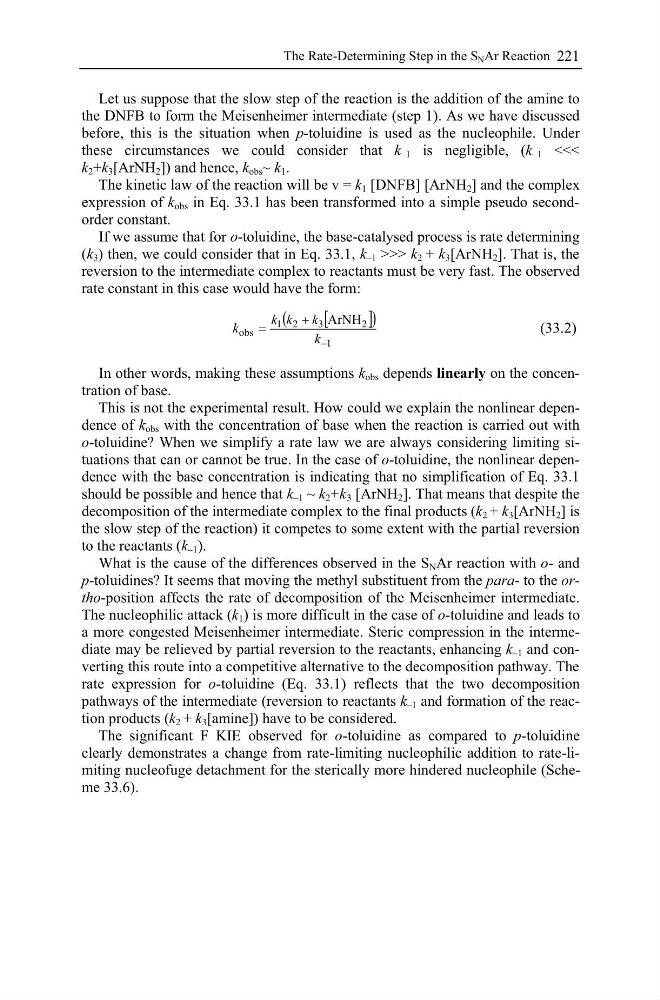
rate constant in this case would have the form:
>
@
>
@
1
1
obs
k
k 1
k o
(33.2)
In other words, making these assumptions k obs
k k depends linearly on the concentration of base.
This is not the experimental result. How could we explain the nonlinear dependence of k obs
k k with the concentration of base when the reaction is carried out with
o-toluidine? When we simplify a rate law we are always considering limiting situations that can or cannot be true. In the case of o-toluidine, the nonlinear dependence with the base concentration is indicating that no simplification of Eq. 33.1
should be possible and hence that k –1
k k ~ k 2
k k +k 3 [ArNH 2 ]. That means that despite the
decomposition of the intermediate complex to the final products (k 2
k k + k 3
k k [ArNH 2 ] is
the slow step of the reaction) it competes to some extent with the partial reversion
to the reactants (k –1
k k ).
What is the cause of the differences observed in the S N Ar reaction with o- and
p-toluidines? It seems that moving the methyl substituent from the para- to the ortho-position affects the rate of decomposition of the Meisenheimer intermediate.
The nucleophilic attack (k 1 ) is more difficult in the case of o-toluidine and leads to
a more congested Meisenheimer intermediate. Steric compression in the intermediate may be relieved by partial reversion to the reactants, enhancing k –1
k k and converting this route into a competitive alternative to the decomposition pathway. The
rate expression for o-toluidine (Eq. 33.1) reflects that the two decomposition
pathways of the intermediate (reversion to reactants k –1
k k and formation of the reaction products (k 2
k k + k 3
k k [amine]) have to be considered.
The significant F KIE observed for o-toluidine as compared to p-toluidine
clearly demonstrates a change from rate-limiting nucleophilic addition to rate-limiting nucleofuge detachment for the sterically more hindered nucleophile (Scheme 33.6).
Let us suppose that the slow step of the reaction is the addition of the amine to
the DNFB to form the Meisenheimer intermediate (step 1). As we have discussed
before, this is the situation when p-toluidine is used as the nucleophile. Under
these circumstances we could consider that k –1
k k is negligible, (k –1
k k <<<
k 2
k k +k 3
k k [ArNH 2 ]) and hence, k obs
k k ~ k 1 .
The kinetic law of the reaction will be v = k 1 [DNFB] [ArNH 2 ] and the complex
expression of k obs
k k in Eq. 33.1 has been transformed into a simple pseudo secondorder constant.
If we assume that for o-toluidine, the base-catalysed process is rate determining
(k 3
k k ) then, we could consider that in Eq. 33.1, k –1
k k >>> k 2
k k + k 3
k k [ArNH 2 ]. That is, the
reversion to the intermediate complex to reactants must be very fast. The observed
rate constant in this case would have the form:
>
@
>
@
1
1
obs
k
k 1
k o
(33.2)
In other words, making these assumptions k obs
k k depends linearly on the concentration of base.
This is not the experimental result. How could we explain the nonlinear dependence of k obs
k k with the concentration of base when the reaction is carried out with
o-toluidine? When we simplify a rate law we are always considering limiting situations that can or cannot be true. In the case of o-toluidine, the nonlinear dependence with the base concentration is indicating that no simplification of Eq. 33.1
should be possible and hence that k –1
k k ~ k 2
k k +k 3 [ArNH 2 ]. That means that despite the
decomposition of the intermediate complex to the final products (k 2
k k + k 3
k k [ArNH 2 ] is
the slow step of the reaction) it competes to some extent with the partial reversion
to the reactants (k –1
k k ).
What is the cause of the differences observed in the S N Ar reaction with o- and
p-toluidines? It seems that moving the methyl substituent from the para- to the ortho-position affects the rate of decomposition of the Meisenheimer intermediate.
The nucleophilic attack (k 1 ) is more difficult in the case of o-toluidine and leads to
a more congested Meisenheimer intermediate. Steric compression in the intermediate may be relieved by partial reversion to the reactants, enhancing k –1
k k and converting this route into a competitive alternative to the decomposition pathway. The
rate expression for o-toluidine (Eq. 33.1) reflects that the two decomposition
pathways of the intermediate (reversion to reactants k –1
k k and formation of the reaction products (k 2
k k + k 3
k k [amine]) have to be considered.
The significant F KIE observed for o-toluidine as compared to p-toluidine
clearly demonstrates a change from rate-limiting nucleophilic addition to rate-limiting nucleofuge detachment for the sterically more hindered nucleophile (Scheme 33.6).