

The Rate-Determining Step in the S N Ar Reaction 219
NO 2
F
NO 2
NO 2
NHR
NO 2
F NH 2 Ar
NO 2
NO 2
step 1
step 2
2
+ ArNH 2
+ HF
2
Scheme 33.3
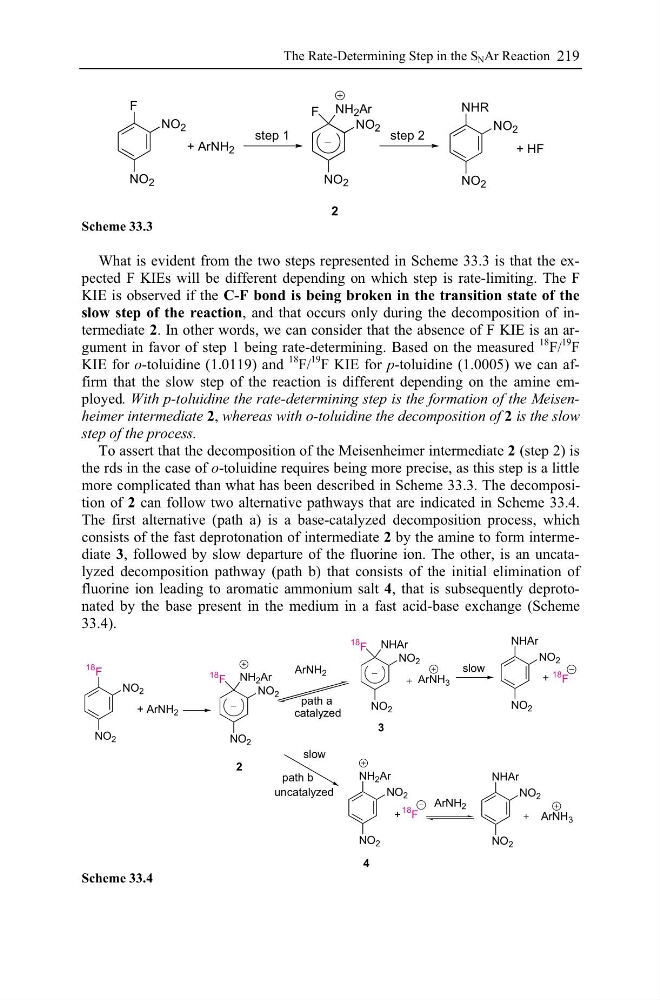
What is evident from the two steps represented in Scheme 33.3 is that the expected F KIEs will be different depending on which step is rate-limiting. The F
KIE is observed if the C-F bond is being broken in the transition state of the
slow step of the reaction, and that occurs only during the decomposition of intermediate 2. In other words, we can consider that the absence of F KIE is an argument in favor of step 1 being rate-determining. Based on the measured
18 F/
19
F
KIE for o-toluidine (1.0119) and
18 F/
19 F KIE for p
r -toluidine (1.0005) we can affirm that the slow step of the reaction is different depending on the amine employed. With p-toluidine the rate-determining step is the formation of the Meisenheimer intermediate 2, whereas with o-toluidine the decomposition of 2 is the slow
step of the process.
To assert that the decomposition of the Meisenheimer intermediate 2 (step 2) is
the rds in the case of o-toluidine requires being more precise, as this step is a little
more complicated than what has been described in Scheme 33.3. The decomposition of 2 can follow two alternative pathways that are indicated in Scheme 33.4.
The first alternative (path a) is a base-catalyzed decomposition process, which
consists of the fast deprotonation of intermediate 2 by the amine to form intermediate 3, followed by slow departure of the fluorine ion. The other, is an uncatalyzed decomposition pathway (path b) that consists of the initial elimination of
fluorine ion leading to aromatic ammonium salt 4, that is subsequently deprotonated by the base present in the medium in a fast acid-base exchange (Scheme
33.4).
NO 2
NHAr
NO 2
NO 2
18 F
NO 2
NO 2
NH 2 Ar
NO 2
NO 2
NHAr
NO 2
18 F NH 2 Ar
NO 2
NO 2
18 F NHAr
NO 2
NO 2
ArNH 2
18 F
+
ArNH 2
ArNH 3
ArNH 3
18 F
+
uncatalyzed
catalyzed
path a
path b
3
4
slow
slow
+ ArNH 2
2
Scheme 33.4
NO 2
F
NO 2
NO 2
NHR
NO 2
F NH 2 Ar
NO 2
NO 2
step 1
step 2
2
+ ArNH 2
+ HF
2
Scheme 33.3
What is evident from the two steps represented in Scheme 33.3 is that the expected F KIEs will be different depending on which step is rate-limiting. The F
KIE is observed if the C-F bond is being broken in the transition state of the
slow step of the reaction, and that occurs only during the decomposition of intermediate 2. In other words, we can consider that the absence of F KIE is an argument in favor of step 1 being rate-determining. Based on the measured
18 F/
19
F
KIE for o-toluidine (1.0119) and
18 F/
19 F KIE for p
r -toluidine (1.0005) we can affirm that the slow step of the reaction is different depending on the amine employed. With p-toluidine the rate-determining step is the formation of the Meisenheimer intermediate 2, whereas with o-toluidine the decomposition of 2 is the slow
step of the process.
To assert that the decomposition of the Meisenheimer intermediate 2 (step 2) is
the rds in the case of o-toluidine requires being more precise, as this step is a little
more complicated than what has been described in Scheme 33.3. The decomposition of 2 can follow two alternative pathways that are indicated in Scheme 33.4.
The first alternative (path a) is a base-catalyzed decomposition process, which
consists of the fast deprotonation of intermediate 2 by the amine to form intermediate 3, followed by slow departure of the fluorine ion. The other, is an uncatalyzed decomposition pathway (path b) that consists of the initial elimination of
fluorine ion leading to aromatic ammonium salt 4, that is subsequently deprotonated by the base present in the medium in a fast acid-base exchange (Scheme
33.4).
NO 2
NHAr
NO 2
NO 2
18 F
NO 2
NO 2
NH 2 Ar
NO 2
NO 2
NHAr
NO 2
18 F NH 2 Ar
NO 2
NO 2
18 F NHAr
NO 2
NO 2
ArNH 2
18 F
+
ArNH 2
ArNH 3
ArNH 3
18 F
+
uncatalyzed
catalyzed
path a
path b
3
4
slow
slow
+ ArNH 2
2
Scheme 33.4