

Level 3 – Case 33
218
NO 2
18 F
NO 2
NO 2
NHAr
NO 2
+ ArNH 2
+ H 18 F
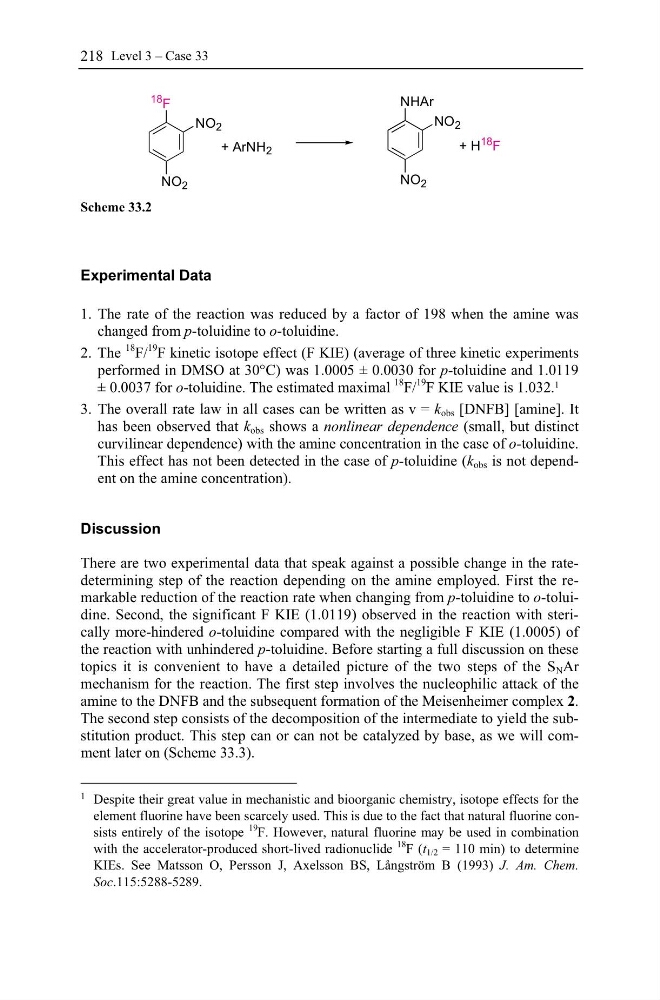
Scheme 33.2
Experimental Data
1. The rate of the reaction was reduced by a factor of 198 when the amine was
changed from p-toluidine to o-toluidine.
2. The
18 F/
19
F kinetic isotope effect (F KIE) (average of three kinetic experiments
performed in DMSO at 30°C) was 1.0005 ± 0.0030 for p-toluidine and 1.0119
± 0.0037 for o-toluidine. The estimated maximal
18 F/
19 F KIE value is 1.032.
1
3. The overall rate law in all cases can be written as v = k obs
k k [DNFB] [amine]. It
has been observed that k obs
k k shows a nonlinear dependence (small, but distinct
curvilinear dependence) with the amine concentration in the case of o-toluidine.
This effect has not been detected in the case of p-toluidine (k obs
k k is not dependent on the amine concentration).
Discussion
There are two experimental data that speak against a possible change in the ratek
determining step of the reaction depending on the amine employed. First the remarkable reduction of the reaction rate when changing from p-toluidine to o-toluidine. Second, the significant F KIE (1.0119) observed in the reaction with sterically more-hindered o-toluidine compared with the negligible F KIE (1.0005) of
the reaction with unhindered p-toluidine. Before starting a full discussion on these
topics it is convenient to have a detailed picture of the two steps of the S N Ar
mechanism for the reaction. The first step involves the nucleophilic attack of the
amine to the DNFB and the subsequent formation of the Meisenheimer complex 2.
The second step consists of the decomposition of the intermediate to yield the substitution product. This step can or can not be catalyzed by base, as we will comment later on (Scheme 33.3).
1 Despite their great value in mechanistic and bioorganic chemistry, isotope effects for the
element fluorine have been scarcely used. This is due to the fact that natural fluorine consists entirely of the isotope
19 F. However, natural fluorine may be used in combination
with the accelerator-produced short-lived radionuclide
18 F (t 1/2 = 110 min) to determine
KIEs. See Matsson O, Persson J, Axelsson BS, Långström B (1993) J. Am. Chem.
Soc.115:5288-5289.
218
NO 2
18 F
NO 2
NO 2
NHAr
NO 2
+ ArNH 2
+ H 18 F
Scheme 33.2
Experimental Data
1. The rate of the reaction was reduced by a factor of 198 when the amine was
changed from p-toluidine to o-toluidine.
2. The
18 F/
19
F kinetic isotope effect (F KIE) (average of three kinetic experiments
performed in DMSO at 30°C) was 1.0005 ± 0.0030 for p-toluidine and 1.0119
± 0.0037 for o-toluidine. The estimated maximal
18 F/
19 F KIE value is 1.032.
1
3. The overall rate law in all cases can be written as v = k obs
k k [DNFB] [amine]. It
has been observed that k obs
k k shows a nonlinear dependence (small, but distinct
curvilinear dependence) with the amine concentration in the case of o-toluidine.
This effect has not been detected in the case of p-toluidine (k obs
k k is not dependent on the amine concentration).
Discussion
There are two experimental data that speak against a possible change in the ratek
determining step of the reaction depending on the amine employed. First the remarkable reduction of the reaction rate when changing from p-toluidine to o-toluidine. Second, the significant F KIE (1.0119) observed in the reaction with sterically more-hindered o-toluidine compared with the negligible F KIE (1.0005) of
the reaction with unhindered p-toluidine. Before starting a full discussion on these
topics it is convenient to have a detailed picture of the two steps of the S N Ar
mechanism for the reaction. The first step involves the nucleophilic attack of the
amine to the DNFB and the subsequent formation of the Meisenheimer complex 2.
The second step consists of the decomposition of the intermediate to yield the substitution product. This step can or can not be catalyzed by base, as we will comment later on (Scheme 33.3).
1 Despite their great value in mechanistic and bioorganic chemistry, isotope effects for the
element fluorine have been scarcely used. This is due to the fact that natural fluorine consists entirely of the isotope
19 F. However, natural fluorine may be used in combination
with the accelerator-produced short-lived radionuclide
18 F (t 1/2 = 110 min) to determine
KIEs. See Matsson O, Persson J, Axelsson BS, Långström B (1993) J. Am. Chem.
Soc.115:5288-5289.