

Level 3 – Case 32
214
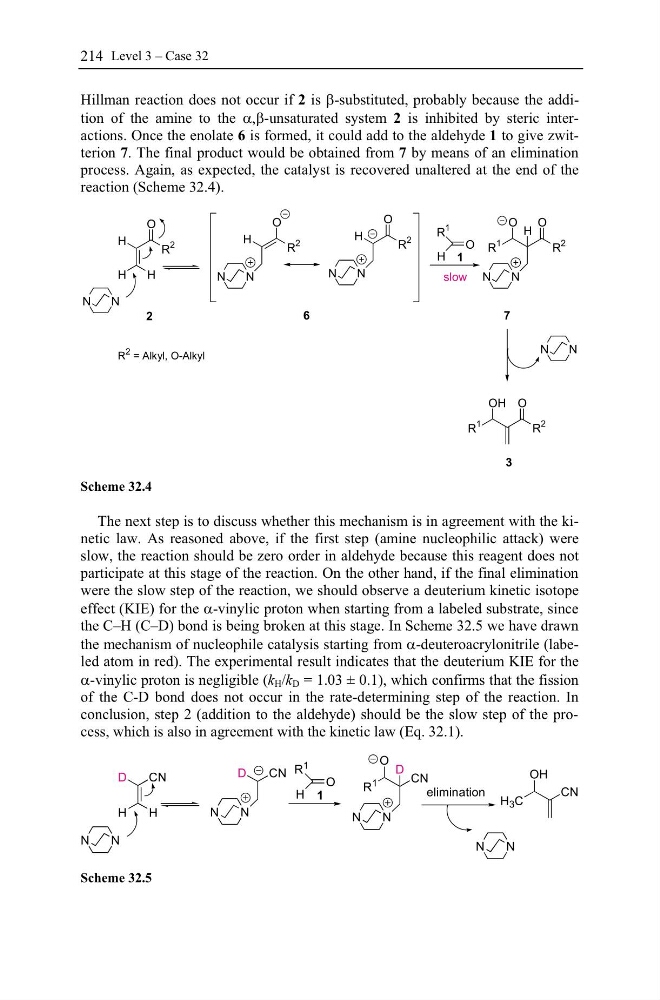
Hillman reaction does not occur if 2 is E-substituted, probably because the addition of the amine to the DE-unsaturated system 2 is inhibited by steric interactions. Once the enolate 6 is formed, it could add to the aldehyde 1 to give zwitterion 7. The final product would be obtained from 7 by means of an elimination
process. Again, as expected, the catalyst is recovered unaltered at the end of the
reaction (Scheme 32.4).
R
1
H
R
2
O
H
H
H
R
2
O
H
N
N
R
2
O
H
N
N
R
2
O
N
N
O
R
1
H
N
N
N
N
R
1
R
2
O
OH
6
7
slow
3
2
R
2 = Alkyl, O-Alkyl
1
Scheme 32.4
The next step is to discuss whether this mechanism is in agreement with the kinetic law. As reasoned above, if the first step (amine nucleophilic attack) were
slow, the reaction should be zero order in aldehyde because this reagent does not
participate at this stage of the reaction. On the other hand, if the final elimination
were the slow step of the reaction, we should observe a deuterium kinetic isotope
effect (KIE) for the D-vinylic proton when starting from a labeled substrate, since
the C–H (C–D) bond is being broken at this stage. In Scheme 32.5 we have drawn
the mechanism of nucleophile catalysis starting from D-deuteroacrylonitrile (labeled atom in red). The experimental result indicates that the deuterium KIE for the
D-vinylic proton is negligible (k H
k k /k D
k k = 1.03 ± 0.1), which confirms that the fission
of the C-D bond does not occur in the rate-determining step of the reaction. In
conclusion, step 2 (addition to the aldehyde) should be the slow step of the process, which is also in agreement with the kinetic law (Eq. 32.1).
N
N
H
H
D
D
N
N
N
N
CN
O
R 1
H
CN
N
N
O
R 1
D
1
CN
OH
H 3 C
elimination
Scheme 32.5
214
Hillman reaction does not occur if 2 is E-substituted, probably because the addition of the amine to the DE-unsaturated system 2 is inhibited by steric interactions. Once the enolate 6 is formed, it could add to the aldehyde 1 to give zwitterion 7. The final product would be obtained from 7 by means of an elimination
process. Again, as expected, the catalyst is recovered unaltered at the end of the
reaction (Scheme 32.4).
R
1
H
R
2
O
H
H
H
R
2
O
H
N
N
R
2
O
H
N
N
R
2
O
N
N
O
R
1
H
N
N
N
N
R
1
R
2
O
OH
6
7
slow
3
2
R
2 = Alkyl, O-Alkyl
1
Scheme 32.4
The next step is to discuss whether this mechanism is in agreement with the kinetic law. As reasoned above, if the first step (amine nucleophilic attack) were
slow, the reaction should be zero order in aldehyde because this reagent does not
participate at this stage of the reaction. On the other hand, if the final elimination
were the slow step of the reaction, we should observe a deuterium kinetic isotope
effect (KIE) for the D-vinylic proton when starting from a labeled substrate, since
the C–H (C–D) bond is being broken at this stage. In Scheme 32.5 we have drawn
the mechanism of nucleophile catalysis starting from D-deuteroacrylonitrile (labeled atom in red). The experimental result indicates that the deuterium KIE for the
D-vinylic proton is negligible (k H
k k /k D
k k = 1.03 ± 0.1), which confirms that the fission
of the C-D bond does not occur in the rate-determining step of the reaction. In
conclusion, step 2 (addition to the aldehyde) should be the slow step of the process, which is also in agreement with the kinetic law (Eq. 32.1).
N
N
H
H
D
D
N
N
N
N
CN
O
R 1
H
CN
N
N
O
R 1
D
1
CN
OH
H 3 C
elimination
Scheme 32.5