

The Baylis-Hillman Reaction 215
Further experimental evidence corroborates the nucleophile catalysis mechanism previously discussed. The effect of the substitution in the aromatic ring is
very significant when aromatic aldehydes are used: the reaction rate is increased
when electron-withdrawing groups are placed in the para-position. Clearly, if the
slow step consists on the nucleophilic attack of enolate 6 to the aldehyde 1, the increase of the electrophilicity of the carbonyl group due to the presence of electronwithdrawing substituents should accelerate the reaction. Other data to be considered is the increase of the reaction rate in polar solvents. This is fully consistent
with the formation of zwitterion 7 in the slow step, since an increase in the polarity of the solvent results in the stabilization of this polar intermediate by effect of
solvation.
Apparently the hypothesis of a nucleophile-catalyzed reaction fits well with all
the experimental data. However, there is still an additional question being the
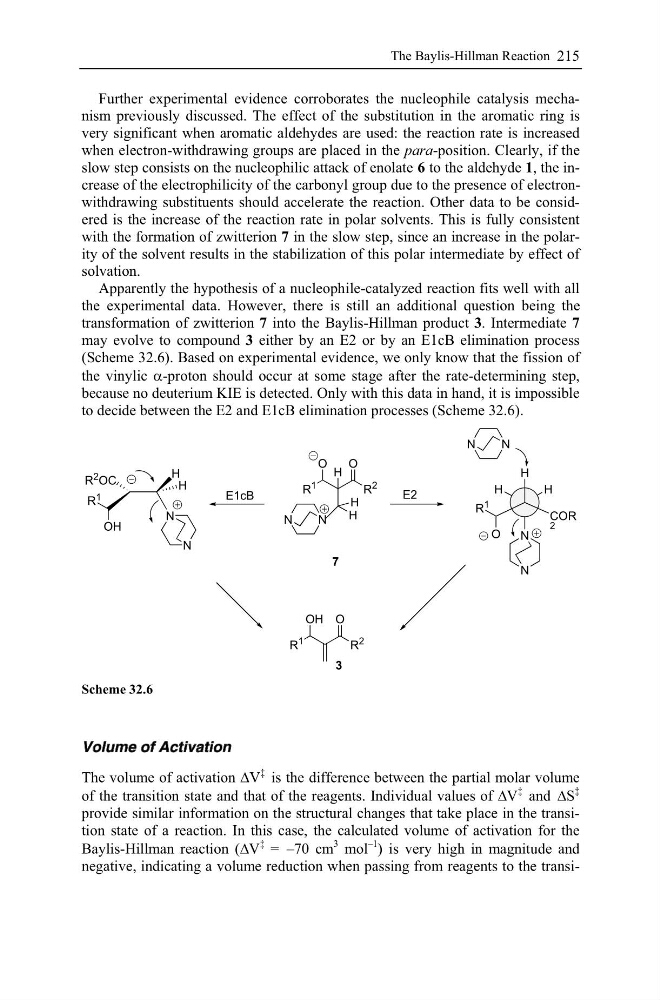
transformation of zwitterion 7 into the Baylis-Hillman product 3. Intermediate 7
may evolve to compound 3 either by an E2 or by an E1cB elimination process
(Scheme 32.6). Based on experimental evidence, we only know that the fission of
the vinylic D-proton should occur at some stage after the rate-determining step,
because no deuterium KIE is detected. Only with this data in hand, it is impossible
to decide between the E2 and E1cB elimination processes (Scheme 32.6).
N
N
R
2
O
R
1
O
7
H
H
H
N
H
H
H
COR
2
N
O
R 1
N
N
H
H
N
N
R 2 OC
OH
R 1
R 1
R 2
O
OH
3
E1cB
Scheme 32.6
V Vo Vo V Vo Vo Vo V Vol lu lum ume e o of f A Ac ct ti ti ti t ti ti t tiv va va v va va va va v vat ti ti ti t ti ti t tio io io io i ion n
The volume of activation 'V
‡ is the difference between the partial molar volume
of the transition state and that of the reagents. Individual values of 'V
‡ and 'S
‡
provide similar information on the structural changes that take place in the transit
tion state of a reaction. In this case, the calculated volume of activation for the
Baylis-Hillman reaction ('V
‡ = –70 cm
3 mol
–1
) is very high in magnitude and
negative, indicating a volume reduction when passing from reagents to the transi-
Further experimental evidence corroborates the nucleophile catalysis mechanism previously discussed. The effect of the substitution in the aromatic ring is
very significant when aromatic aldehydes are used: the reaction rate is increased
when electron-withdrawing groups are placed in the para-position. Clearly, if the
slow step consists on the nucleophilic attack of enolate 6 to the aldehyde 1, the increase of the electrophilicity of the carbonyl group due to the presence of electronwithdrawing substituents should accelerate the reaction. Other data to be considered is the increase of the reaction rate in polar solvents. This is fully consistent
with the formation of zwitterion 7 in the slow step, since an increase in the polarity of the solvent results in the stabilization of this polar intermediate by effect of
solvation.
Apparently the hypothesis of a nucleophile-catalyzed reaction fits well with all
the experimental data. However, there is still an additional question being the
transformation of zwitterion 7 into the Baylis-Hillman product 3. Intermediate 7
may evolve to compound 3 either by an E2 or by an E1cB elimination process
(Scheme 32.6). Based on experimental evidence, we only know that the fission of
the vinylic D-proton should occur at some stage after the rate-determining step,
because no deuterium KIE is detected. Only with this data in hand, it is impossible
to decide between the E2 and E1cB elimination processes (Scheme 32.6).
N
N
R
2
O
R
1
O
7
H
H
H
N
H
H
H
COR
2
N
O
R 1
N
N
H
H
N
N
R 2 OC
OH
R 1
R 1
R 2
O
OH
3
E1cB
Scheme 32.6
V Vo Vo V Vo Vo Vo V Vol lu lum ume e o of f A Ac ct ti ti ti t ti ti t tiv va va v va va va va v vat ti ti ti t ti ti t tio io io io i ion n
The volume of activation 'V
‡ is the difference between the partial molar volume
of the transition state and that of the reagents. Individual values of 'V
‡ and 'S
‡
provide similar information on the structural changes that take place in the transit
tion state of a reaction. In this case, the calculated volume of activation for the
Baylis-Hillman reaction ('V
‡ = –70 cm
3 mol
–1
) is very high in magnitude and
negative, indicating a volume reduction when passing from reagents to the transi-