

The Baylis-Hillman Reaction 213
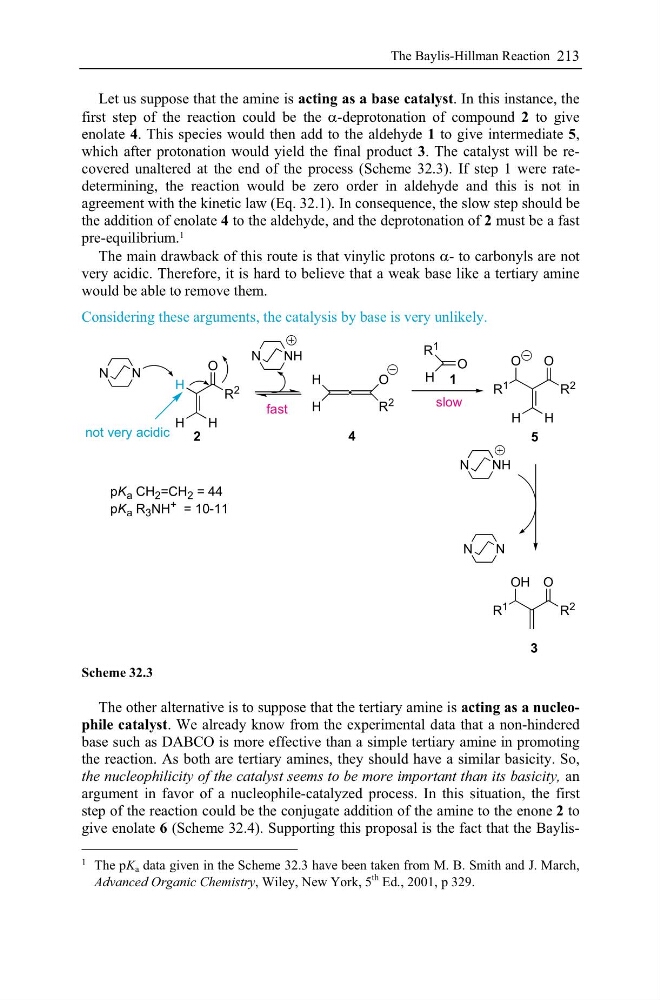
Let us suppose that the amine is acting as a base catalyst. In this instance, the
first step of the reaction could be the D-deprotonation of compound 2 to give
enolate 4. This species would then add to the aldehyde 1 to give intermediate 5,
which after protonation would yield the final product 3. The catalyst will be recovered unaltered at the end of the process (Scheme 32.3). If step 1 were ratedetermining, the reaction would be zero order in aldehyde and this is not in
agreement with the kinetic law (Eq. 32.1). In consequence, the slow step should be
the addition of enolate 4 to the aldehyde, and the deprotonation of 2 must be a fast
pre-equilibrium.
1
The main drawback of this route is that vinylic protons D- to carbonyls are not
very acidic. Therefore, it is hard to believe that a weak base like a tertiary amine
would be able to remove them.
Considering these arguments, the catalysis by base is very unlikely.
R 2
O
H
H
H
H
O
R 2
O
R 1
H
R 2
O
R 1
O
H
H
R 1
R 2
O
OH
N
N
N
N
not very acidic
5
3
2
4
pK a
K K CH 2 =CH 2 = 44
pK a
K K R 3 NH + = 10-11
slow
fast
1
Scheme 32.3
The other alternative is to suppose that the tertiary amine is acting as a nucleophile catalyst. We already know from the experimental data that a non-hindered
base such as DABCO is more effective than a simple tertiary amine in promoting
the reaction. As both are tertiary amines, they should have a similar basicity. So,
the nucleophilicity of the catalyst seems to be more important than its basicity, an
argument in favor of a nucleophile-catalyzed process. In this situation, the first
step of the reaction could be the conjugate addition of the amine to the enone 2 to
give enolate 6 (Scheme 32.4). Supporting this proposal is the fact that the Baylis1 The pK a
K K data given in the Scheme 32.3 have been
a
taken from M. B. Smith and J. March,
n
Advanced Organic Chemistry, Wiley, New York, 5
th Ed., 2001, p 329.
Let us suppose that the amine is acting as a base catalyst. In this instance, the
first step of the reaction could be the D-deprotonation of compound 2 to give
enolate 4. This species would then add to the aldehyde 1 to give intermediate 5,
which after protonation would yield the final product 3. The catalyst will be recovered unaltered at the end of the process (Scheme 32.3). If step 1 were ratedetermining, the reaction would be zero order in aldehyde and this is not in
agreement with the kinetic law (Eq. 32.1). In consequence, the slow step should be
the addition of enolate 4 to the aldehyde, and the deprotonation of 2 must be a fast
pre-equilibrium.
1
The main drawback of this route is that vinylic protons D- to carbonyls are not
very acidic. Therefore, it is hard to believe that a weak base like a tertiary amine
would be able to remove them.
Considering these arguments, the catalysis by base is very unlikely.
R 2
O
H
H
H
H
O
R 2
O
R 1
H
R 2
O
R 1
O
H
H
R 1
R 2
O
OH
N
N
N
N
not very acidic
5
3
2
4
pK a
K K CH 2 =CH 2 = 44
pK a
K K R 3 NH + = 10-11
slow
fast
1
Scheme 32.3
The other alternative is to suppose that the tertiary amine is acting as a nucleophile catalyst. We already know from the experimental data that a non-hindered
base such as DABCO is more effective than a simple tertiary amine in promoting
the reaction. As both are tertiary amines, they should have a similar basicity. So,
the nucleophilicity of the catalyst seems to be more important than its basicity, an
argument in favor of a nucleophile-catalyzed process. In this situation, the first
step of the reaction could be the conjugate addition of the amine to the enone 2 to
give enolate 6 (Scheme 32.4). Supporting this proposal is the fact that the Baylis1 The pK a
K K data given in the Scheme 32.3 have been
a
taken from M. B. Smith and J. March,
n
Advanced Organic Chemistry, Wiley, New York, 5
th Ed., 2001, p 329.