

Level 3 – Case 32
212
Experimental Data
1. The reaction rate was significantly improved when bases such as DABCO were
used rather than simply tertiary amines like Et 3 N.
N
N
DABCO
2. The reaction does not take place when the DE-unsaturated compound is E-substituted.
3. For aromatic aldehydes, the reaction is much faster when electron-withdrawing
substituents (like nitro groups) are placed on the para-position of the ring.
4. The reaction has a very high negative volume of activation ('V
‡ = –70 cm
3
mol
–1
).
5. The reaction rate is increased in polar solvents such as N,N-dimethylformamide N N
(DMF), methanol or acetonitrile.
6. The kinetic law for the reaction is:
v = k[R
1
CHO][CH 2 =CHCOR
2
R ]
where k =
k k obs
k k [tertiary amine] (32.1)
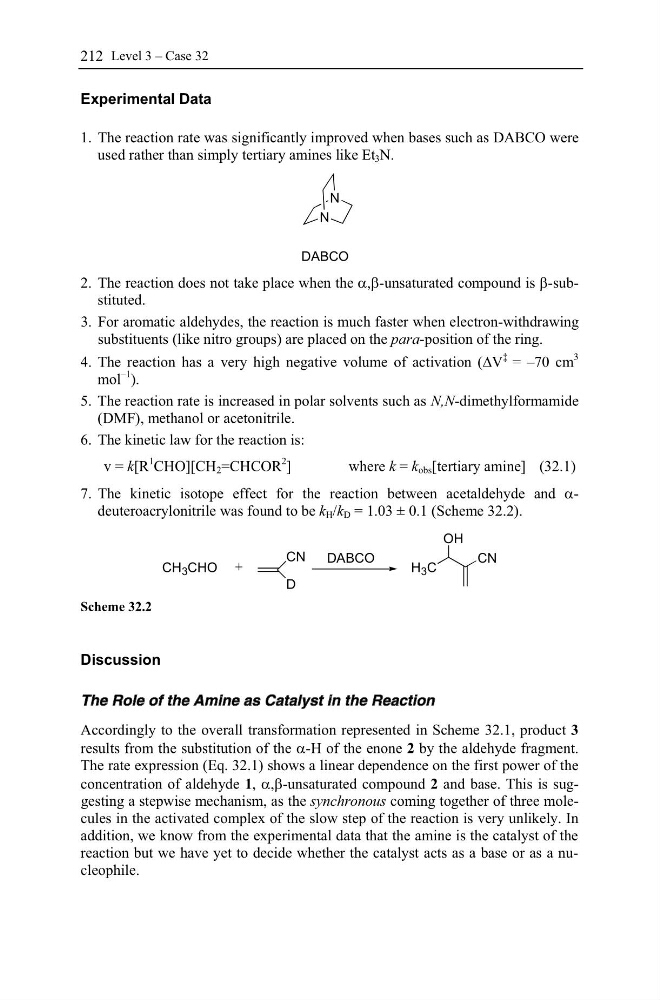
7. The kinetic isotope effect for the reaction between acetaldehyde and Ddeuteroacrylonitrile was found to be k H
k k /k D
k k = 1.03 ± 0.1 (Scheme 32.2).
CH 3 CHO
CN
D
DABCO
CN
OH
H 3 C
Scheme 32.2
Discussion
T Th T Th Th Th Th T T e e R Ro ol le le l le le le
l le o of f t th t th th th th t t e e A Am mi in i in in in i i e e a as s C Ca Ca C Ca Ca Ca Ca C Cat ta ta t ta ta ta ta t tal ly l ly ys ys y ys ys ys ys y y t t i in i in in in i i t th t th th th th t t e e R Re e e
Rea a a
eac ct ti ti ti t ti ti t tio io io io i ion n
Accordingly to the overall transformation represented in Scheme 32.1, product 3
results from the substitution of the D-H of the enone 2 by the aldehyde fragment.
The rate expression (Eq. 32.1) shows a linear dependence on the first power of the
concentration of aldehyde 1, DE-unsaturated compound 2 and base. This is suggesting a stepwise mechanism, as the synchronous coming together of three molecules in the activated complex of the slow step of the reaction is very unlikely. In
addition, we know from the experimental data that the amine is the catalyst of the
reaction but we have yet to decide whether the catalyst acts as a base or as a nucleophile.
212
Experimental Data
1. The reaction rate was significantly improved when bases such as DABCO were
used rather than simply tertiary amines like Et 3 N.
N
N
DABCO
2. The reaction does not take place when the DE-unsaturated compound is E-substituted.
3. For aromatic aldehydes, the reaction is much faster when electron-withdrawing
substituents (like nitro groups) are placed on the para-position of the ring.
4. The reaction has a very high negative volume of activation ('V
‡ = –70 cm
3
mol
–1
).
5. The reaction rate is increased in polar solvents such as N,N-dimethylformamide N N
(DMF), methanol or acetonitrile.
6. The kinetic law for the reaction is:
v = k[R
1
CHO][CH 2 =CHCOR
2
R ]
where k =
k k obs
k k [tertiary amine] (32.1)
7. The kinetic isotope effect for the reaction between acetaldehyde and Ddeuteroacrylonitrile was found to be k H
k k /k D
k k = 1.03 ± 0.1 (Scheme 32.2).
CH 3 CHO
CN
D
DABCO
CN
OH
H 3 C
Scheme 32.2
Discussion
T Th T Th Th Th Th T T e e R Ro ol le le l le le le
l le o of f t th t th th th th t t e e A Am mi in i in in in i i e e a as s C Ca Ca C Ca Ca Ca Ca C Cat ta ta t ta ta ta ta t tal ly l ly ys ys y ys ys ys ys y y t t i in i in in in i i t th t th th th th t t e e R Re e e
Rea a a
eac ct ti ti ti t ti ti t tio io io io i ion n
Accordingly to the overall transformation represented in Scheme 32.1, product 3
results from the substitution of the D-H of the enone 2 by the aldehyde fragment.
The rate expression (Eq. 32.1) shows a linear dependence on the first power of the
concentration of aldehyde 1, DE-unsaturated compound 2 and base. This is suggesting a stepwise mechanism, as the synchronous coming together of three molecules in the activated complex of the slow step of the reaction is very unlikely. In
addition, we know from the experimental data that the amine is the catalyst of the
reaction but we have yet to decide whether the catalyst acts as a base or as a nucleophile.