

Level 3 – Case 32
The Baylis-Hillman Reaction
Key point: Catalysis. Volume of activation
R 2
O
DABCO
R
1
R
2
O
OH
R 1 H
O
The Baylis-Hillman Reaction
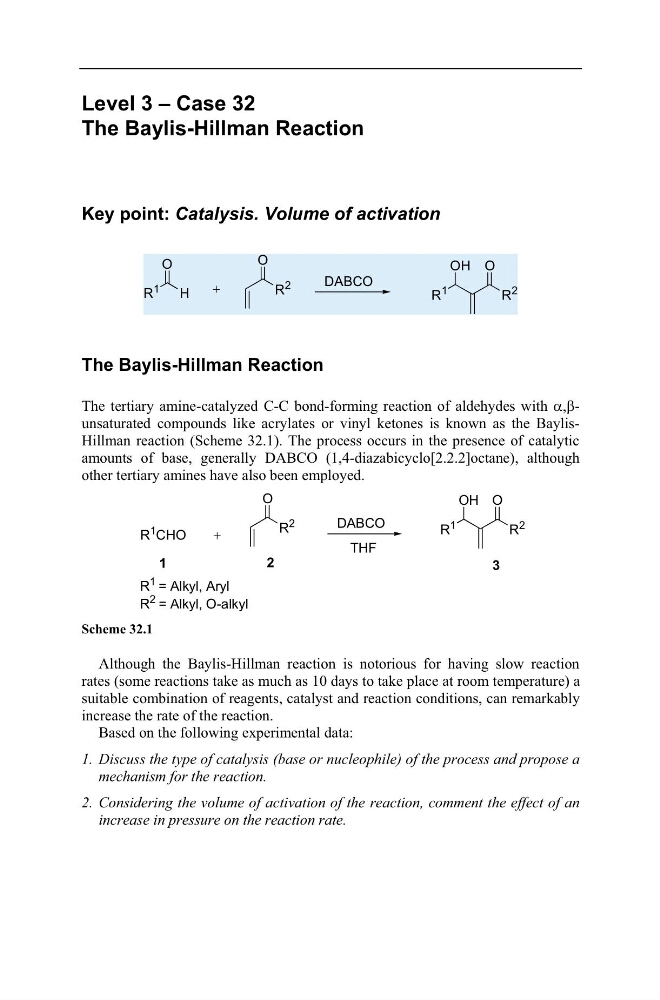
The tertiary amine-catalyzed C-C bond-forming reaction of aldehydes with DEunsaturated compounds like acrylates or vinyl ketones is known as the BaylisHillman reaction (Scheme 32.1). The process occurs in the presence of catalytic
amounts of base, generally DABCO (1,4-diazabicyclo[2.2.2]octane), although
other tertiary amines have also been employed.
R 2
O
DABCO
THF
R 1
R 2
O
OH
R 1 CHO
R 1 = Alkyl, Aryl
R 2 = Alky k k l, O-alkyl
1
2
3
Scheme 32.1
Although the Baylis-Hillman reaction is notorious for having slow reaction
rates (some reactions take as much as 10 days to take place at room temperature) a
suitable combination of reagents, catalyst and reaction conditions, can remarkably
increase the rate of the reaction.
Based on the following experimental data:
1. Discuss the type of catalysis (base or nucleophile) of the process and propose a
mechanism for the reaction.
2. Considering the volume of activation of the reaction, comment the effect of an
increase in pressure on the reaction rate.
The Baylis-Hillman Reaction
Key point: Catalysis. Volume of activation
R 2
O
DABCO
R
1
R
2
O
OH
R 1 H
O
The Baylis-Hillman Reaction
The tertiary amine-catalyzed C-C bond-forming reaction of aldehydes with DEunsaturated compounds like acrylates or vinyl ketones is known as the BaylisHillman reaction (Scheme 32.1). The process occurs in the presence of catalytic
amounts of base, generally DABCO (1,4-diazabicyclo[2.2.2]octane), although
other tertiary amines have also been employed.
R 2
O
DABCO
THF
R 1
R 2
O
OH
R 1 CHO
R 1 = Alkyl, Aryl
R 2 = Alky k k l, O-alkyl
1
2
3
Scheme 32.1
Although the Baylis-Hillman reaction is notorious for having slow reaction
rates (some reactions take as much as 10 days to take place at room temperature) a
suitable combination of reagents, catalyst and reaction conditions, can remarkably
increase the rate of the reaction.
Based on the following experimental data:
1. Discuss the type of catalysis (base or nucleophile) of the process and propose a
mechanism for the reaction.
2. Considering the volume of activation of the reaction, comment the effect of an
increase in pressure on the reaction rate.