

Level 2 – Case 31
206
R
IPh
O
R 1 CH NR 2
2
3
R
O
IPh
R 1
NR 2
N
R 1
R
O
R 2
IPh
12
Scheme 31.6
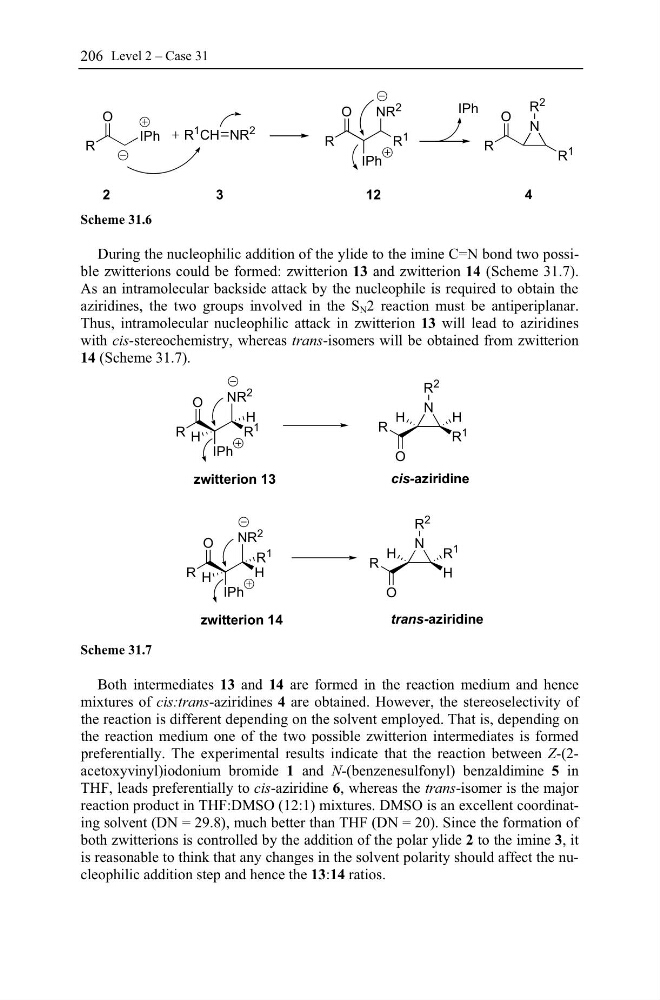
During the nucleophilic addition of the ylide to the imine C=N bond two possible zwitterions could be formed: zwitterion 13 and zwitterion 14 (Scheme 31.7).
As an intramolecular backside attack by the nucleophile is required to obtain the
aziridines, the two groups involved in the S N 2 reaction must be antiperiplanar.
Thus, intramolecular nucleophilic attack in zwitterion 13 will lead to aziridines
with cis-stereochemistry, whereas trans-isomers will be obtained from zwitterion
14 (Scheme 31.7).
R
O
IPh
H
NR 2
R 1
H
R
O
IPh
R 1
NR 2
H
H
N
H
R 2
O
R
H
R 1
N
R 1
R 2
O
R
H
H
N
zwitterion 13
cis-aziridine
zwitterion 14
trans-aziridine
Scheme 31.7
Both intermediates 13 and 14 are formed in the reaction medium and hence
mixtures of cis:trans-aziridines 4 are obtained. However, the stereoselectivity of
the reaction is different depending on the solvent employed. That is, depending on
the reaction medium one of the two possible zwitterion intermediates is formed
preferentially. The experimental results indicate that the reaction between Z-(2- Z Z
acetoxyvinyl)iodonium bromide 1 and N-(benzenesulfonyl) benzaldimine
N N
5 in
THF, leads preferentially to cis-aziridine 6, whereas the trans-isomer is the major
reaction product in THF:DMSO (12:1) mixtures. DMSO is an excellent coordinating solvent (DN = 29.8), much better than THF (DN = 20). Since the formation of
both zwitterions is controlled by the addition of the polar ylide 2 to the imine 3, it
is reasonable to think that any changes in the solvent polarity should affect the nucleophilic addition step and hence the 13:14 ratios.
206
R
IPh
O
R 1 CH NR 2
2
3
R
O
IPh
R 1
NR 2
N
R 1
R
O
R 2
IPh
12
Scheme 31.6
During the nucleophilic addition of the ylide to the imine C=N bond two possible zwitterions could be formed: zwitterion 13 and zwitterion 14 (Scheme 31.7).
As an intramolecular backside attack by the nucleophile is required to obtain the
aziridines, the two groups involved in the S N 2 reaction must be antiperiplanar.
Thus, intramolecular nucleophilic attack in zwitterion 13 will lead to aziridines
with cis-stereochemistry, whereas trans-isomers will be obtained from zwitterion
14 (Scheme 31.7).
R
O
IPh
H
NR 2
R 1
H
R
O
IPh
R 1
NR 2
H
H
N
H
R 2
O
R
H
R 1
N
R 1
R 2
O
R
H
H
N
zwitterion 13
cis-aziridine
zwitterion 14
trans-aziridine
Scheme 31.7
Both intermediates 13 and 14 are formed in the reaction medium and hence
mixtures of cis:trans-aziridines 4 are obtained. However, the stereoselectivity of
the reaction is different depending on the solvent employed. That is, depending on
the reaction medium one of the two possible zwitterion intermediates is formed
preferentially. The experimental results indicate that the reaction between Z-(2- Z Z
acetoxyvinyl)iodonium bromide 1 and N-(benzenesulfonyl) benzaldimine
N N
5 in
THF, leads preferentially to cis-aziridine 6, whereas the trans-isomer is the major
reaction product in THF:DMSO (12:1) mixtures. DMSO is an excellent coordinating solvent (DN = 29.8), much better than THF (DN = 20). Since the formation of
both zwitterions is controlled by the addition of the polar ylide 2 to the imine 3, it
is reasonable to think that any changes in the solvent polarity should affect the nucleophilic addition step and hence the 13:14 ratios.