

Stereoselective Synthesis of 2-Acylaziridines 205
Discussion
Any proposed mechanism for the aziridination of Z-(2-acetoxyvinyl)iodonium Z Z
bromides 1 with imines 3 must give a reasonable explanation for the two steps of
the reaction. In other words, it must be able to interpret the formation of ylides 2
and their further addition to imines 3 to form the aziridines 4.
Do we have any information about the slow step of the process? Well, since
we know that the reaction of iodonium salts 1 with para-substituted N-(arenesul- N N
fonyl)benzaldimines is sensitive to the nature of the substituents present on the
sulfonyl aromatic ring, the imines must be necessarily involved in the rate-determining step of the reaction. In consequence, if the reaction between the ylides and
the imines (second step) is rate-limiting, the formation of the ylides (first step)
must be a fast pre-equilibrium.
Next we are going to discuss each of the two reaction steps in detail.
S St te te t te te te te t tep ep ep p 1 1: : F Fo Fo F Fo Fo Fo F For rm r rm rm rm rm r r a at ti ti ti t ti ti t tio io io io i ion n o of f y yl y yl yl y yl y y i
li li l li li l lid id id i id i ide de d de d de de d des s 2 2
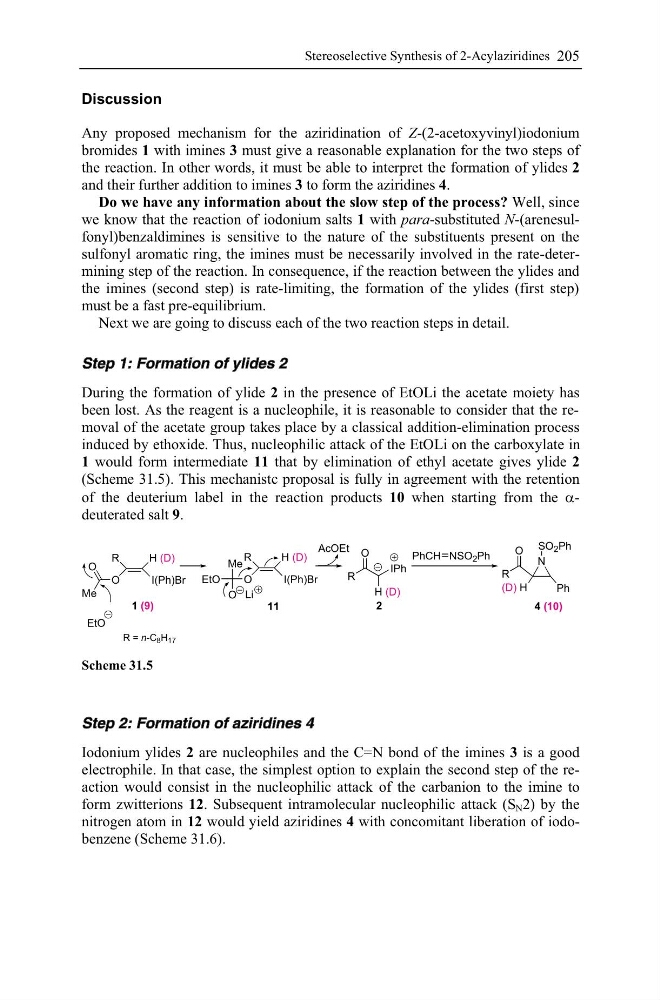
During the formation of ylide 2 in the presence of EtOLi the acetate moiety has
been lost. As the reagent is a nucleophile, it is reasonable to consider that the removal of the acetate group takes place by a classical addition-elimination process
induced by ethoxide. Thus, nucleophilic attack of the EtOLi on the carboxylate in
1 would form intermediate 11 that by elimination of ethyl acetate gives ylide 2
(Scheme 31.5). This mechanistc proposal is fully in agreement with the retention
of the deuterium label in the reaction products 10 when starting from the Ddeuterated salt 9.
I(Ph)Br
O
R
O
Me
H (D)
I(Ph)Br
O
R
Me
O
EtO
H (D)
AcOEt
R
IPh
O
H (D)
PhCH NSO 2 Ph
EtO
Li
N
Ph
R
O SO 2 Ph
(D) H
1 (9)
11
2
4 (10)
R = n-C 8 H 17
Scheme 31.5
S St te te t te te te te t tep ep ep p 2 2: : F Fo Fo F Fo Fo Fo F For rm r rm rm rm rm r r a at ti ti ti t ti ti t tio io io io i ion n o of f a az az a az a a i
zi zi z zi zi z zir i ir i ir i i i
ri ri r ri ri r rid id id i id i idi di di d di di d din i in in in i i e es s 4 4
Iodonium ylides 2 are nucleophiles and the C=N bond of the imines 3 is a good
electrophile. In that case, the simplest option to explain the second step of the reaction would consist in the nucleophilic attack of the carbanion to the imine to
form zwitterions 12. Subsequent intramolecular nucleophilic attack (S N 2) by the
nitrogen atom in 12 would yield aziridines 4 with concomitant liberation of iodobenzene (Scheme 31.6).
Discussion
Any proposed mechanism for the aziridination of Z-(2-acetoxyvinyl)iodonium Z Z
bromides 1 with imines 3 must give a reasonable explanation for the two steps of
the reaction. In other words, it must be able to interpret the formation of ylides 2
and their further addition to imines 3 to form the aziridines 4.
Do we have any information about the slow step of the process? Well, since
we know that the reaction of iodonium salts 1 with para-substituted N-(arenesul- N N
fonyl)benzaldimines is sensitive to the nature of the substituents present on the
sulfonyl aromatic ring, the imines must be necessarily involved in the rate-determining step of the reaction. In consequence, if the reaction between the ylides and
the imines (second step) is rate-limiting, the formation of the ylides (first step)
must be a fast pre-equilibrium.
Next we are going to discuss each of the two reaction steps in detail.
S St te te t te te te te t tep ep ep p 1 1: : F Fo Fo F Fo Fo Fo F For rm r rm rm rm rm r r a at ti ti ti t ti ti t tio io io io i ion n o of f y yl y yl yl y yl y y i
li li l li li l lid id id i id i ide de d de d de de d des s 2 2
During the formation of ylide 2 in the presence of EtOLi the acetate moiety has
been lost. As the reagent is a nucleophile, it is reasonable to consider that the removal of the acetate group takes place by a classical addition-elimination process
induced by ethoxide. Thus, nucleophilic attack of the EtOLi on the carboxylate in
1 would form intermediate 11 that by elimination of ethyl acetate gives ylide 2
(Scheme 31.5). This mechanistc proposal is fully in agreement with the retention
of the deuterium label in the reaction products 10 when starting from the Ddeuterated salt 9.
I(Ph)Br
O
R
O
Me
H (D)
I(Ph)Br
O
R
Me
O
EtO
H (D)
AcOEt
R
IPh
O
H (D)
PhCH NSO 2 Ph
EtO
Li
N
Ph
R
O SO 2 Ph
(D) H
1 (9)
11
2
4 (10)
R = n-C 8 H 17
Scheme 31.5
S St te te t te te te te t tep ep ep p 2 2: : F Fo Fo F Fo Fo Fo F For rm r rm rm rm rm r r a at ti ti ti t ti ti t tio io io io i ion n o of f a az az a az a a i
zi zi z zi zi z zir i ir i ir i i i
ri ri r ri ri r rid id id i id i idi di di d di di d din i in in in i i e es s 4 4
Iodonium ylides 2 are nucleophiles and the C=N bond of the imines 3 is a good
electrophile. In that case, the simplest option to explain the second step of the reaction would consist in the nucleophilic attack of the carbanion to the imine to
form zwitterions 12. Subsequent intramolecular nucleophilic attack (S N 2) by the
nitrogen atom in 12 would yield aziridines 4 with concomitant liberation of iodobenzene (Scheme 31.6).