

Level 2 – Case 31
204
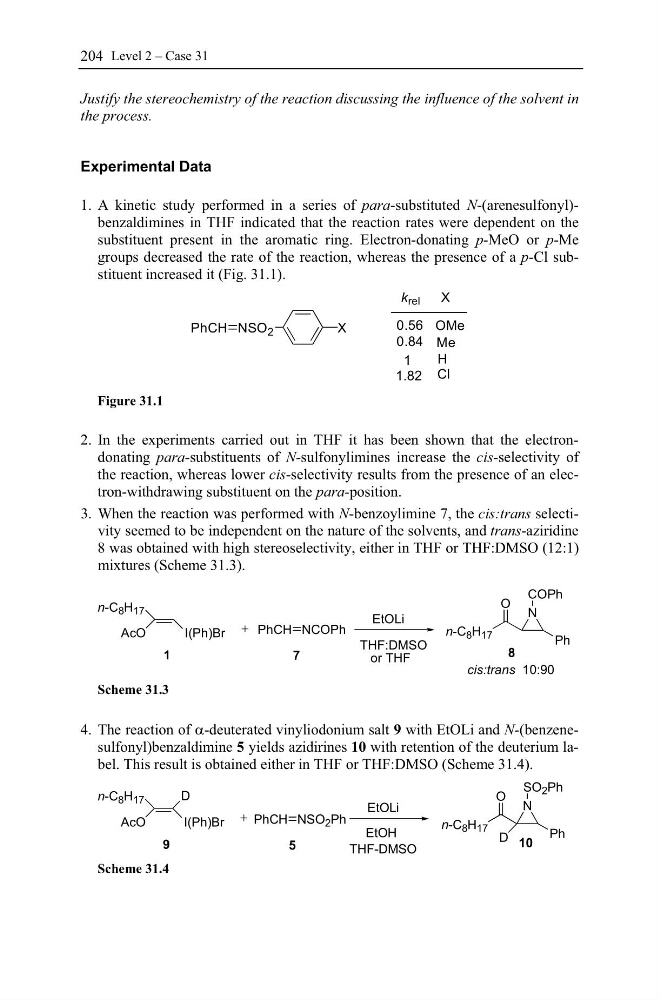
Justify the stereochemistry of the reaction discussing the influence of the solvent in
the process.
Experimental Data
1. A kinetic study performed in a series of para-substituted N-(arenesulfonyl)- N N
benzaldimines in THF indicated that the reaction rates were dependent on the
substituent present in the aromatic ring. Electron-donating p-MeO or p-Me
groups decreased the rate of the reaction, whereas the presence of a p-Cl substituent increased it (Fig. 31.1).
PhCH NSO 2
X
H
Cl
X
Me
OMe
k rel
0.56
0.84
1
1.82
Figure 31.1
2. In the experiments carried out in THF it has been shown that the electrondonating para-substituents of N-sulfonylimines increase the
N N
cis-selectivity of
the reaction, whereas lower cis-selectivity results from the presence of an electron-withdrawing substituent on the para-position.
3. When the reaction was performed with N-benzoylimine 7, the
N N
cis:trans selectivity seemed to be independent on the nature of the solvents, and trans-aziridine
8 was obtained with high stereoselectivity, either in THF or THF:DMSO (12:1)
mixtures (Scheme 31.3).
I(Ph)Br
AcO
n-C 8 H 17
PhCH NCOPh
EtOLi
THF:DMSO
or THF
N
Ph
n-C 8 H 17
O
COPh
7
cis:trans 10:90
8
Scheme 31.3
4. The reaction of D-deuterated vinyliodonium salt 9 with EtOLi and N-(benzene- N N
sulfonyl)benzaldimine 5 yields azidirines 10 with retention of the deuterium label. This result is obtained either in THF or THF:DMSO (Scheme 31.4).
r
I(Ph)Br
AcO
n-C 8 H 17
D
PhCH NSO 2 Ph
EtOH
THF-DMSO
EtOLi
N
Ph
n-C 8 H 17
O
SO 2 Ph
D
9
10
5
Scheme 31.4
204
Justify the stereochemistry of the reaction discussing the influence of the solvent in
the process.
Experimental Data
1. A kinetic study performed in a series of para-substituted N-(arenesulfonyl)- N N
benzaldimines in THF indicated that the reaction rates were dependent on the
substituent present in the aromatic ring. Electron-donating p-MeO or p-Me
groups decreased the rate of the reaction, whereas the presence of a p-Cl substituent increased it (Fig. 31.1).
PhCH NSO 2
X
H
Cl
X
Me
OMe
k rel
0.56
0.84
1
1.82
Figure 31.1
2. In the experiments carried out in THF it has been shown that the electrondonating para-substituents of N-sulfonylimines increase the
N N
cis-selectivity of
the reaction, whereas lower cis-selectivity results from the presence of an electron-withdrawing substituent on the para-position.
3. When the reaction was performed with N-benzoylimine 7, the
N N
cis:trans selectivity seemed to be independent on the nature of the solvents, and trans-aziridine
8 was obtained with high stereoselectivity, either in THF or THF:DMSO (12:1)
mixtures (Scheme 31.3).
I(Ph)Br
AcO
n-C 8 H 17
PhCH NCOPh
EtOLi
THF:DMSO
or THF
N
Ph
n-C 8 H 17
O
COPh
7
cis:trans 10:90
8
Scheme 31.3
4. The reaction of D-deuterated vinyliodonium salt 9 with EtOLi and N-(benzene- N N
sulfonyl)benzaldimine 5 yields azidirines 10 with retention of the deuterium label. This result is obtained either in THF or THF:DMSO (Scheme 31.4).
r
I(Ph)Br
AcO
n-C 8 H 17
D
PhCH NSO 2 Ph
EtOH
THF-DMSO
EtOLi
N
Ph
n-C 8 H 17
O
SO 2 Ph
D
9
10
5
Scheme 31.4