

Stereoselective Synthesis of 2-Acylaziridines 207
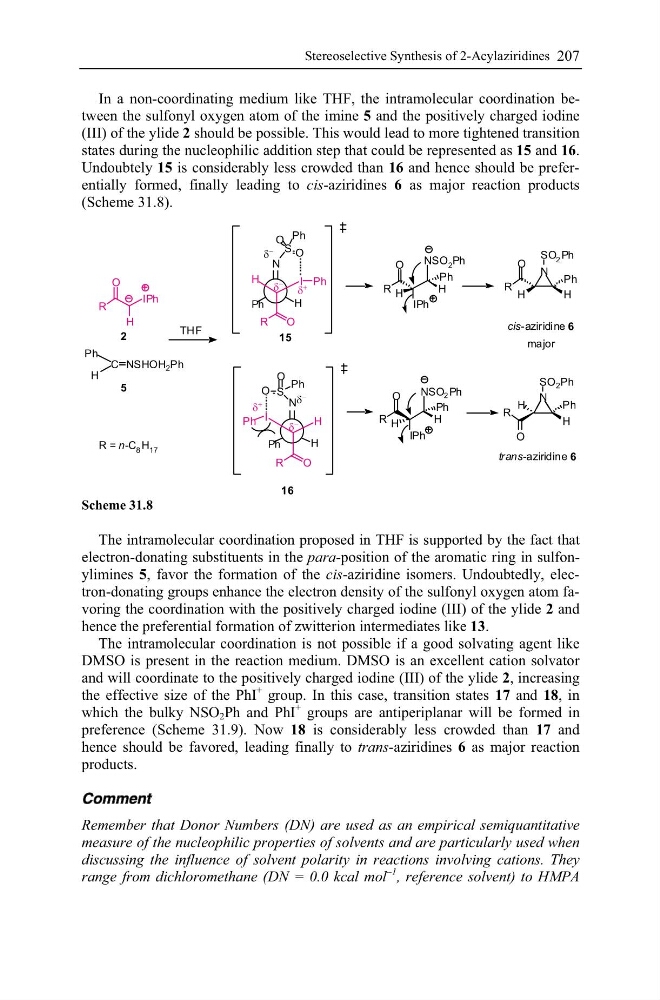
In a non-coordinating medium like THF, the intramolecular coordination between the sulfonyl oxygen atom of the imine 5 and the positively charged iodine
(III) of the ylide 2 should be possible. This would lead to more tightened transition
states during the nucleophilic addition step that could be represented as 15 and 16.
Undoubtely 15 is considerably less crowded than 16 and hence should be preferentially formed, finally leading to cis-aziridines 6 as major reaction products
(Scheme 31.8).
H
H
O
IPh
H
R
THF
C NSHOH 2 Ph
Ph h
H
Ph Ph
Ph Ph
H
O
R
N
S S
I
Ph
O
O O Ph
H
I
O
R
Ph
N
S S O
Ph
O O
H
NSO 2
O Ph
Ph
H
R
O O
IPh
Ph
H
R
O
IPh
H
NSO 2 Ph
R
H
P h
H
N N
H
O
SO 2 Ph
H
O O
R
N N
H
SO 2
O O Ph
Ph
2
5
trans-aziridine 6
G
G
G
R = n-C 8 H 17
major
15
cis-aziridine 6
16
G
G
G
Scheme 31.8
The intramolecular coordination proposed in THF is supported by the fact that
electron-donating substituents in the para-position of the aromatic ring in sulfonylimines 5, favor the formation of the cis-aziridine isomers. Undoubtedly, electron-donating groups enhance the electron density of the sulfonyl oxygen atom favoring the coordination with the positively charged iodine (III) of the ylide 2 and
hence the preferential formation of zwitterion intermediates like 13.
The intramolecular coordination is not possible if a good solvating agent like
DMSO is present in the reaction medium. DMSO is an excellent cation solvator
and will coordinate to the positively charged iodine (III) of the ylide 2, increasing
the effective size of the PhI
+ group. In this case, transition states 17 and 18, in
which the bulky NSO 2 Ph and PhI
+ groups are antiperiplanar will be formed in
preference (Scheme 31.9). Now 18 is considerably less crowded than 17 and
hence should be favored, leading finally to trans-aziridines 6 as major reaction
products.
C Co om mm me en nt t
Remember that Donor Numbers (DN) are used as an empirical semiquantitative
measure of the nucleophilic properties of solvents and are particularly used when
discussing the influence of solvent polarity in reactions involving cations. They
range from dichloromethane (DN = 0.0 kcal mol
–1
l l , reference solvent) to HMPA
In a non-coordinating medium like THF, the intramolecular coordination between the sulfonyl oxygen atom of the imine 5 and the positively charged iodine
(III) of the ylide 2 should be possible. This would lead to more tightened transition
states during the nucleophilic addition step that could be represented as 15 and 16.
Undoubtely 15 is considerably less crowded than 16 and hence should be preferentially formed, finally leading to cis-aziridines 6 as major reaction products
(Scheme 31.8).
H
H
O
IPh
H
R
THF
C NSHOH 2 Ph
Ph h
H
Ph Ph
Ph Ph
H
O
R
N
S S
I
Ph
O
O O Ph
H
I
O
R
Ph
N
S S O
Ph
O O
H
NSO 2
O Ph
Ph
H
R
O O
IPh
Ph
H
R
O
IPh
H
NSO 2 Ph
R
H
P h
H
N N
H
O
SO 2 Ph
H
O O
R
N N
H
SO 2
O O Ph
Ph
2
5
trans-aziridine 6
G
G
G
R = n-C 8 H 17
major
15
cis-aziridine 6
16
G
G
G
Scheme 31.8
The intramolecular coordination proposed in THF is supported by the fact that
electron-donating substituents in the para-position of the aromatic ring in sulfonylimines 5, favor the formation of the cis-aziridine isomers. Undoubtedly, electron-donating groups enhance the electron density of the sulfonyl oxygen atom favoring the coordination with the positively charged iodine (III) of the ylide 2 and
hence the preferential formation of zwitterion intermediates like 13.
The intramolecular coordination is not possible if a good solvating agent like
DMSO is present in the reaction medium. DMSO is an excellent cation solvator
and will coordinate to the positively charged iodine (III) of the ylide 2, increasing
the effective size of the PhI
+ group. In this case, transition states 17 and 18, in
which the bulky NSO 2 Ph and PhI
+ groups are antiperiplanar will be formed in
preference (Scheme 31.9). Now 18 is considerably less crowded than 17 and
hence should be favored, leading finally to trans-aziridines 6 as major reaction
products.
C Co om mm me en nt t
Remember that Donor Numbers (DN) are used as an empirical semiquantitative
measure of the nucleophilic properties of solvents and are particularly used when
discussing the influence of solvent polarity in reactions involving cations. They
range from dichloromethane (DN = 0.0 kcal mol
–1
l l , reference solvent) to HMPA