

Level 2 – Case 29
194
Apparently, in both mechanisms the steric factors are important to explain the
relative reaction rates observed for the different substrates. At this point we should
study in detail the remaining data, starting with the differences observed in the
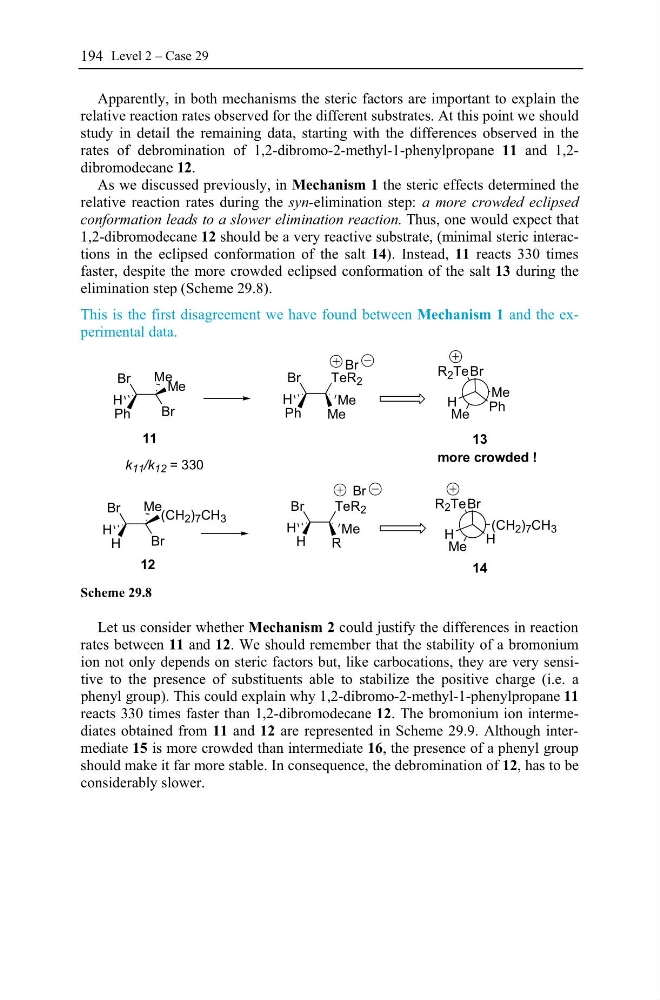
rates of debromination of 1,2-dibromo-2-methyl-1-phenylpropane 11 and 1,2dibromodecane 12.
As we discussed previously, in Mechanism 1 the steric effects determined the
relative reaction rates during the syn-elimination step: a more crowded eclipsed
conformation leads to a slower elimination reaction. Thus, one would expect that
1,2-dibromodecane 12 should be a very reactive substrate, (minimal steric interactions in the eclipsed conformation of the salt 14). Instead, 11 reacts 330 times
faster, despite the more crowded eclipsed conformation of the salt 13 during the
elimination step (Scheme 29.8).
This is the first disagreement we have found between Mechanism 1 and the experimental data.
Br
Br
Me
Me
M M
Ph
H
Br
Me
Ph
H
Me
TeR 2
Br
H
Me
R 2 Te
Me
Br
Ph
11
more crowded !
k 11 /k 12 = 330
2
Br
Br
(CH 2 ) 7 CH 3
Me
H
H
Br
R
H
H
Me
TeR 2
Br
H
Me
R 2 Te
(CH 2 ) 7 CH 3
Br
H
12
14
13
Scheme 29.8
Let us consider whether Mechanism 2
r
could justify the differences in reaction
rates between 11 and 12. We should remember that the stability of a bromonium
ion not only depends on steric factors but, like carbocations, they are very sensitive to the presence of substituents able to stabilize the positive charge (i.e. a
phenyl group). This could explain why 1,2-dibromo-2-methyl-1-phenylpropane 11
reacts 330 times faster than 1,2-dibromodecane 12. The bromonium ion intermediates obtained from 11 and 12 are represented in Scheme 29.9. Although intermediate 15 is more crowded than intermediate 16, the presence of a phenyl group
should make it far more stable. In consequence, the debromination of 12, has to be
considerably slower.
194
Apparently, in both mechanisms the steric factors are important to explain the
relative reaction rates observed for the different substrates. At this point we should
study in detail the remaining data, starting with the differences observed in the
rates of debromination of 1,2-dibromo-2-methyl-1-phenylpropane 11 and 1,2dibromodecane 12.
As we discussed previously, in Mechanism 1 the steric effects determined the
relative reaction rates during the syn-elimination step: a more crowded eclipsed
conformation leads to a slower elimination reaction. Thus, one would expect that
1,2-dibromodecane 12 should be a very reactive substrate, (minimal steric interactions in the eclipsed conformation of the salt 14). Instead, 11 reacts 330 times
faster, despite the more crowded eclipsed conformation of the salt 13 during the
elimination step (Scheme 29.8).
This is the first disagreement we have found between Mechanism 1 and the experimental data.
Br
Br
Me
Me
M M
Ph
H
Br
Me
Ph
H
Me
TeR 2
Br
H
Me
R 2 Te
Me
Br
Ph
11
more crowded !
k 11 /k 12 = 330
2
Br
Br
(CH 2 ) 7 CH 3
Me
H
H
Br
R
H
H
Me
TeR 2
Br
H
Me
R 2 Te
(CH 2 ) 7 CH 3
Br
H
12
14
13
Scheme 29.8
Let us consider whether Mechanism 2
r
could justify the differences in reaction
rates between 11 and 12. We should remember that the stability of a bromonium
ion not only depends on steric factors but, like carbocations, they are very sensitive to the presence of substituents able to stabilize the positive charge (i.e. a
phenyl group). This could explain why 1,2-dibromo-2-methyl-1-phenylpropane 11
reacts 330 times faster than 1,2-dibromodecane 12. The bromonium ion intermediates obtained from 11 and 12 are represented in Scheme 29.9. Although intermediate 15 is more crowded than intermediate 16, the presence of a phenyl group
should make it far more stable. In consequence, the debromination of 12, has to be
considerably slower.