

Stereoselective Debromination of Vicinal Dibromides 195
H
(CH 2 ) 7 CH 3
H
Me
Br
Br
Br
Me
Me
M M
Ph
H
Br
Br
(CH 2 ) 7 CH 3
Me
H
H
Me
H
Me
Br
15
16
11
12
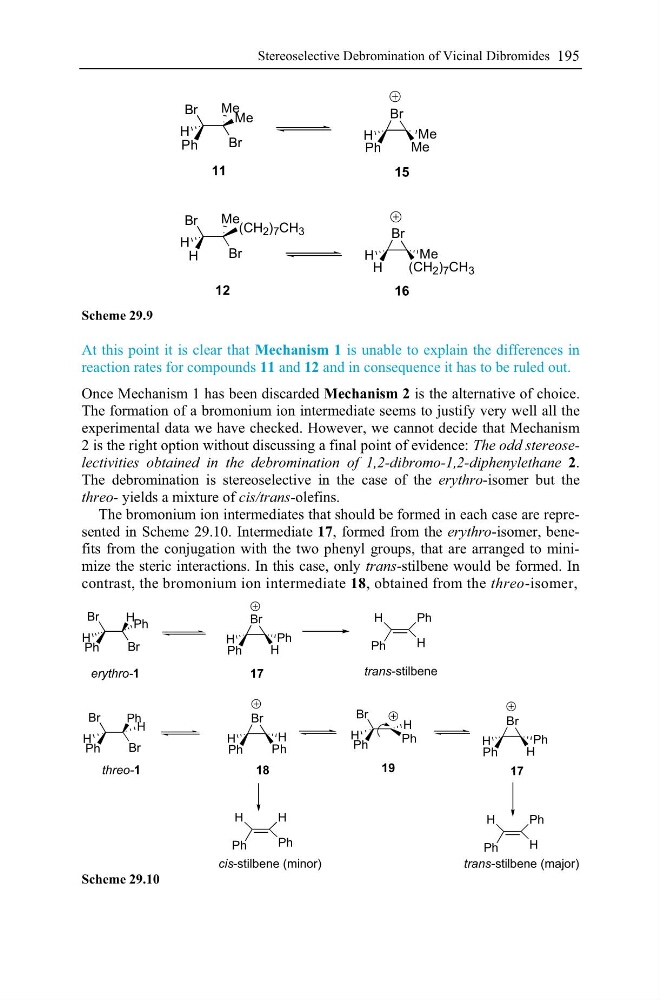
Scheme 29.9
At this point it is clear that Mechanism 1 is unable to explain the differences in
reaction rates for compounds 11 and 12 and in consequence it has to be ruled out.
Once Mechanism 1 has been discarded Mechanism 2 is the alternative of choice.
The formation of a bromonium ion intermediate seems to justify very well all the
experimental data we have checked. However, we cannot decide that Mechanism
2 is the right option without discussing a final point of evidence: The odd stereoselectivities obtained in the debromination of 1,2-dibromo-1,2-diphenylethane 2.
The debromination is stereoselective in the case of the erythro-isomer but the
threo- yields a mixture of cis/trans-olefins.
The bromonium ion intermediates that should be formed in each case are represented in Scheme 29.10. Intermediate 17, formed from the erythro-isomer, benefits from the conjugation with the two phenyl groups, that are arranged to minimize the steric interactions. In this case, only trans-stilbene would be formed. In
contrast, the bromonium ion intermediate 18, obtained from the threo-isomer,
Ph
H
H
Ph
Br
Ph
Br
Br
H
Ph
H
threo-1
erythro-1
Ph
Br
H
Ph
Ph
H
H
Br
Ph
H
Ph
Br
Br
Ph
H
h h
H
Ph
H
H
Ph
Br
trans-stilbene
cis-stilbene (minor)
trans-stilbene (major)
Ph
H
Ph
H
H
Ph
Ph
H
Ph
H
Ph
H
17
18
17 1 1 1
19
Scheme 29.10
H
(CH 2 ) 7 CH 3
H
Me
Br
Br
Br
Me
Me
M M
Ph
H
Br
Br
(CH 2 ) 7 CH 3
Me
H
H
Me
H
Me
Br
15
16
11
12
Scheme 29.9
At this point it is clear that Mechanism 1 is unable to explain the differences in
reaction rates for compounds 11 and 12 and in consequence it has to be ruled out.
Once Mechanism 1 has been discarded Mechanism 2 is the alternative of choice.
The formation of a bromonium ion intermediate seems to justify very well all the
experimental data we have checked. However, we cannot decide that Mechanism
2 is the right option without discussing a final point of evidence: The odd stereoselectivities obtained in the debromination of 1,2-dibromo-1,2-diphenylethane 2.
The debromination is stereoselective in the case of the erythro-isomer but the
threo- yields a mixture of cis/trans-olefins.
The bromonium ion intermediates that should be formed in each case are represented in Scheme 29.10. Intermediate 17, formed from the erythro-isomer, benefits from the conjugation with the two phenyl groups, that are arranged to minimize the steric interactions. In this case, only trans-stilbene would be formed. In
contrast, the bromonium ion intermediate 18, obtained from the threo-isomer,
Ph
H
H
Ph
Br
Ph
Br
Br
H
Ph
H
threo-1
erythro-1
Ph
Br
H
Ph
Ph
H
H
Br
Ph
H
Ph
Br
Br
Ph
H
h h
H
Ph
H
H
Ph
Br
trans-stilbene
cis-stilbene (minor)
trans-stilbene (major)
Ph
H
Ph
H
H
Ph
Ph
H
Ph
H
Ph
H
17
18
17 1 1 1
19
Scheme 29.10