

Stereoselective Debromination of Vicinal Dibromides 193
cis-olefin
H
R
R 2 Te
H
Br
R
trans-olefin
H
R
H
R
R
H
H
R
H
H
R 2 Te
R
Br
R
syn-elimination
syn-elimination
Br
Br
R
H
R
H
threo-dibromide
Br
Br
H
R
R
H
erythro-dibromide
erythro-salt
threo-salt
7
8
TeR 2
TeR 2
Scheme 29.6
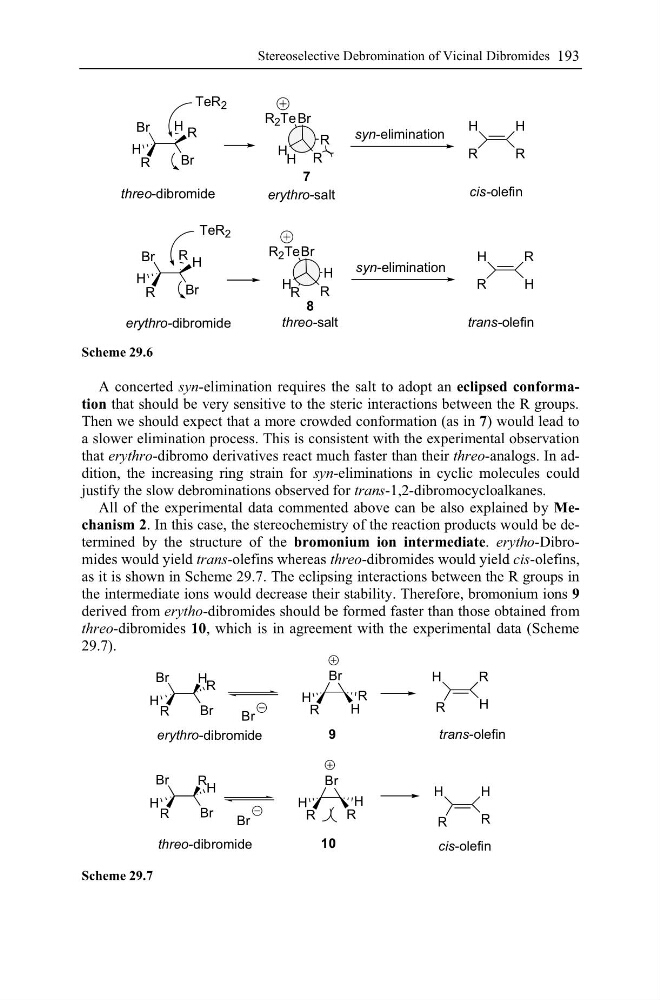
A concerted syn-elimination requires the salt to adopt an eclipsed conformation that should be very sensitive to the steric interactions between the R groups.
Then we should expect that a more crowded conformation (as in 7) would lead to
a slower elimination process. This is consistent with the experimental observation
that erythro-dibromo derivatives react much faster than their threo-analogs. In addition, the increasing ring strain for syn-eliminations in cyclic molecules could
justify the slow debrominations observed for trans-1,2-dibromocycloalkanes.
All of the experimental data commented above can be also explained by Mechanism 2. In this case, the stereochemistry of the reaction products would be determined by the structure of the bromonium ion intermediate. erytho-Dibromides would yield trans-olefins whereas threo-dibromides would yield cis-olefins,
as it is shown in Scheme 29.7. The eclipsing interactions between the R groups in
the intermediate ions would decrease their stability. Therefore, bromonium ions 9
derived from erytho-dibromides should be formed faster than those obtained from
threo-dibromides 10, which is in agreement with the experimental data (Scheme
29.7).
R
Br
Br
H
R
H
R
H
H
R
Br
R
Br
Br
R
H
H
R
R
H
H
Br
erythro-dibromide
threo-dibromide
cis-olefin
trans-olefin
R
H
R
H
H
R
R
H
9
10
Br
Br
Scheme 29.7
cis-olefin
H
R
R 2 Te
H
Br
R
trans-olefin
H
R
H
R
R
H
H
R
H
H
R 2 Te
R
Br
R
syn-elimination
syn-elimination
Br
Br
R
H
R
H
threo-dibromide
Br
Br
H
R
R
H
erythro-dibromide
erythro-salt
threo-salt
7
8
TeR 2
TeR 2
Scheme 29.6
A concerted syn-elimination requires the salt to adopt an eclipsed conformation that should be very sensitive to the steric interactions between the R groups.
Then we should expect that a more crowded conformation (as in 7) would lead to
a slower elimination process. This is consistent with the experimental observation
that erythro-dibromo derivatives react much faster than their threo-analogs. In addition, the increasing ring strain for syn-eliminations in cyclic molecules could
justify the slow debrominations observed for trans-1,2-dibromocycloalkanes.
All of the experimental data commented above can be also explained by Mechanism 2. In this case, the stereochemistry of the reaction products would be determined by the structure of the bromonium ion intermediate. erytho-Dibromides would yield trans-olefins whereas threo-dibromides would yield cis-olefins,
as it is shown in Scheme 29.7. The eclipsing interactions between the R groups in
the intermediate ions would decrease their stability. Therefore, bromonium ions 9
derived from erytho-dibromides should be formed faster than those obtained from
threo-dibromides 10, which is in agreement with the experimental data (Scheme
29.7).
R
Br
Br
H
R
H
R
H
H
R
Br
R
Br
Br
R
H
H
R
R
H
H
Br
erythro-dibromide
threo-dibromide
cis-olefin
trans-olefin
R
H
R
H
H
R
R
H
9
10
Br
Br
Scheme 29.7