

Level 2 – Case 29
192
After analyzing the kinetic data we are not able to decide which one is the best option. Both mechanisms are in good agreement with the rate law and both can justify why the reaction is accelerated in more polar solvents and with more electron-rich organotellurides.
It is time to discuss the stereochemistry of the reaction.
S St te te t te te te te t ter re re r re re re re r reo oc ch he em mi is is i is i is is i i t tr t tr tr tr tr t t y
ry ry y
From the experimental data we know that the debromination is highly stereoselective, threo-dibromides leading to cis-olefins and erythro-dibromides to transolefins. Let us consider whether the two proposed mechanisms can explain these
results.
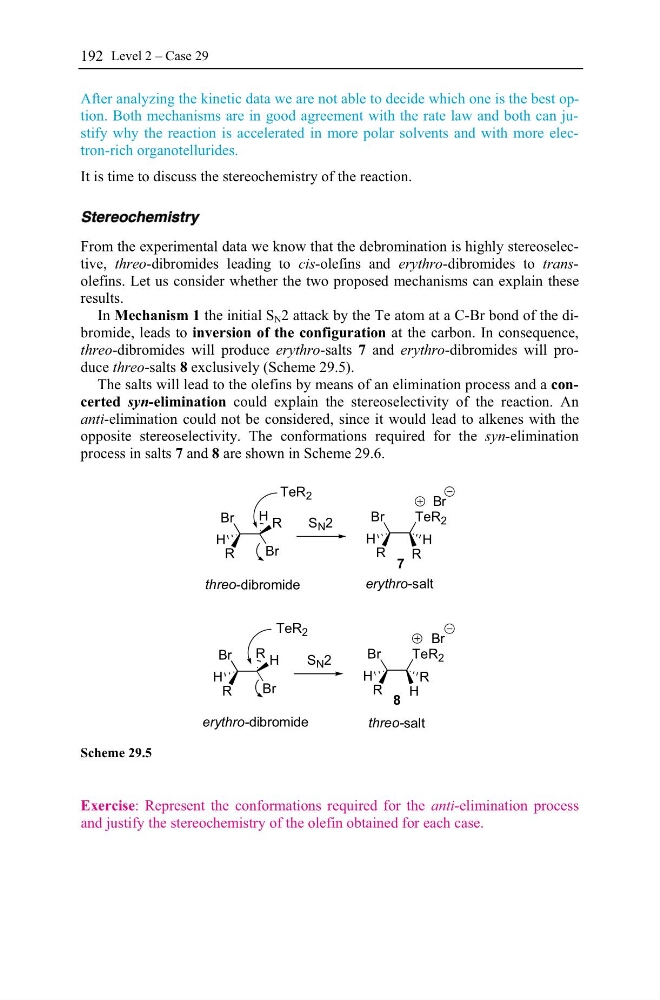
In Mechanism 1 the initial S N 2 attack by the Te atom at a C-Br bond of the dibromide, leads to inversion of the configuration at the carbon. In consequence,
threo-dibromides will produce erythro-salts 7 and erythro-dibromides will produce threo-salts 8 exclusively (Scheme 29.5).
The salts will lead to the olefins by means of an elimination process and a concerted syn-elimination could explain the stereoselectivity of the reaction. An
anti-elimination could not be considered, since it would lead to alkenes with the
opposite stereoselectivity. The conformations required for the syn-elimination
process in salts 7 and 8 are shown in Scheme 29.6.
Br
Br
R
H
R
H
Br
R
R
H
H
TeR 2
Br
threo-dibromide
erythro-salt
Br
Br
H
R
R
H
Br
H
R
H
R
TeR 2
Br
erythro-dibromide
threo-salt
S N 2
S N 2
7
8
TeR 2
TeR 2
Scheme 29.5
Exercise: Represent the conformations required for the anti-elimination process
and justify the stereochemistry of the olefin obtained for each case.
192
After analyzing the kinetic data we are not able to decide which one is the best option. Both mechanisms are in good agreement with the rate law and both can justify why the reaction is accelerated in more polar solvents and with more electron-rich organotellurides.
It is time to discuss the stereochemistry of the reaction.
S St te te t te te te te t ter re re r re re re re r reo oc ch he em mi is is i is i is is i i t tr t tr tr tr tr t t y
ry ry y
From the experimental data we know that the debromination is highly stereoselective, threo-dibromides leading to cis-olefins and erythro-dibromides to transolefins. Let us consider whether the two proposed mechanisms can explain these
results.
In Mechanism 1 the initial S N 2 attack by the Te atom at a C-Br bond of the dibromide, leads to inversion of the configuration at the carbon. In consequence,
threo-dibromides will produce erythro-salts 7 and erythro-dibromides will produce threo-salts 8 exclusively (Scheme 29.5).
The salts will lead to the olefins by means of an elimination process and a concerted syn-elimination could explain the stereoselectivity of the reaction. An
anti-elimination could not be considered, since it would lead to alkenes with the
opposite stereoselectivity. The conformations required for the syn-elimination
process in salts 7 and 8 are shown in Scheme 29.6.
Br
Br
R
H
R
H
Br
R
R
H
H
TeR 2
Br
threo-dibromide
erythro-salt
Br
Br
H
R
R
H
Br
H
R
H
R
TeR 2
Br
erythro-dibromide
threo-salt
S N 2
S N 2
7
8
TeR 2
TeR 2
Scheme 29.5
Exercise: Represent the conformations required for the anti-elimination process
and justify the stereochemistry of the olefin obtained for each case.