

Stereoselective Debromination of Vicinal Dibromides 191
D Di is sc cu us ss si io on n
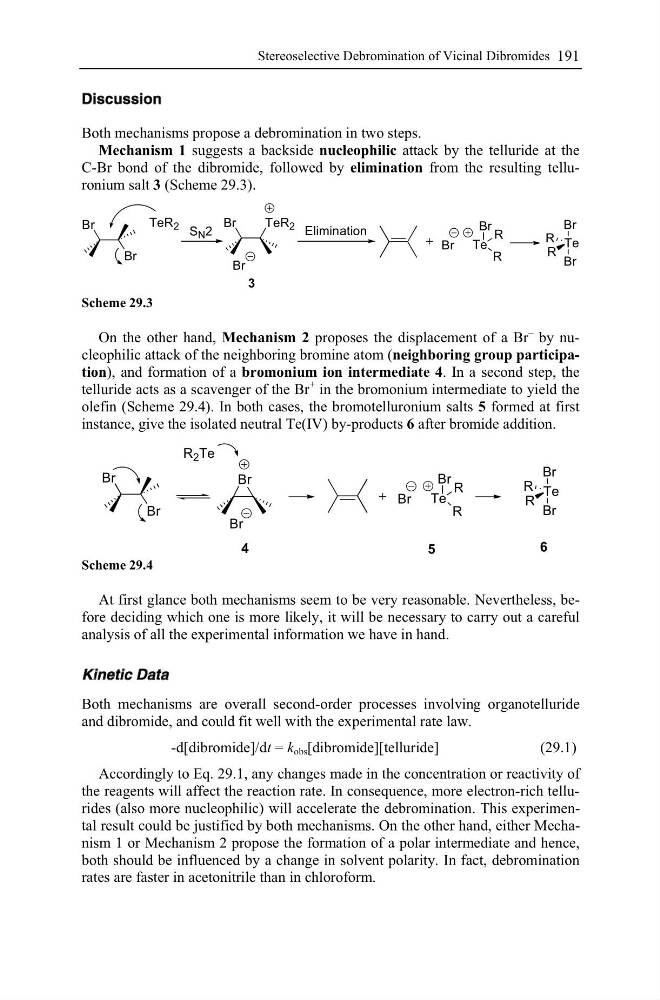
Both mechanisms propose a debromination in two steps.
Mechanism 1 suggests a backside nucleophilic attack by the telluride at the
C-Br bond of the dibromide, followed by elimination from the resulting telluronium salt 3 (Scheme 29.3).
Br
Br
TeR 2 S N 2
Br
TeR 2
Br
Br Te
Br R
R
Br
Te
Br
R
R
Elimination
3
Scheme 29.3
On the other hand, Mechanism 2 proposes the displacement of a Br
– by nu–
cleophilic attack of the neighboring bromine atom (neighboring group participation), and formation of a bromonium ion intermediate 4. In a second step, the
telluride acts as a scavenger of the Br
+ in the bromonium intermediate to yield the
olefin (Scheme 29.4). In both cases, the bromotelluronium salts 5 formed at first
instance, give the isolated neutral Te(IV) by-products 6 after bromide addition.
Br
Br
Br
Te
Br R
R
4
6
5
R 2 Te
Br
Br
Br
Te
Br
R
R
Scheme 29.4
At first glance both mechanisms seem to be very reasonable. Nevertheless, before deciding which one is more likely, it will be necessary to carry out a careful
analysis of all the experimental information we have in hand.
K Ki Ki Ki K Ki Ki K Kin i in in in i i e et ti ti ti t ti ti t tic ic ic ic i i D Da Da Da Da
Da Dat ta ta t ta ta ta ta t ta
Both mechanisms are overall second-order processes involving organotelluride
and dibromide, and could fit well with the experimental rate law.
-d[dibromide]/dt =
t k obs
k k [dibromide][telluride]
(29.1)
Accordingly to Eq. 29.1, any changes made in the concentration or reactivity of
the reagents will affect the reaction rate. In consequence, more electron-rich tellurides (also more nucleophilic) will accelerate the debromination. This experimental result could be justified by both mechanisms. On the other hand, either Mechanism 1 or Mechanism 2 propose the formation of a polar intermediate and hence,
both should be influenced by a change in solvent polarity. In fact, debromination
rates are faster in acetonitrile than in chloroform.
D Di is sc cu us ss si io on n
Both mechanisms propose a debromination in two steps.
Mechanism 1 suggests a backside nucleophilic attack by the telluride at the
C-Br bond of the dibromide, followed by elimination from the resulting telluronium salt 3 (Scheme 29.3).
Br
Br
TeR 2 S N 2
Br
TeR 2
Br
Br Te
Br R
R
Br
Te
Br
R
R
Elimination
3
Scheme 29.3
On the other hand, Mechanism 2 proposes the displacement of a Br
– by nu–
cleophilic attack of the neighboring bromine atom (neighboring group participation), and formation of a bromonium ion intermediate 4. In a second step, the
telluride acts as a scavenger of the Br
+ in the bromonium intermediate to yield the
olefin (Scheme 29.4). In both cases, the bromotelluronium salts 5 formed at first
instance, give the isolated neutral Te(IV) by-products 6 after bromide addition.
Br
Br
Br
Te
Br R
R
4
6
5
R 2 Te
Br
Br
Br
Te
Br
R
R
Scheme 29.4
At first glance both mechanisms seem to be very reasonable. Nevertheless, before deciding which one is more likely, it will be necessary to carry out a careful
analysis of all the experimental information we have in hand.
K Ki Ki Ki K Ki Ki K Kin i in in in i i e et ti ti ti t ti ti t tic ic ic ic i i D Da Da Da Da
Da Dat ta ta t ta ta ta ta t ta
Both mechanisms are overall second-order processes involving organotelluride
and dibromide, and could fit well with the experimental rate law.
-d[dibromide]/dt =
t k obs
k k [dibromide][telluride]
(29.1)
Accordingly to Eq. 29.1, any changes made in the concentration or reactivity of
the reagents will affect the reaction rate. In consequence, more electron-rich tellurides (also more nucleophilic) will accelerate the debromination. This experimental result could be justified by both mechanisms. On the other hand, either Mechanism 1 or Mechanism 2 propose the formation of a polar intermediate and hence,
both should be influenced by a change in solvent polarity. In fact, debromination
rates are faster in acetonitrile than in chloroform.