

Level 2 – Case 29
190
Br
Br
Br
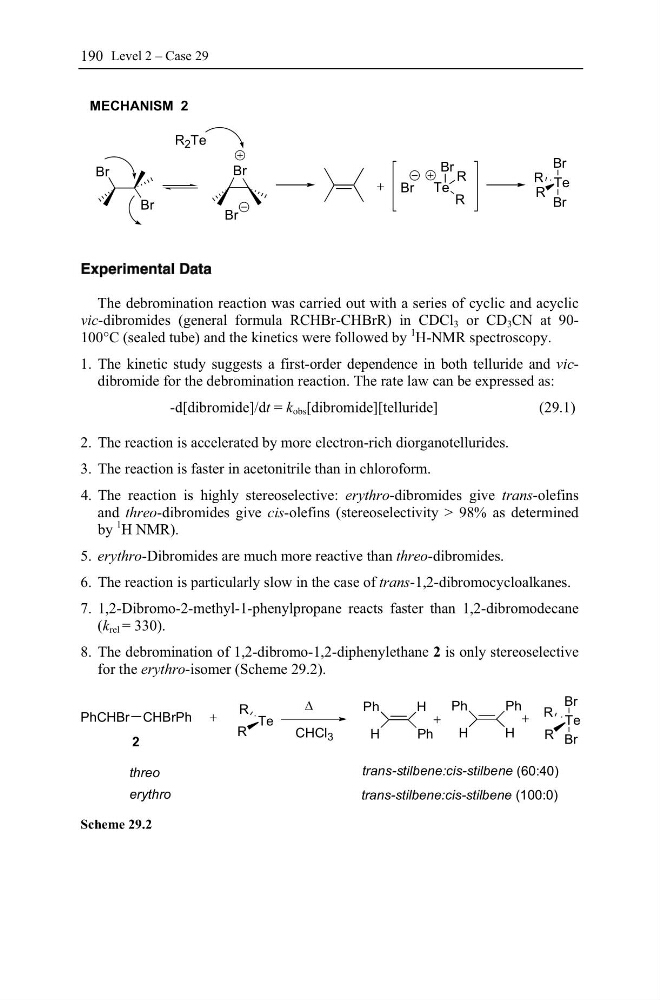
MECHANISM 2
Te
Br R
R
Br
Te
Br
R
R
R 2 Te
Br
Br
E Ex xp pe er ri im me en nt ta al l D Da at ta a
The debromination reaction was carried out with a series of cyclic and acyclic
vic-dibromides (general formula RCHBr-CHBrR) in CDCl 3 or CD 3 CN at 90100°C (sealed tube) and the kinetics were followed by
1
H-NMR spectroscopy.
1. The kinetic study suggests a first-order dependence in both telluride and vicdibromide for the debromination reaction. The rate law can be expressed as:
-d[dibromide]/dt =
t k obs
k k [dibromide][telluride]
(29.1)
2. The reaction is accelerated by more electron-rich diorganotellurides.
3. The reaction is faster in acetonitrile than in chloroform.
4. The reaction is highly stereoselective: erythro-dibromides give trans-olefins
and threo-dibromides give cis-olefins (stereoselectivity > 98% as determined
by
1 H NMR).
5. erythro-Dibromides are much more reactive than threo-dibromides.
6. The reaction is particularly slow in the case of trans-1,2-dibromocycloalkanes.
7. 1,2-Dibromo-2-methyl-1-phenylpropane reacts faster than 1,2-dibromodecane
(k rel
k k = 330).
8. The debromination of 1,2-dibromo-1,2-diphenylethane 2 is only stereoselective
for the erythro-isomer (Scheme 29.2).
R
Te
R
H
Ph
Ph
H
'
PhCHBr CHBrPh
CHCl 3
Ph
H
Ph
H
threo
erythro
trans-stilbene:cis-stilbene (60:40)
trans-stilbene:cis-stilbene (100:0)
2
Br
Te
Br
R
R
Scheme 29.2
190
Br
Br
Br
MECHANISM 2
Te
Br R
R
Br
Te
Br
R
R
R 2 Te
Br
Br
E Ex xp pe er ri im me en nt ta al l D Da at ta a
The debromination reaction was carried out with a series of cyclic and acyclic
vic-dibromides (general formula RCHBr-CHBrR) in CDCl 3 or CD 3 CN at 90100°C (sealed tube) and the kinetics were followed by
1
H-NMR spectroscopy.
1. The kinetic study suggests a first-order dependence in both telluride and vicdibromide for the debromination reaction. The rate law can be expressed as:
-d[dibromide]/dt =
t k obs
k k [dibromide][telluride]
(29.1)
2. The reaction is accelerated by more electron-rich diorganotellurides.
3. The reaction is faster in acetonitrile than in chloroform.
4. The reaction is highly stereoselective: erythro-dibromides give trans-olefins
and threo-dibromides give cis-olefins (stereoselectivity > 98% as determined
by
1 H NMR).
5. erythro-Dibromides are much more reactive than threo-dibromides.
6. The reaction is particularly slow in the case of trans-1,2-dibromocycloalkanes.
7. 1,2-Dibromo-2-methyl-1-phenylpropane reacts faster than 1,2-dibromodecane
(k rel
k k = 330).
8. The debromination of 1,2-dibromo-1,2-diphenylethane 2 is only stereoselective
for the erythro-isomer (Scheme 29.2).
R
Te
R
H
Ph
Ph
H
'
PhCHBr CHBrPh
CHCl 3
Ph
H
Ph
H
threo
erythro
trans-stilbene:cis-stilbene (60:40)
trans-stilbene:cis-stilbene (100:0)
2
Br
Te
Br
R
R
Scheme 29.2