

A Dearomatizing Disrotatory Electrocyclic Ring Closure
r r
187
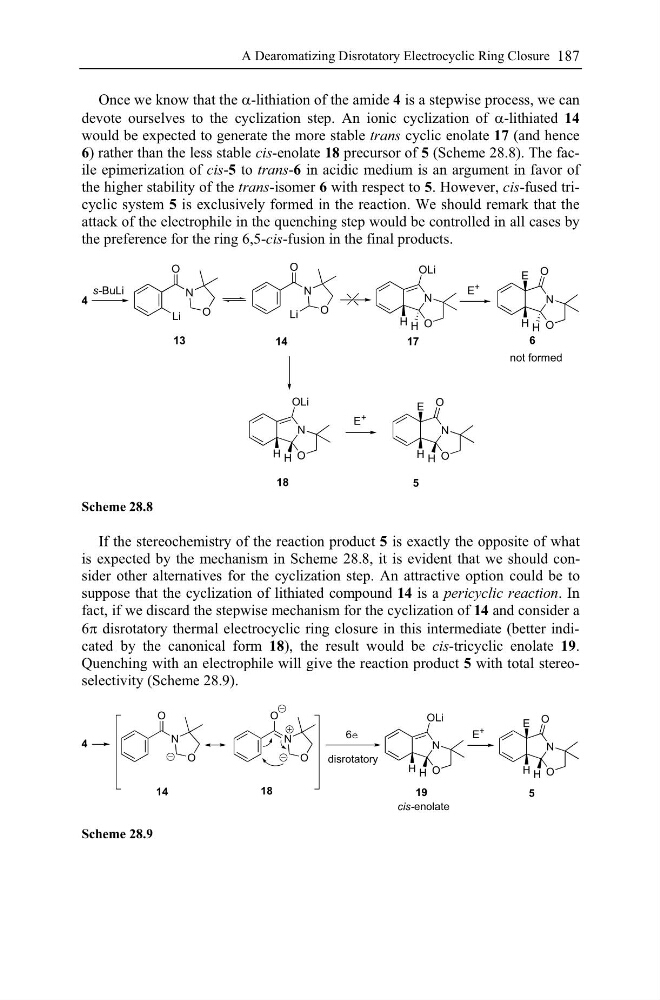
Once we know that the D-lithiation of the amide 4 is a stepwise process, we can
devote ourselves to the cyclization step. An ionic cyclization of D-lithiated 14
would be expected to generate the more stable trans cyclic enolate 17 (and hence
6) rather than the less stable cis-enolate 18 precursor of 5 (Scheme 28.8). The facile epimerization of cis-5 to trans-6 in acidic medium is an argument in favor of
the higher stability of the trans-isomer 6 with respect to 5. However, cis-fused tricyclic system 5 is exclusively formed in the reaction. We should remark that the
attack of the electrophile in the quenching step would be controlled in all cases by
the preference for the ring 6,5-cis-fusion in the final products.
N
O
O
Li
N
O
OLi
H H
N
O
O
E
H H
N
O
OLi
H H
N
O
O
E
H H
14
4
17
6
18
5
E +
E +
N
O
O
13
not formed
s-BuLi
Scheme 28.8
If the stereochemistry of the reaction product 5 is exactly the opposite of what
is expected by the mechanism in Scheme 28.8, it is evident that we should consider other alternatives for the cyclization step. An attractive option could be to
suppose that the cyclization of lithiated compound 14 is a pericyclic reaction. In
fact, if we discard the stepwise mechanism for the cyclization of 14 and consider a
6S disrotatory thermal electrocyclic ring closure in this intermediate (better indicated by the canonical form 18), the result would be cis-tricyclic enolate 19.
Quenching with an electrophile will give the reaction product 5 with total stereoselectivity (Scheme 28.9).
N
O
O
N
O
O
N
O
OLi
H H
N
O
O
E
H H
E +
4
5
14
6e
disrotatory
19
cis-enolate
18
r r
187
Once we know that the D-lithiation of the amide 4 is a stepwise process, we can
devote ourselves to the cyclization step. An ionic cyclization of D-lithiated 14
would be expected to generate the more stable trans cyclic enolate 17 (and hence
6) rather than the less stable cis-enolate 18 precursor of 5 (Scheme 28.8). The facile epimerization of cis-5 to trans-6 in acidic medium is an argument in favor of
the higher stability of the trans-isomer 6 with respect to 5. However, cis-fused tricyclic system 5 is exclusively formed in the reaction. We should remark that the
attack of the electrophile in the quenching step would be controlled in all cases by
the preference for the ring 6,5-cis-fusion in the final products.
N
O
O
Li
N
O
OLi
H H
N
O
O
E
H H
N
O
OLi
H H
N
O
O
E
H H
14
4
17
6
18
5
E +
E +
N
O
O
13
not formed
s-BuLi
Scheme 28.8
If the stereochemistry of the reaction product 5 is exactly the opposite of what
is expected by the mechanism in Scheme 28.8, it is evident that we should consider other alternatives for the cyclization step. An attractive option could be to
suppose that the cyclization of lithiated compound 14 is a pericyclic reaction. In
fact, if we discard the stepwise mechanism for the cyclization of 14 and consider a
6S disrotatory thermal electrocyclic ring closure in this intermediate (better indicated by the canonical form 18), the result would be cis-tricyclic enolate 19.
Quenching with an electrophile will give the reaction product 5 with total stereoselectivity (Scheme 28.9).
N
O
O
N
O
O
N
O
OLi
H H
N
O
O
E
H H
E +
4
5
14
6e
disrotatory
19
cis-enolate
18